
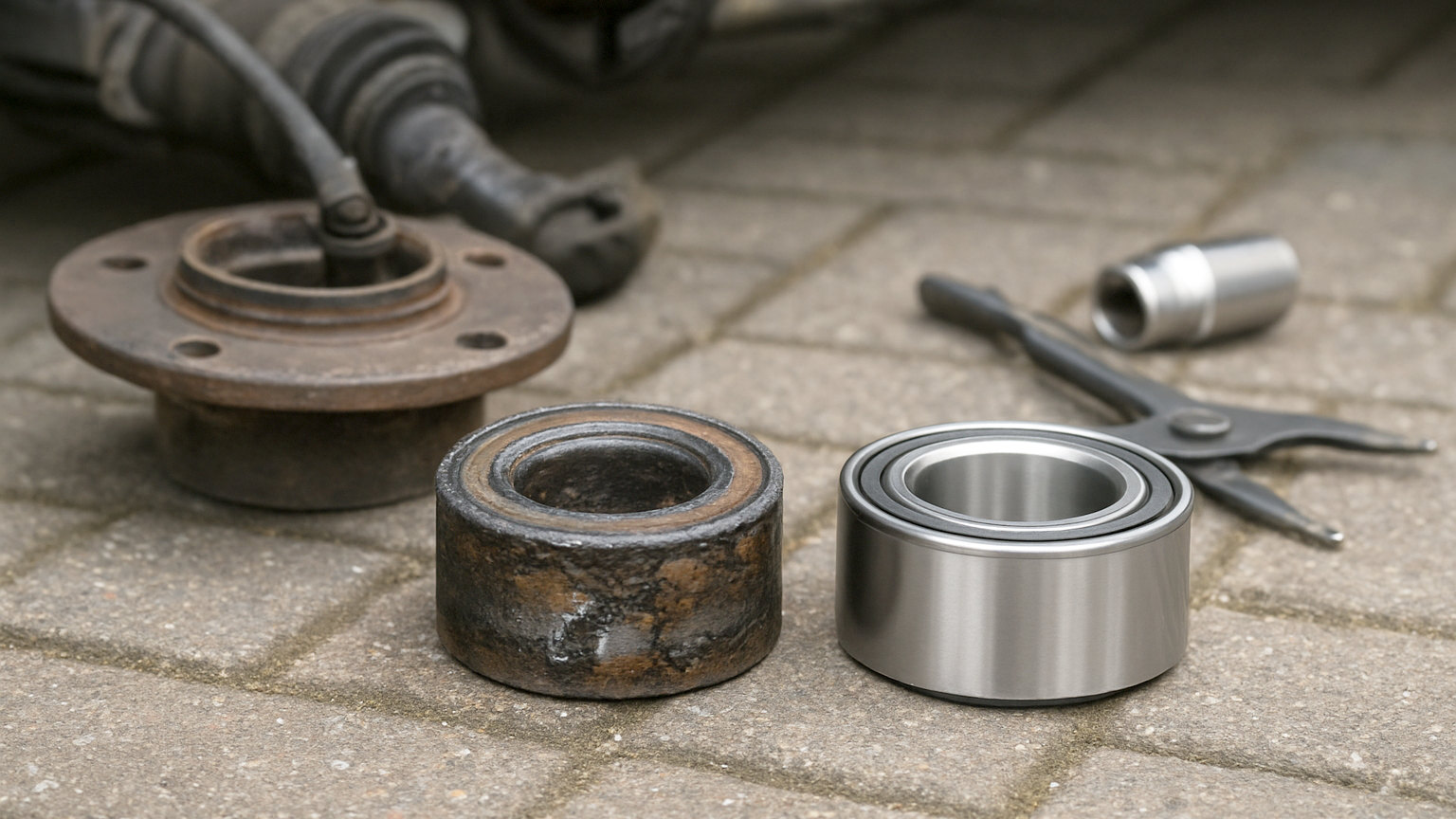
Modern sealed wheel bearings are designed to last the life of the vehicle and frequently do. Figures of a hundred thousand miles and beyond are entirely normal, and plenty of cars are scrapped with their original bearings still quiet. That makes a failure at moderate mileage worth understanding, because it usually reflects conditions rather than ordinary wear.
Is there a service interval?
Not for sealed units, since there is nothing to service. They cannot be adjusted, regreased or dismantled, so they appear in no schedule and are inspected rather than maintained. Older adjustable tapered roller bearings are different, and vehicles fitted with them do have a specified interval for cleaning and repacking with grease.
Why do front bearings fail first?
Because they work hardest. The front of a car carries more weight, particularly with a transverse engine, and the front bearings take steering loads as well as vertical and cornering forces. On a front wheel drive car they also transmit drive. It is entirely normal for front bearings to need replacing while the rears remain original.
Does the road matter?
Considerably, and it explains a great deal about British bearing life. Potholes and sharp edged drain covers deliver shock loads that dent the races, and each impact contributes. Cars used on poor rural roads or in areas with heavy winter salting fail sooner than those on smooth well maintained surfaces, which is why bearing life varies so widely between similar vehicles.
Which side fails more often?
The nearside, in most cases, because it takes the kerbs, the drain covers and the worst of the road edge. It also sits closer to standing water. Anecdotally the nearside front is the most commonly replaced bearing on any car, and that pattern reflects the environment rather than anything about the design.
Does towing shorten their life?
Yes. A towbar loads the rear axle, and a heavy nose weight increases the load on the rear bearings substantially. Frequent towing therefore accelerates rear bearing wear on a car where they would otherwise last indefinitely. The same applies to any vehicle regularly carrying heavy loads.
Do bigger wheels make a difference?
They can. Heavier wheels increase unsprung mass, so every impact transmits more energy into the bearing. Wheels with a different offset move the load further from the bearing centre, increasing the leverage acting on it. Wheel spacers do the same. None of these guarantees a failure, and all shorten the expected life to some degree.
Should they be replaced preventatively?
Generally not, since a healthy bearing gives no benefit from being replaced and the work carries a small risk of introducing a fitting error. The exception is where a hub is being dismantled for another reason, since the incremental cost of a new bearing while everything is apart is far lower than doing the job twice.
What is the realistic expectation?
Treat them as components that should last the life of the car and be prepared for one or two failures on a high mileage vehicle used on poor roads. Budgeting for a front bearing somewhere past a hundred thousand miles is sensible, and treating an earlier failure as a signal to look for a cause rather than as normal wear is the more useful approach.
Do trailers and caravans differ?
Considerably, since many still use adjustable tapered roller bearings that require periodic cleaning, inspection and repacking with grease. They also stand unused for long periods, which allows moisture to accumulate. A caravan bearing that has never been touched in a decade is a far more likely failure than a car bearing of the same age.
When should you start checking?
Past about sixty thousand miles it is worth including a rock and spin check whenever the wheels are off for tyres or brakes. It costs nothing and it catches a developing bearing while it is still an inexpensive job rather than one that has also damaged a brake disc.


