
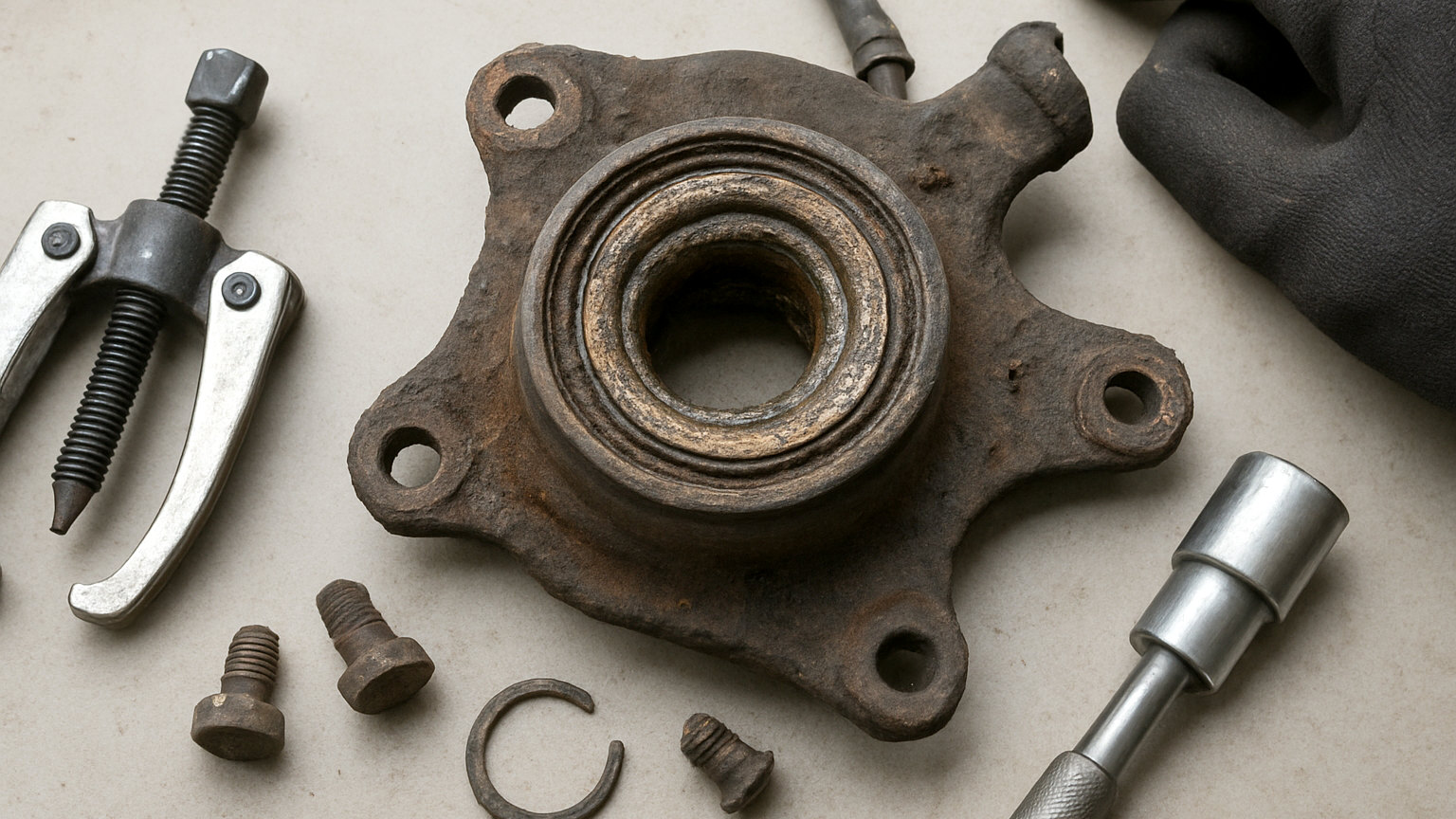
Wheel bearings rarely fail without warning. They deteriorate over weeks or months, and the sequence of symptoms is consistent enough that the diagnosis is usually straightforward once you know what to listen for. The difficulty is that the early stages are so subtle that most people attribute them to the road surface, which is why bearings are often well advanced before anyone investigates.
What does the early stage sound like?
A faint hum at motorway speed that seems to come from the road rather than the car, usually noticed on a quiet stretch of smooth tarmac where it cannot be explained away. It rises and falls with road speed rather than engine speed. At this stage most drivers assume it is tyre noise or a coarse surface, and it can persist unremarked for months.
How does it progress?
The hum becomes a drone across a broader speed range, then a rumble audible at lower speeds, then a growl or grinding that can be heard with the window down at thirty miles an hour. In the final stage there is often a metallic roughness that can be felt through the floor or the steering wheel. Each stage takes weeks or months rather than days.
What is the cornering test?
The single most useful check and it needs only a quiet road with gentle sweeping bends. Drive at a steady speed where the noise is clear, then take a long gentle curve one way and then the other. Weight transfers onto the outside wheels, so a failing bearing gets noticeably louder when loaded and quieter when unloaded. A noise that changes clearly with direction is a bearing.
Which corner is it?
The bearing that gets louder is on the outside of the turn. So if the noise increases turning left, the failing bearing is on the right hand side of the car. That single observation narrows it to one of two wheels immediately, and combining it with whether the noise seems to come from ahead of or behind you usually identifies the exact corner.
How do you separate it from tyre noise?
Tyre noise changes noticeably with the road surface, becoming much quieter on smooth new tarmac and louder on coarse chippings. Bearing noise is far less affected. Tyre noise also tends not to respond to gentle cornering. The definitive test is to swap the front wheels to the rear and drive the same road, since a tyre problem travels with the wheels while a bearing stays put.
Does it change when braking?
Usually not, which distinguishes it from brake noise. A dragging caliper produces a similar roar that follows road speed, and the difference is heat: a dragging brake makes that wheel far hotter than its opposite number, which is easy to check after a drive. Applying the brakes gently at a steady speed changes brake noise and leaves bearing noise largely unaffected.
Is there play by then?
Frequently, by the time the noise is obvious. Raising the wheel and rocking it firmly at the twelve and six o clock positions reveals movement that should not be there. Having someone press the brake pedal while you repeat it removes any contribution from a worn ball joint, which makes the result more reliable.
Can you hear it while stationary?
No, since the bearing only makes noise when rotating under load. With the wheel raised, spinning it by hand and listening for roughness or rumble can reveal a badly worn bearing, and feeling for vibration through the spring or the hub while it spins is more sensitive than listening. A healthy bearing spins silently and smoothly.
What should you do about it?
Have it inspected rather than waiting for it to become obvious, since the noise is telling you the bearing is already deteriorating. It is also an MOT failure once play is detectable, and in the worst case a bearing can seize or collapse, which affects steering and braking on that corner. There is usually time to plan the work, and not indefinitely.


