
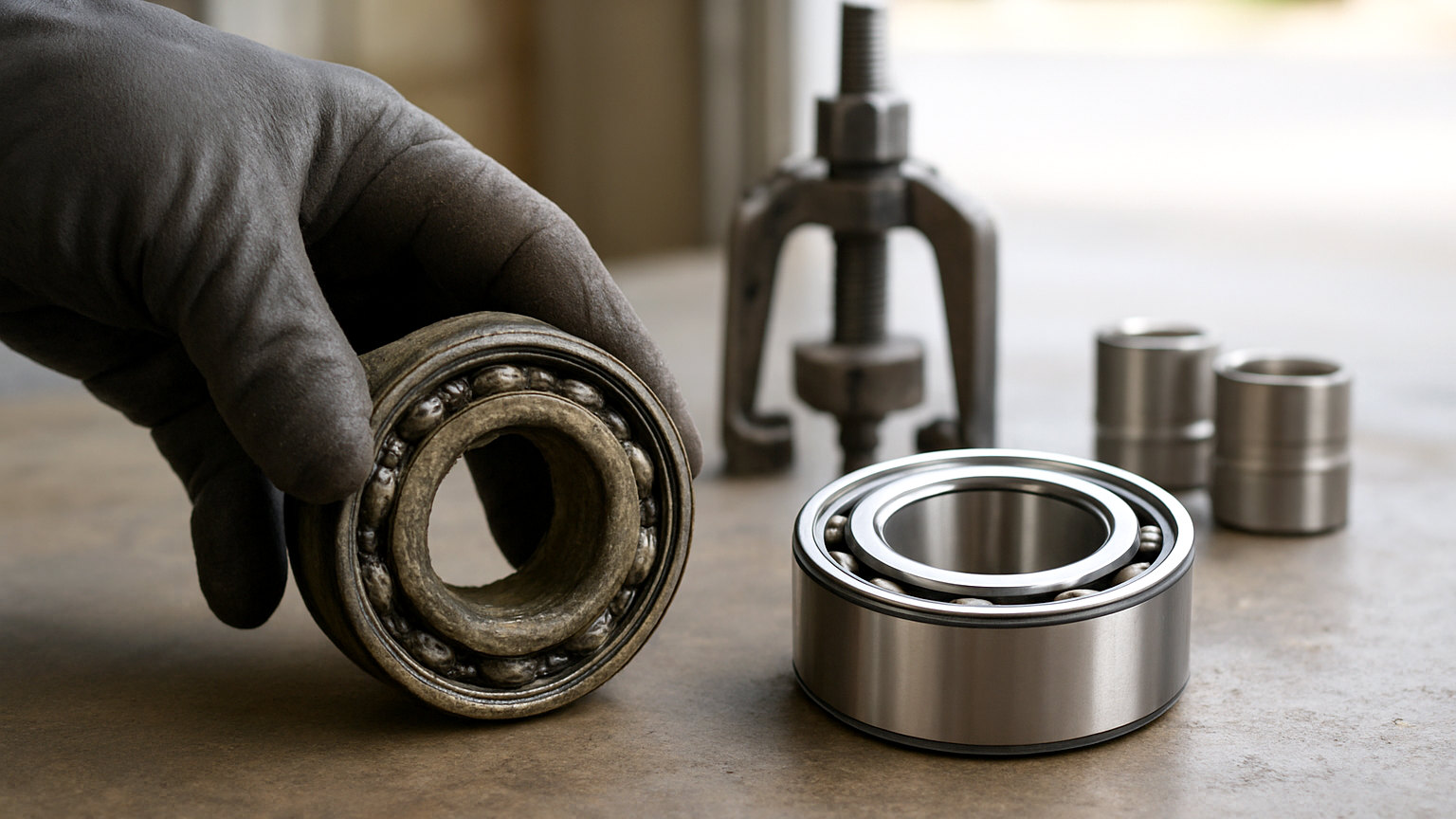
A wheel bearing that has begun to hum is not an emergency, and one that is grinding with detectable play is a different matter. The honest answer sits between the two extremes of ignoring it entirely and abandoning the car, and it depends on which stage the bearing has reached and how quickly the symptoms are progressing.
What happens if one fails completely?
In the worst case the bearing seizes or breaks up, which can allow the hub to move, the wheel to tilt, or in extreme cases the wheel assembly to separate from the car. Braking and steering on that corner are compromised. It is rare, because bearings give so much warning, and it is the reason the warnings should not be ignored indefinitely.
How fast do they deteriorate?
Unpredictably, which is the difficulty. Some hum quietly for a year without much change. Others go from a faint noise to a serious grinding within a few weeks, because the surface damage is self accelerating: each flake of material removed becomes a hard particle circulating and damaging everything else. There is no reliable way to know which pattern yours will follow.
What are the stages?
A faint hum at speed, then a drone across a wider speed range, then a rumble audible at low speed, then a grinding or growling with roughness felt through the car. Play usually appears somewhere in the later stages. Broadly, the first two stages allow you to plan the repair over weeks, and the last two mean acting now.
Which symptoms mean stop?
Grinding or a metallic scraping. Obvious play when rocking the wheel. A wheel that feels rough when spun by hand. Vibration through the steering that has appeared alongside the noise. Any noise accompanied by the wheel running unusually hot. And an ABS warning light on the same corner, since that suggests the encoder ring is being affected.
Is a long journey a bad idea?
With anything beyond a faint hum, yes. Sustained motorway speed is exactly the condition that generates the most heat and the most cycles, and it is the least convenient place for a failure. If a bearing is audible and you have a long trip planned, dealing with it beforehand is a sensible precaution rather than an overreaction.
Does it affect the MOT?
Yes. Excessive play in a wheel bearing is a failure, and a tester will find it by rocking the wheel. Noise alone without play is more of a judgement, and it may be recorded as an advisory. Since a bearing showing play has usually been noisy for some time, this is one of the failures that surprises owners least once they think about it.
Does it damage anything else?
It can. Play in the bearing lets the brake disc move relative to the caliper, which produces uneven pad wear and can cause disc thickness variation and judder. Excessive heat from a failing bearing affects the grease in adjacent components and the brake fluid at that caliper. Replacing pads or discs on a car with a worn bearing simply repeats the wear.
What is the sensible approach?
Get it diagnosed as soon as you notice a consistent hum, so you know which corner and how far gone it is. Then plan the work rather than waiting to see. Bearings are not usually an expensive repair by the standards of the things they can damage, and the gap between a planned job and a roadside failure is entirely within your control at this stage.
How should you drive in the meantime?
Moderately, and avoid long motorway runs, heavy loads and towing until it is dealt with. Those are the conditions that generate the most heat and the most cycles. Around town at modest speeds a bearing in the early stages will not deteriorate quickly, which is usually enough to get you to a booked appointment.
Does it get worse in the wet?
Not the bearing itself, though water reaching a damaged seal accelerates the internal corrosion. What changes noticeably is your ability to hear it, since wet roads produce more tyre noise. A bearing that seems quieter in the rain has not improved, it is simply being masked.


