
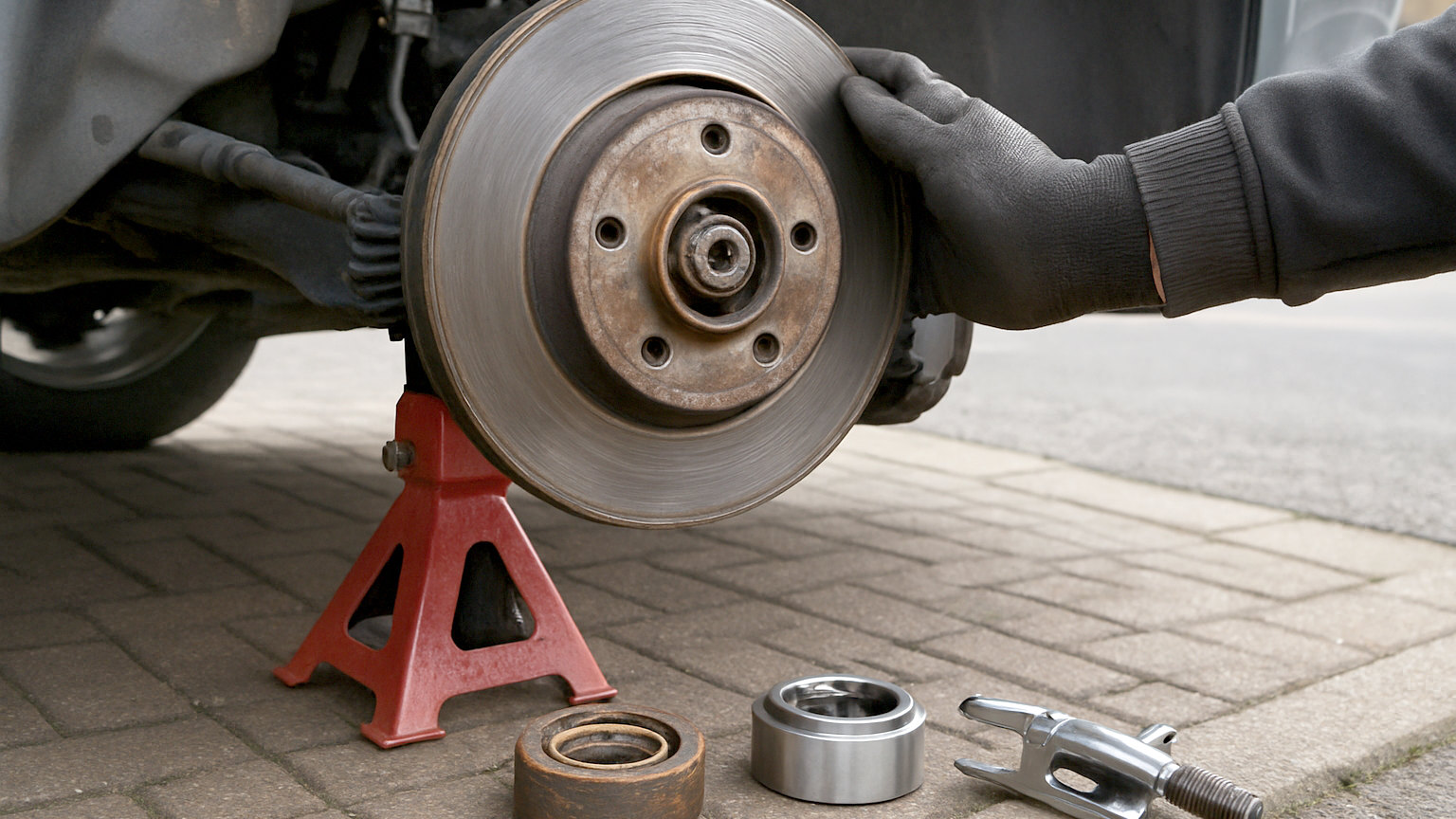
Checking a wheel bearing for play is a straightforward test that anyone can carry out with a jack and axle stands, and it is also easy to get a misleading result. The problem is that a worn suspension ball joint allows the wheel to move in a very similar way, so the test needs a second step to tell the two apart before any parts are ordered.
What is the basic test?
With the wheel safely raised and clear of the ground, grip the tyre at the twelve and six o clock positions and rock it firmly in and out. Any perceptible knocking or movement suggests play in either the bearing or the suspension joints. Repeat at three and nine o clock, since that position tends to reveal steering components rather than the bearing.
How do you tell it from a ball joint?
Have someone press the brake pedal firmly while you repeat the twelve and six test. The brake clamps the disc to the hub, which removes any bearing play from the equation. If the movement disappears, it was the bearing. If it remains, a suspension joint or a wheel bearing carrier bush is responsible. That single step turns an ambiguous result into a clear one.
Can you see the movement?
Often, and it is more reliable than feeling for it. Have someone rock the wheel while you watch the gap between the brake disc and the caliper or the dust shield, since a bearing with play allows the disc to move relative to the fixed components. Watching a specific reference point is considerably more sensitive than judging by hand.
What does spinning the wheel tell you?
With the car in neutral and the handbrake off, spinning the wheel by hand should be smooth and near silent. A rumble, a gritty feel, or a noise that rises and falls as it rotates all indicate a failing bearing. Resting a hand on the spring or the hub carrier while it spins is more sensitive than listening, since a rough bearing transmits vibration you can feel.
Is a small amount of play normal?
On a modern sealed bearing, essentially none should be detectable. On older adjustable tapered roller bearings a very small amount is normal and they are set with a specified preload. If you are unsure which type you have, the safest position is that any obvious knocking is a problem worth investigating rather than a characteristic.
Can a bearing be noisy with no play?
Frequently, and this catches people out. The rolling surfaces can be pitted and rough, producing considerable noise, while the clearances remain small enough that no movement is detectable. That means a clean rocking test does not exonerate a bearing. Noise and play are separate symptoms and either alone is enough to justify replacement.
What safety precautions matter?
Axle stands rather than a jack alone, on firm level ground, with the car in gear or park and the opposite wheels chocked. Rocking a wheel applies real force to the car, and a vehicle supported only by a jack can be dislodged by exactly that kind of movement. Nothing about this test requires any part of you to be under the car.
What should you do with the result?
Note which corner, whether the play disappeared with the brake applied, and whether the wheel felt rough when spun. Those three observations tell a workshop almost everything they need, and they distinguish a bearing from a ball joint before any diagnostic time is charged. It is also worth checking all four while the tools are out.
How does it compare with the road test?
The two complement each other. The rocking test finds play, and the cornering test on the road finds noise, and a bearing can have either symptom without the other. Doing both gives a far more complete picture than relying on one, and together they will identify almost any bearing worth replacing.


