
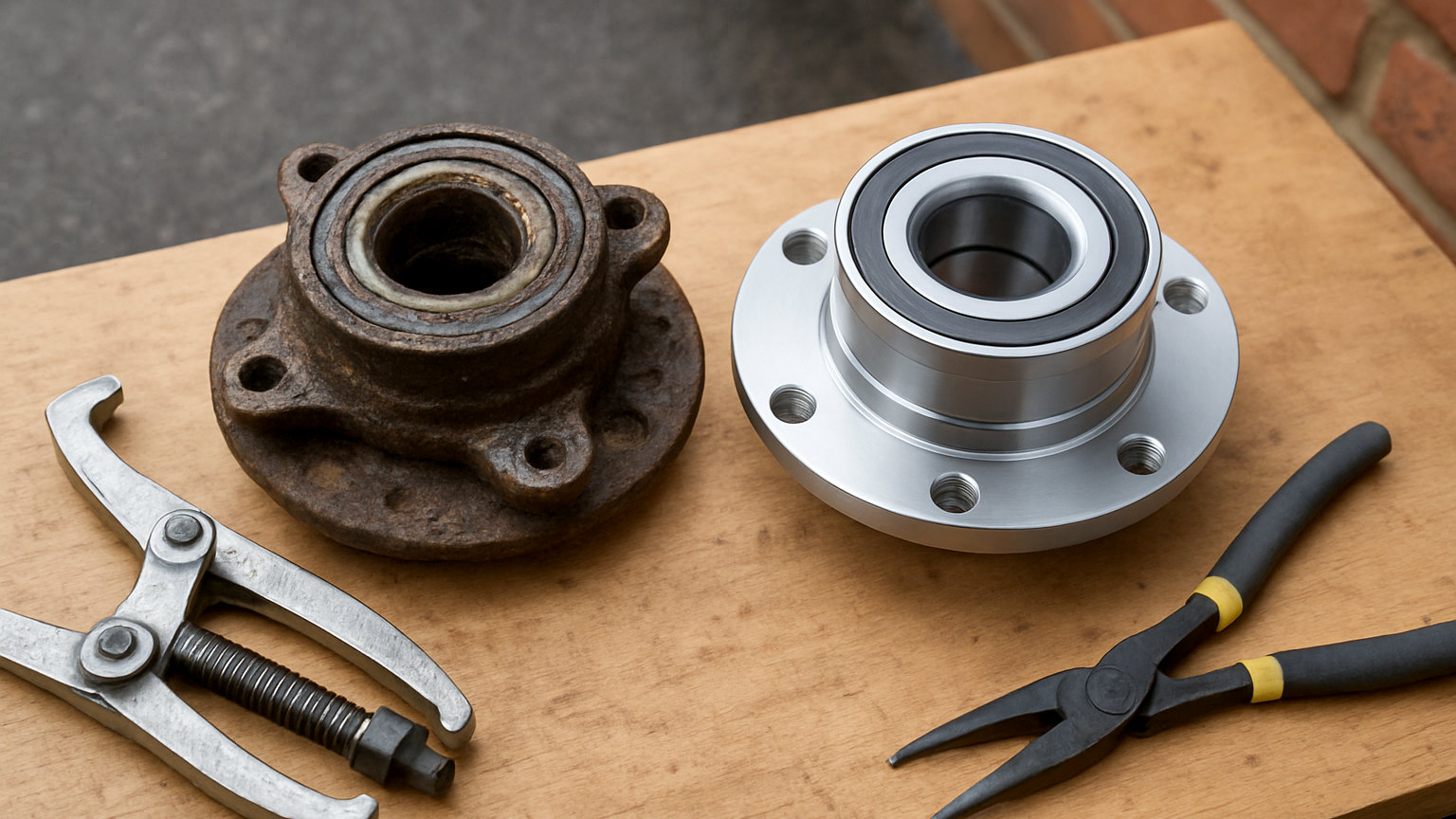
Wheel bearings are best known for noise, and once play develops they can produce vibration as well. The mechanism is straightforward: a bearing with clearance lets the whole hub assembly move slightly, and everything mounted to that hub moves with it, including the wheel and the brake disc. The result can appear as a vibration, a judder or both.
How does a bearing produce vibration?
Play allows the wheel to tilt and shift under load, so it no longer runs true. That produces a vibration proportional to road speed, usually felt through the steering wheel if the bearing is at the front and through the floor if it is at the rear. Unlike an imbalance, it tends to worsen steadily with speed rather than peaking in a particular band.
How do you tell it from wheel imbalance?
Imbalance typically appears in a distinct speed range, becoming noticeable around fifty to seventy and often easing again above it. Bearing vibration increases progressively with speed and is usually accompanied by a hum or rumble that imbalance does not produce. Balancing the wheels is a quick way to eliminate one possibility, and a persistent vibration after balancing points elsewhere.
Why does it make the brakes judder?
Because the brake disc is mounted on the hub, so any bearing play lets the disc move relative to the caliper. That produces runout, meaning the disc wobbles as it rotates, which pushes the pads in and out with each revolution. Over a few thousand miles that uneven contact wears the disc unevenly, producing thickness variation and a judder under braking.
Does it damage the discs permanently?
It can. Once thickness variation has developed, the disc needs machining or replacing even after the bearing is corrected. That is why fitting new discs to a car with a worn bearing is a poor sequence, since the new discs will develop the same variation. The bearing should be dealt with first and the brakes assessed afterwards.
Can it cause a pull?
Indirectly. A bearing with significant play changes the wheel angles slightly under load, which affects how the car tracks, and a bearing that is dragging because it is seizing produces a pull towards that side. Both are secondary effects rather than the primary symptom, and both point at a bearing that is already well past the early stages.
Does it affect the steering?
At the front, yes. Play in the bearing lets the wheel move relative to the steering geometry, which makes the steering feel vague and less precise, and it can produce a wandering sensation requiring correction. That combination of vagueness and a hum from the same corner is quite characteristic once you know to associate them.
How is it confirmed?
By checking for play with the wheel raised, rocking it at twelve and six o clock, and repeating with the brake pedal pressed to eliminate suspension joints. Measuring disc runout with a dial gauge, if a workshop has one, shows directly whether the hub is moving. And spinning the wheel by hand while feeling the hub carrier reveals roughness.
What order should the work be done in?
Bearing first, then reassess the brakes and the alignment. Replacing pads and discs while the hub still has play means the new components inherit the same problem. It is one of the clearer cases where sequence determines whether the repair lasts, and it is worth confirming a workshop is approaching it that way before agreeing to brake work.
Is the vibration dangerous?
The vibration itself is a symptom rather than a hazard, and what it indicates matters more. A bearing loose enough to produce vibration is well advanced, so it should be dealt with promptly rather than monitored. At that stage it is also affecting braking and steering precision, which is a better reason to act than the discomfort.
Could it be something else?
Frequently, and imbalance is the most common alternative. A buckled wheel, a tyre that is out of round or a worn driveshaft joint all produce vibration proportional to road speed. What distinguishes a bearing is the accompanying hum and the fact that balancing makes no difference.


