
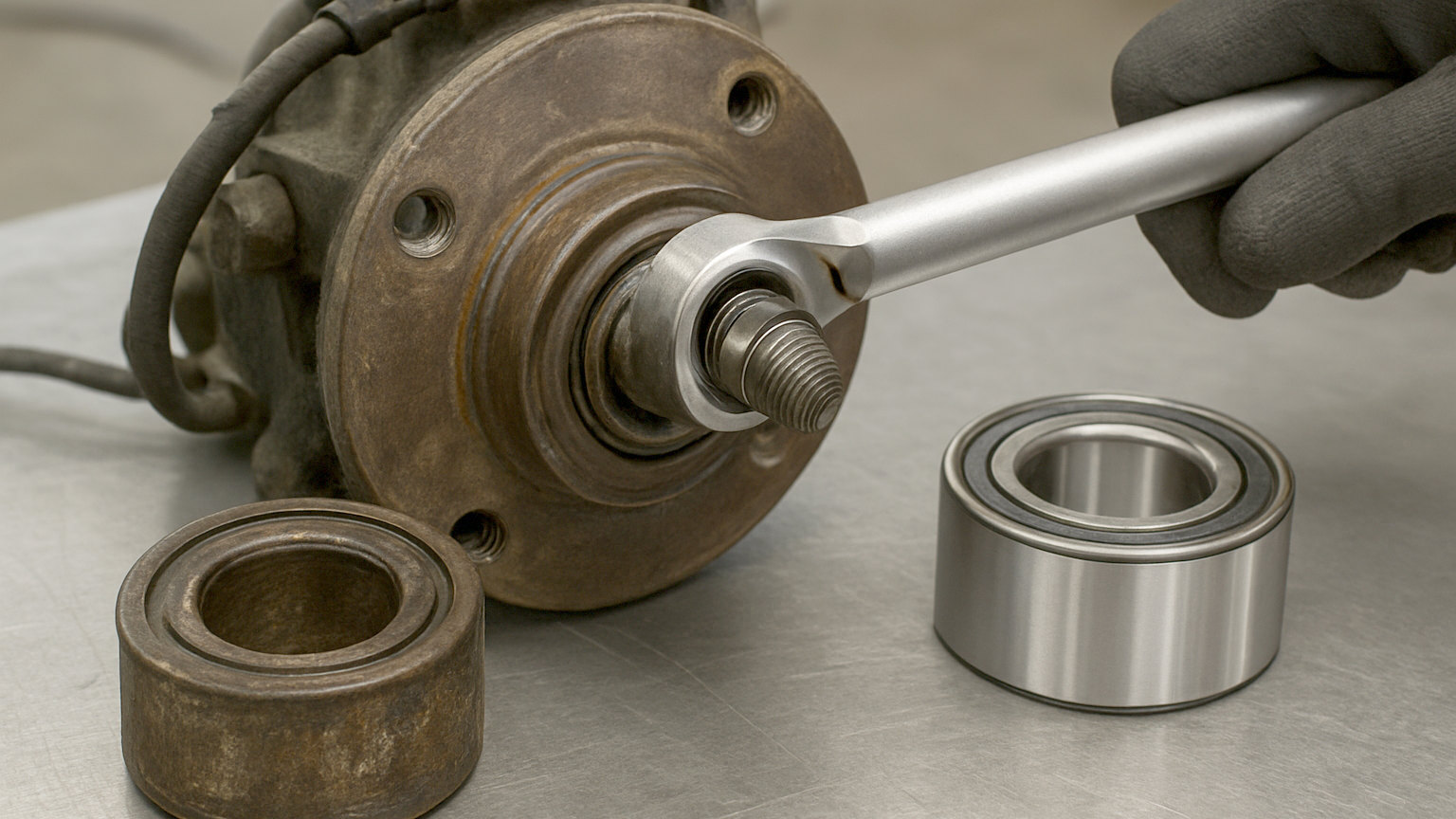
Few fixings on a car have as direct an effect on the life of a component as the hub or driveshaft nut. On many bearing designs it does not simply hold things together; it sets the preload, meaning the load the bearing operates under. Too little and the bearing runs loose; too much and it is crushed. Either way it fails long before it should.
What is preload?
A deliberate small load applied to the bearing so the rolling elements are always in firm contact with the races. Without it the elements can skid rather than roll, which produces flat spots and rapid wear. With too much, the contact pressure is excessive, the grease is squeezed out and the bearing overheats. The correct figure sits in a narrow band between the two.
How is it set?
On sealed units, usually by torquing the driveshaft or hub nut to a specified figure, since the internal geometry of the bearing determines the preload once the nut is tight. On older adjustable tapered roller bearings it is set by tightening while rotating the hub, then backing off a specified amount and securing with a split pin, which is a genuine adjustment rather than a torque figure.
How high are the figures?
Often several hundred newton metres on a driveshaft nut, which is far beyond what a normal socket set and body weight can achieve accurately. Some specify a torque followed by an additional angle, which requires either an angle gauge or careful marking. Guessing with a breaker bar is not close enough on a fixing where the consequence is a destroyed bearing.
Why are some nuts single use?
Because they are designed to stretch slightly when tightened, which maintains clamping load, and a stretched fastener cannot be relied upon a second time. Others are staked, meaning part of the collar is deformed into a groove on the shaft to lock them, and that deformation cannot be undone. Either way, reusing one risks it loosening in service.
What happens if it is too loose?
The bearing runs with clearance, so the elements skid and hammer rather than rolling smoothly, and play develops quickly. The symptom is a bearing that becomes noisy within weeks or months of fitting. In the worst case the nut works loose entirely, which allows the hub to move and is a serious safety matter rather than simply a premature failure.
What happens if it is too tight?
The bearing is crushed slightly, contact pressures rise, and the grease is forced out of the loaded area. It runs hot, the grease degrades, and the races pit and flake. The result again is a bearing that becomes noisy far sooner than it should, and the cause is invisible from outside. It is a genuinely common consequence of tightening by feel.
Should the wheel be on the ground?
Many procedures specify tightening the driveshaft nut with the car on its wheels rather than raised, so the load path is correct and the hub cannot rotate. Trying to hold the hub while applying several hundred newton metres in the air is both difficult and a good way to damage something. The handbook or workshop data states the correct method.
What should you ask a garage?
Whether a new driveshaft nut is included and what torque specification is being used. Both are reasonable questions and both distinguish a job done to specification from one done by feel. It is also worth asking on any work where the hub is disturbed, since the nut is frequently reused simply because nobody thought to order a new one.
Can you check it yourself afterwards?
Not the preload, since that requires dismantling. What you can do is check for play by rocking the wheel a few hundred miles after the work, and listen for any noise developing. A bearing that was fitted incorrectly usually announces itself within a few thousand miles, which is well inside any warranty period and makes a claim considerably easier to argue.
Does it apply to non driven wheels?
Yes, though the arrangement differs. A non driven hub often uses a large nut or a bolt through the centre rather than a driveshaft nut, and it still has a specified torque that sets the preload on some designs. The principle is identical: the figure matters and guessing shortens the life of the bearing.


