
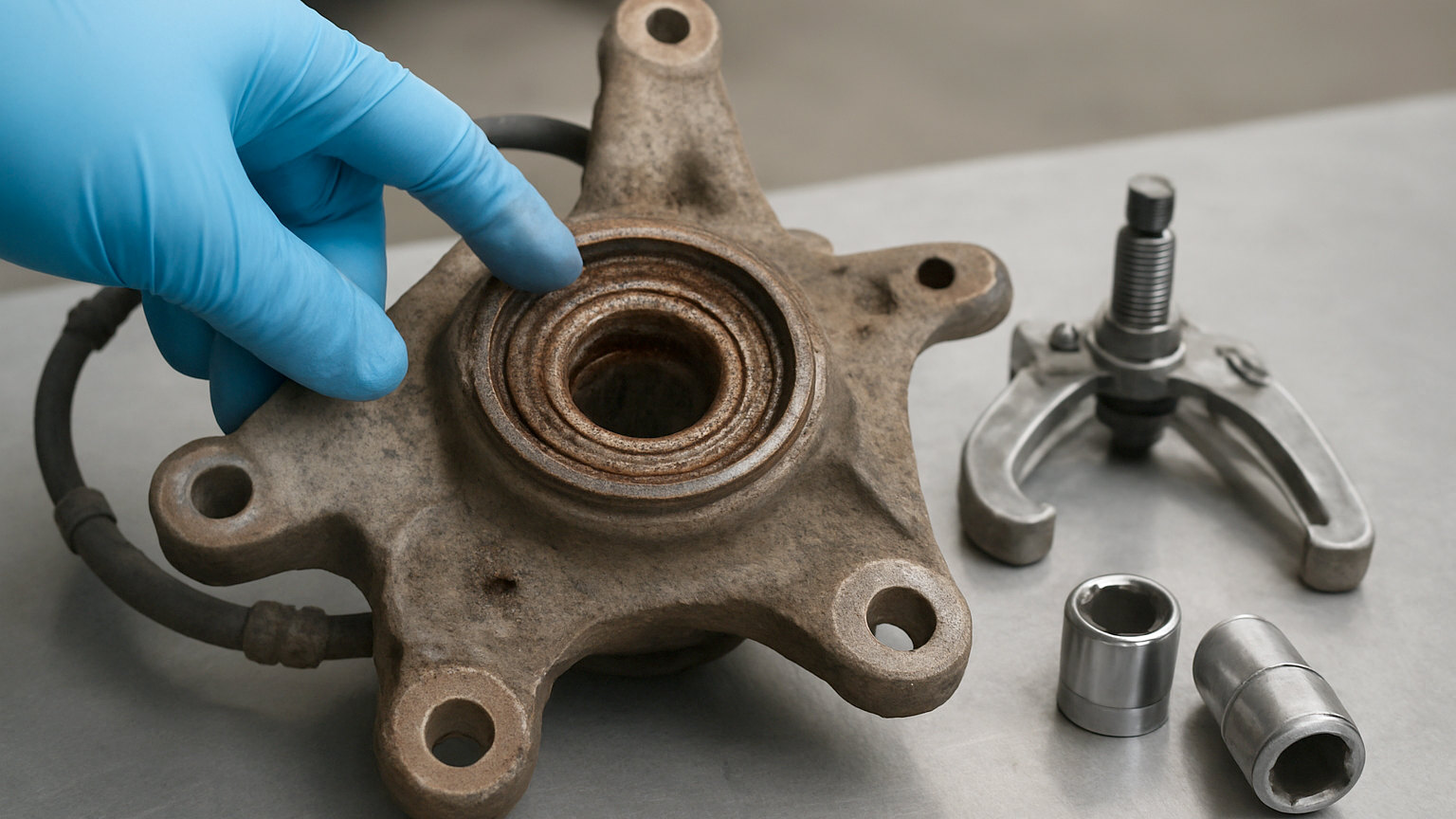
Wheel bearing replacement varies enormously between vehicles, which is why quotes for what sounds like the same job can differ by a factor of three. At one extreme a bolt on hub assembly comes off with four bolts in under an hour. At the other, a pressed in cartridge requires the hub carrier removed from the car and a hydraulic press to change it.
What does a bolt on assembly involve?
Removing the wheel, the brake caliper and disc, disconnecting the ABS sensor, and on a driven wheel undoing the large central driveshaft nut. The old assembly then unbolts from the carrier and the new one bolts on. It is straightforward, needs no specialist press, and the labour is modest. The part costs more, and the total is often similar to the alternative.
What does a pressed in bearing involve?
Considerably more. The hub must be pressed out of the bearing, the retaining circlip removed, the old bearing pressed out of the carrier and the new one pressed in, then the hub pressed back through it. On many cars the carrier has to come off the vehicle entirely, which means disconnecting the ball joint, track rod end and driveshaft.
Why does pressing direction matter?
Because force must be applied to the race being pressed, never through the rolling elements. Pressing on the wrong race sends the load through the balls and dents both races, damaging a brand new bearing before the car moves. It is the single most common reason a replacement fails early, and it is why proper bearing drivers rather than improvised tools matter.
What about the driveshaft nut?
It is usually a large nut at a high torque, often several hundred newton metres, and it frequently must be replaced rather than reused since many are designed to be tightened once. Getting the torque right matters because on some designs it sets the bearing preload. It is one of the fixings where guessing produces either a loose hub or a crushed bearing.
Can it be done at home?
A bolt on assembly is within reach for a competent home mechanic with axle stands, a good torque wrench and a way of undoing the driveshaft nut. A pressed in bearing generally is not, unless you have access to a press. Kits that pull the bearing in place using threaded rod exist and work on some vehicles, and they are harder work than they look.
What should be checked at the same time?
The ABS sensor and its wiring, which is disturbed during the job and is a common source of a warning light afterwards. The brake disc for runout and scoring, since a worn bearing frequently damages it. The driveshaft boots, which are right there. And the suspension ball joint and track rod end, particularly if the carrier has to come off anyway.
Does alignment need checking afterwards?
If the carrier was removed, or the track rod end or ball joint disconnected, then yes without exception. On a simple bolt on assembly where nothing in the suspension was disturbed, alignment should be unaffected. It is worth asking which applies, since a quote that includes carrier removal should also include an alignment check.
What should you ask before agreeing?
Which type of bearing your car uses and therefore what the labour time is, whether the driveshaft nut is included as a new part, whether the ABS sensor will be inspected, and whether alignment is needed. Those four questions make two quotes genuinely comparable rather than leaving you choosing on a headline figure alone.
How long should it take?
A bolt on assembly is frequently under an hour per corner. A pressed in bearing requiring the carrier to come off can be three or four times that, particularly if fixings are seized. Asking for the labour time rather than only the total makes it clear which kind of job you are being quoted for.


