
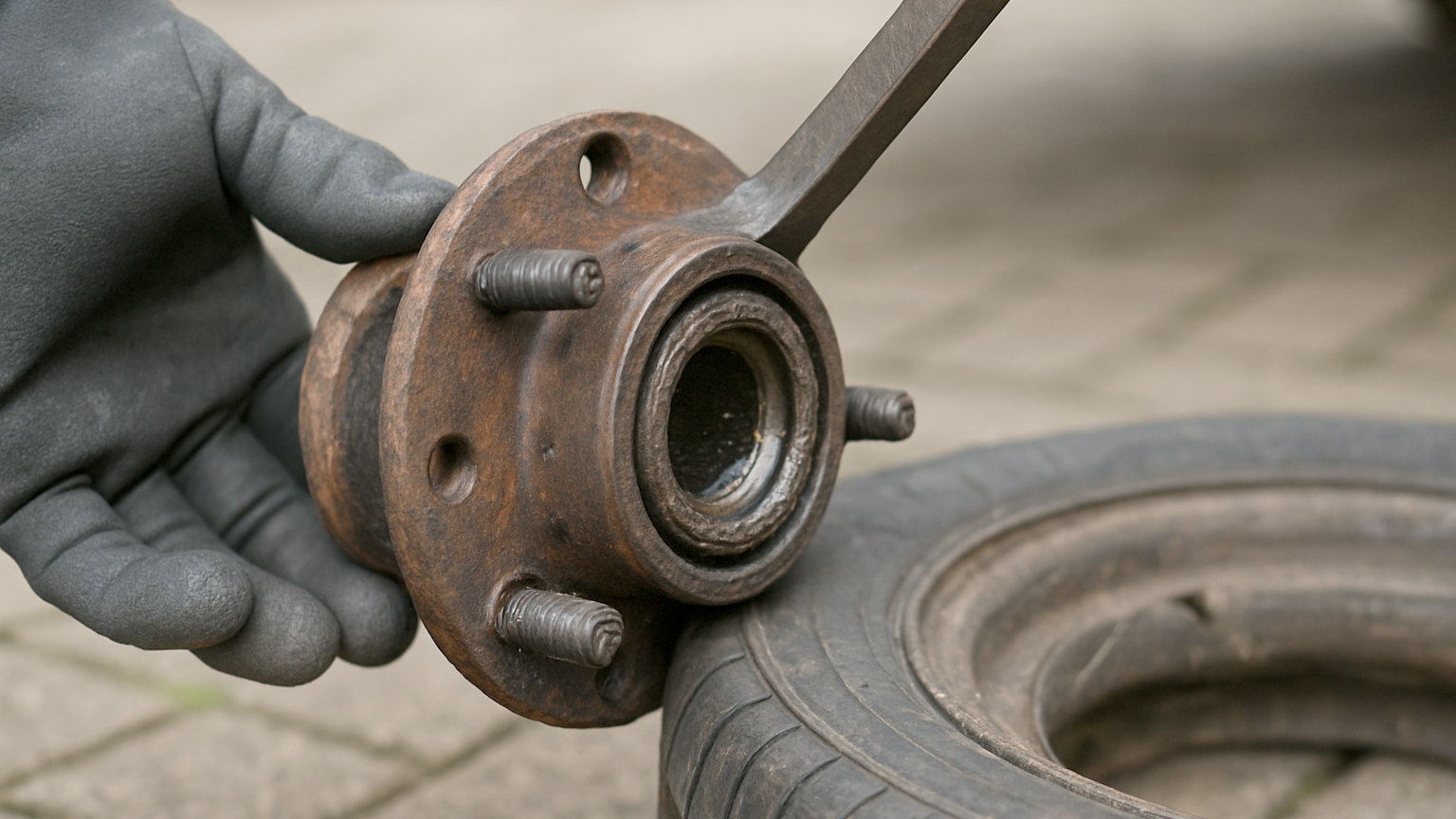
Uneven tyre wear is usually attributed to alignment, and a worn wheel bearing produces very similar patterns for a related reason. A bearing with play allows the wheel to tilt and shift under load, so the angles at which the tyre meets the road change constantly while driving even though the static alignment measurement may be perfectly correct.
Why does static alignment not show it?
Because alignment is measured on a stationary car with no cornering or braking forces applied. A bearing with a small amount of play sits in one position at rest and moves as soon as the car is loaded. The geometry the tyre actually experiences on the road is therefore different from the figures on the printout, which is why alignment on a car with a worn bearing rarely cures the wear.
What wear pattern does it produce?
Frequently irregular rather than a neat single shoulder. Patchy or scalloped wear around the circumference is common, since the wheel is moving rather than running true. There may be accelerated wear on one edge as the camber shifts under load. The irregularity is the clue, since a straightforward alignment error tends to produce a more uniform pattern.
How much play does it take?
Less than people expect. A bearing with movement small enough to be difficult to feel by hand can still allow the wheel angle to change measurably under cornering loads, which are far higher than anything you can apply while rocking a wheel in a workshop. That is why noise often appears before the play is obvious, and why both symptoms matter independently.
Does it affect the brakes as well?
Yes, and it frequently does. The disc is mounted to the same hub, so play lets it move relative to the caliper, producing runout and uneven pad contact. Over a few thousand miles that develops into disc thickness variation and a judder under braking. A car with uneven tyre wear, a hum and a brake judder on the same corner is describing one fault rather than three.
What order should things be done in?
Bearing first, then alignment, then tyres. Setting the geometry before replacing the bearing means adjusting the angles to compensate for a component that is about to be replaced, so the alignment has to be paid for twice. Fitting new tyres before either is simply donating part of their life to a fault that has not been fixed.
Can the tyre be saved?
Rarely once a pattern has developed, since an irregular surface tends to perpetuate itself and a scalloped tyre remains noisy even after the cause is corrected. Rotating it can extend its life slightly. The realistic approach is to fix the bearing, accept the current tyre is compromised, and expect the replacement to wear evenly.
How do you confirm the bearing is responsible?
Check for play at twelve and six o clock with the brake pedal pressed to eliminate suspension joints, spin the wheel by hand feeling for roughness, and listen for a hum that changes with gentle cornering. If those point at the bearing and the tyre wear is on the same corner, the connection is straightforward.
What should you tell a garage?
Which corner shows the wear, whether there is a hum from that side, and whether the noise changes when cornering. That prompts an inspection of the bearing rather than an automatic alignment booking, and it is the difference between fixing the cause and adjusting around it. Alignment is still worth doing afterwards, once the hub is sound.
Does it apply to rear bearings too?
Equally. A worn rear bearing changes the rear geometry under load and wears the tyre in the same irregular way, and because rear tyres are inspected less often it can go unnoticed for longer. Uneven rear tyre wear with a drone from the back of the car is worth checking for play before booking an alignment.


