
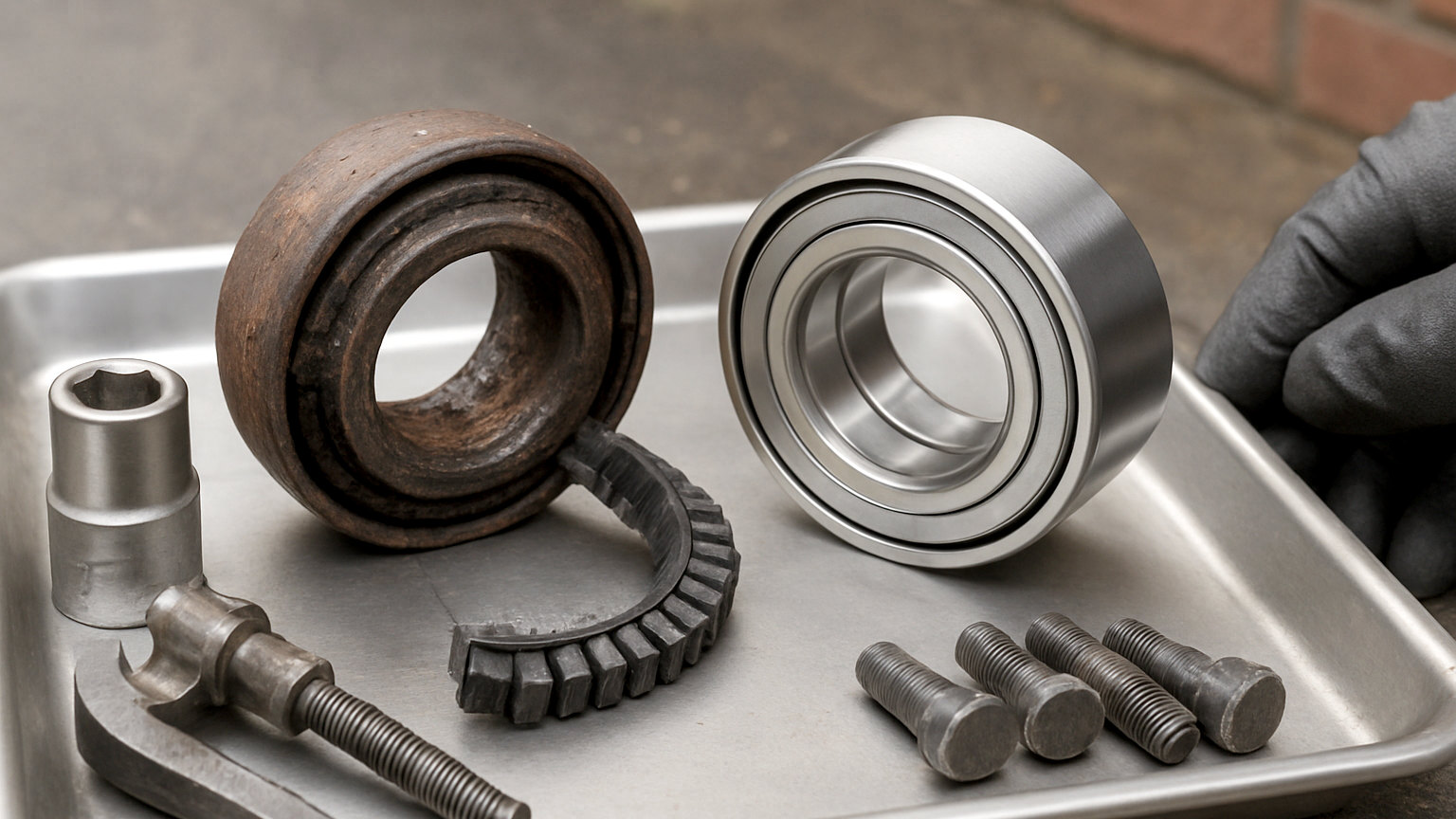
An ABS warning light and a humming wheel bearing on the same corner are frequently the same fault rather than two coincidental ones. On most modern cars the wheel speed sensor reads a magnetic encoder ring built into the bearing seal, so anything that damages the bearing can also disturb the signal the ABS system depends on.
How does the sensor actually work?
A magnetic encoder ring, moulded into one of the bearing seals, carries alternating magnetic poles around its circumference. A sensor mounted in the hub carrier reads those poles passing and produces a signal proportional to wheel speed. It is compact and reliable, and it means the sensor ring is a consumable part of the bearing rather than a separate component.
How does a failing bearing affect it?
Play in the bearing changes the gap between the sensor and the encoder ring, which can weaken or distort the signal. Damage to the seal can damage the ring itself. Metal particles from a disintegrating bearing can stick to the magnetic surface and corrupt the pattern. Any of these produces an intermittent or missing wheel speed signal and a warning light.
What lights come on?
Typically the ABS light, often with the traction control and stability control lights alongside, since those systems all depend on wheel speed data. On some vehicles the speedometer or the odometer may behave oddly. Diagnostic codes will usually name the specific wheel, which is helpful because it tells you which corner to inspect.
Is it always the bearing?
No, and it is worth checking the alternatives first since some are far cheaper. The sensor itself can fail. Its wiring runs through a flexing area near the suspension and chafes or breaks. Corrosion in the connector is common. Debris on the sensor tip disrupts the reading. All are worth eliminating before condemning a bearing, particularly if there is no noise or play.
Why does fitting direction matter?
Because the encoder ring is on one side of the bearing only, and it must face the sensor. Fitting a bearing the wrong way round leaves the sensor reading nothing, so the ABS light stays on with a brand new part fitted. It is a genuinely common mistake, and it is the first thing to suspect if a light appears immediately after a bearing replacement.
Can the ring be damaged during fitting?
Easily. The magnetic material is delicate and can be demagnetised by heat, by impact, or by being placed near a strong magnet or a magnetic parts tray. Bearings are usually supplied with the encoder side marked and a warning about handling. That fragility is one of the practical arguments for using a bolt on hub assembly where the option exists.
How is it diagnosed properly?
By reading the fault codes to identify the corner, then checking live wheel speed data while the car is driven or the wheel is spun. A signal that drops out or reads erratically while the others are steady confirms the corner. Inspecting the sensor, its wiring and its connector comes next, and only then is the bearing implicated.
Does it matter beyond the light?
Yes. With a wheel speed signal missing, the ABS, traction control and stability systems disable themselves, so the car brakes and handles as an older vehicle would. That is manageable in ordinary conditions and unwelcome in an emergency or on a slippery surface. It is also an MOT failure, since the warning lamp must not remain illuminated.
Will the light clear itself?
Sometimes temporarily, if the fault is intermittent, which is misleading rather than reassuring. A code will remain stored even after the lamp goes out, and reading it identifies the corner. A light that comes and goes usually means a marginal signal rather than a resolved problem, and it will return.
Which should be replaced first?
Check the sensor, its wiring and its connector before the bearing, since those are far cheaper and account for a meaningful share of these faults. Only when they check out, and particularly if there is also noise or play from that corner, does the bearing become the likely answer.


