
Toe is the simplest alignment angle to picture and the most consequential to get wrong. Looking down at the car from above, it describes whether the front edges of the wheels point slightly towards each other or slightly away. The amounts involved are tiny, often a millimetre or two across the wheel diameter, and the effect on tyre life is disproportionately large.
What is toe in and toe out?
Toe in means the front edges of the wheels point towards each other, so the car is very slightly pigeon toed. Toe out is the opposite, with the front edges pointing away. Manufacturers specify a small amount of one or the other depending on the vehicle, and the correct figure is a deliberate design choice rather than an attempt to set the wheels perfectly parallel.
Why not set them exactly straight?
Because the suspension and steering components flex under load, so the angle at rest is not the angle when the car is driving. A rear wheel drive car tends to be set with a little toe in, because driving forces push the front wheels outwards. A front wheel drive car is often set with slightly less or even a little toe out, since the driven wheels pull inwards under power.
How does incorrect toe wear tyres?
By dragging the tyre sideways. A wheel that is not pointing exactly where the car is travelling is being scrubbed across the road surface continuously, and that abrasion removes rubber at a remarkable rate. A toe error too small to see by eye can destroy a set of front tyres in a few thousand miles, which is why it is the most expensive setting to ignore.
What does the wear look like?
Feathering, meaning the tread blocks are worn to a sharp edge on one side and a ramp on the other. You can feel it by running a hand across the tread in each direction: smooth one way and sharp the other. Excessive toe in wears the outer edges of both front tyres, while excessive toe out wears the inner edges. Both patterns are distinctive once you know to look.
How does toe affect handling?
Toe in gives straight line stability, since each wheel is trying to steer the car towards the other and they cancel out, so any disturbance is self correcting. Toe out gives sharper turn in response, because the outside wheel is already pointing into the corner. Too much toe out makes a car darty and nervous at speed, needing constant small corrections to hold a lane.
How is it adjusted?
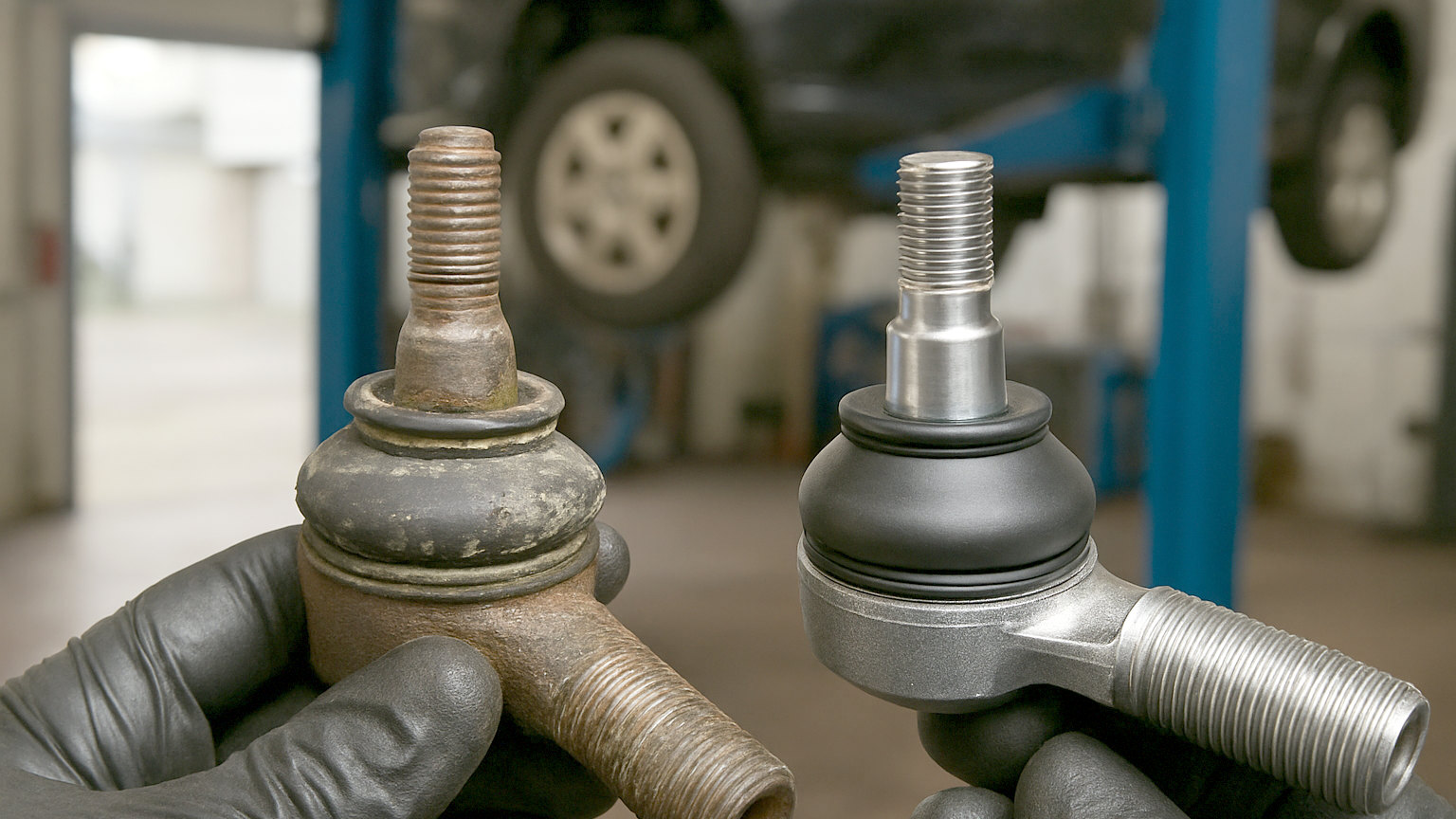
By lengthening or shortening the track rods, which are threaded for exactly that purpose. The total toe determines how the car tracks, and the balance between left and right determines where the steering wheel sits when the wheels point straight ahead. That is why alignment should be carried out with the steering wheel clamped in the centred position.
Is rear toe adjustable?
On many modern cars, yes, and it matters more than people expect. Rear toe affects stability and tyre wear at the back, and a rear wheel out of specification makes the car crab slightly, which then requires a steering offset to travel straight. On simpler rear suspension designs there is no adjustment, and a measurement out of specification means something is bent or worn.
What knocks toe out?
Potholes and kerbs, since the track rod is the component most easily disturbed by a sideways impact. Worn track rod ends and suspension bushes, which allow the angle to change under load even when the static measurement looks correct. And any steering repair, since replacing a track rod end alters the length of the rod and therefore the setting.
How do you know if toe is wrong?
By the tyres, principally. Run a hand across the tread blocks of each front tyre in both directions, and a sharp edge one way with a smooth ramp the other means feathering. Look also at whether one edge is wearing faster than the rest. Those two checks take a minute and they identify the problem long before the tyre reaches the limit.


