
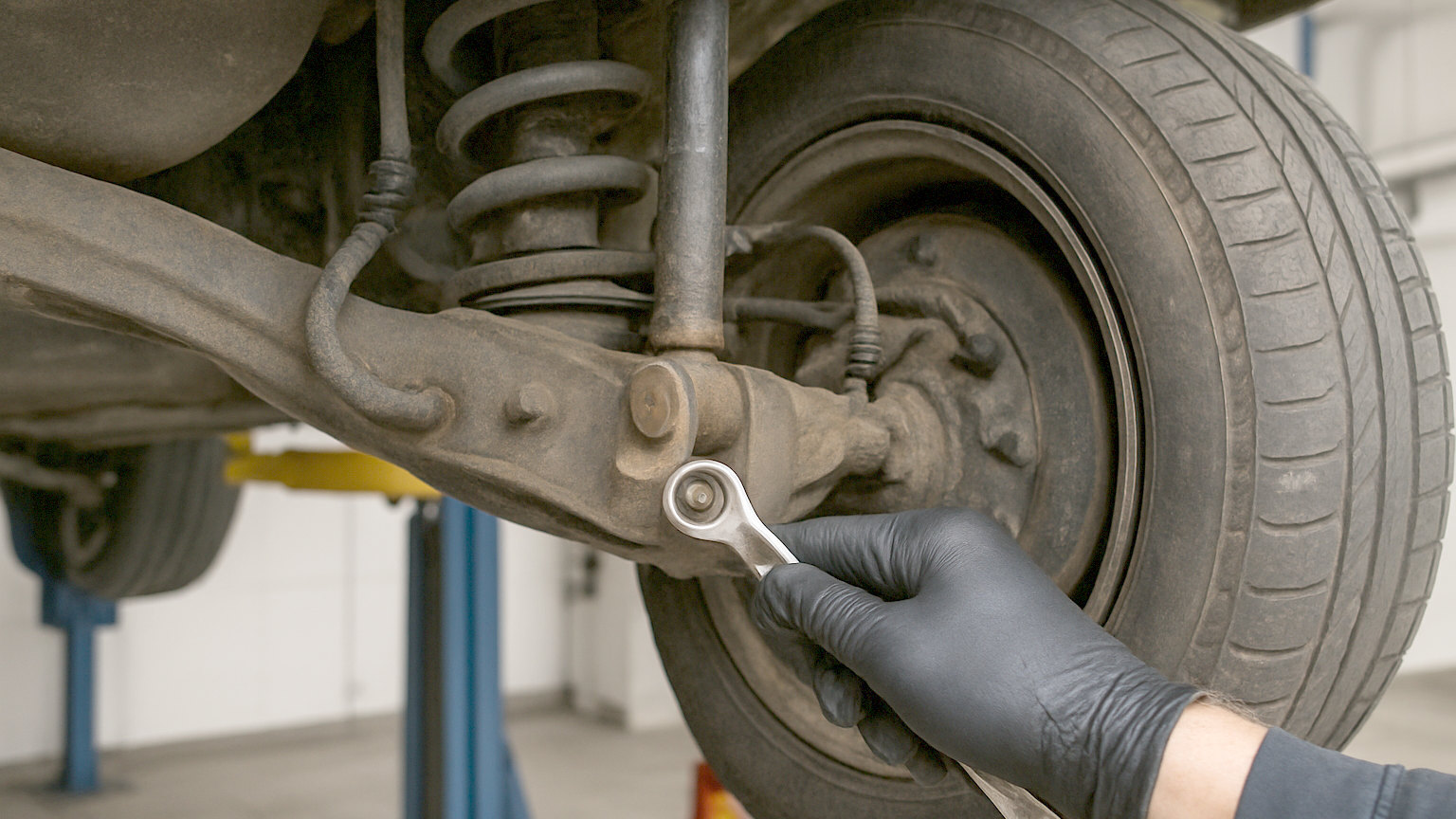
Thrust angle is the least understood alignment measurement and frequently the explanation for a car that cannot be made to drive straight. It describes the direction the rear axle is actually pointing relative to the vehicle centreline. When that direction is not straight ahead, the car travels slightly sideways, and no amount of front adjustment corrects it.
What does crabbing mean?
The car travelling with its body at a slight angle to its direction of travel, sometimes called dog tracking because it resembles a dog trotting at an angle. It happens because the rear wheels are steering the car very slightly, and the front wheels must be turned to compensate. From behind it can be visible as the rear of the car sitting offset from the front.
How does it affect the steering wheel?
It is the most common cause of a steering wheel that will not sit straight despite repeated tracking adjustments. Because the front wheels have to be offset to counter the rear, the steering wheel sits crooked whenever the car is travelling straight. Adjusting the front toe simply moves the crookedness around rather than removing it.
Why can it not be fixed at the front?
Because the rear wheels are determining the direction the car actually travels, and the front is only following. A front alignment set to the body centreline produces a car that pulls; set to the thrust line it produces a car that travels straight with a crooked wheel. Neither is correct, and the only real fix is squaring the rear.
What causes it?
Rear toe settings that have drifted on cars where they are adjustable. Worn or perished rear suspension bushes allowing the axle to sit out of position. A bent trailing arm or axle component after an impact. And accident damage to the shell or subframe, which is the most serious and the reason thrust angle is used as a diagnostic on used cars.
Can it be adjusted?
On cars with adjustable rear toe, yes, and correcting it is straightforward. On simpler rear suspension designs with no adjustment, a thrust angle out of specification means something is bent or worn and must be replaced. That is a more substantial job, and it explains why some alignment quotes come with the caveat that the rear cannot be corrected.
How is it measured?
Only by a four wheel alignment, which reads all four wheels simultaneously and calculates the relationship between the axles. Two wheel tracking measures the front alone and is entirely blind to it. That single difference is the strongest practical argument for paying for the full measurement rather than the cheaper adjustment.
Does it affect tyre wear?
Yes, at both ends. The rear tyres wear unevenly because they are being dragged slightly sideways, and the fronts wear because they are running at an offset to compensate. A car with an uncorrected thrust angle will get through tyres faster at all four corners, which makes the cost of measuring it look small by comparison.
What should you ask for?
A four wheel alignment with a printout showing the thrust angle figure explicitly. If it is out of specification, ask whether the rear is adjustable on your vehicle and, if not, what component is suspected. A workshop that measures it and explains the finding is giving you information a tracking adjustment never could.
How much is too much?
Manufacturers publish a tolerance, usually a small fraction of a degree, and anything beyond it is worth investigating. A reading marginally outside on an older car may simply reflect settled bushes. One well outside, particularly on a car with no rear adjustment, points at something bent and deserves a proper inspection rather than acceptance, because something has almost certainly moved and adjustment alone will not address it. On a car with no rear adjustment the answer is usually a replacement component rather than a setting, and identifying which one is the point of the measurement.


