
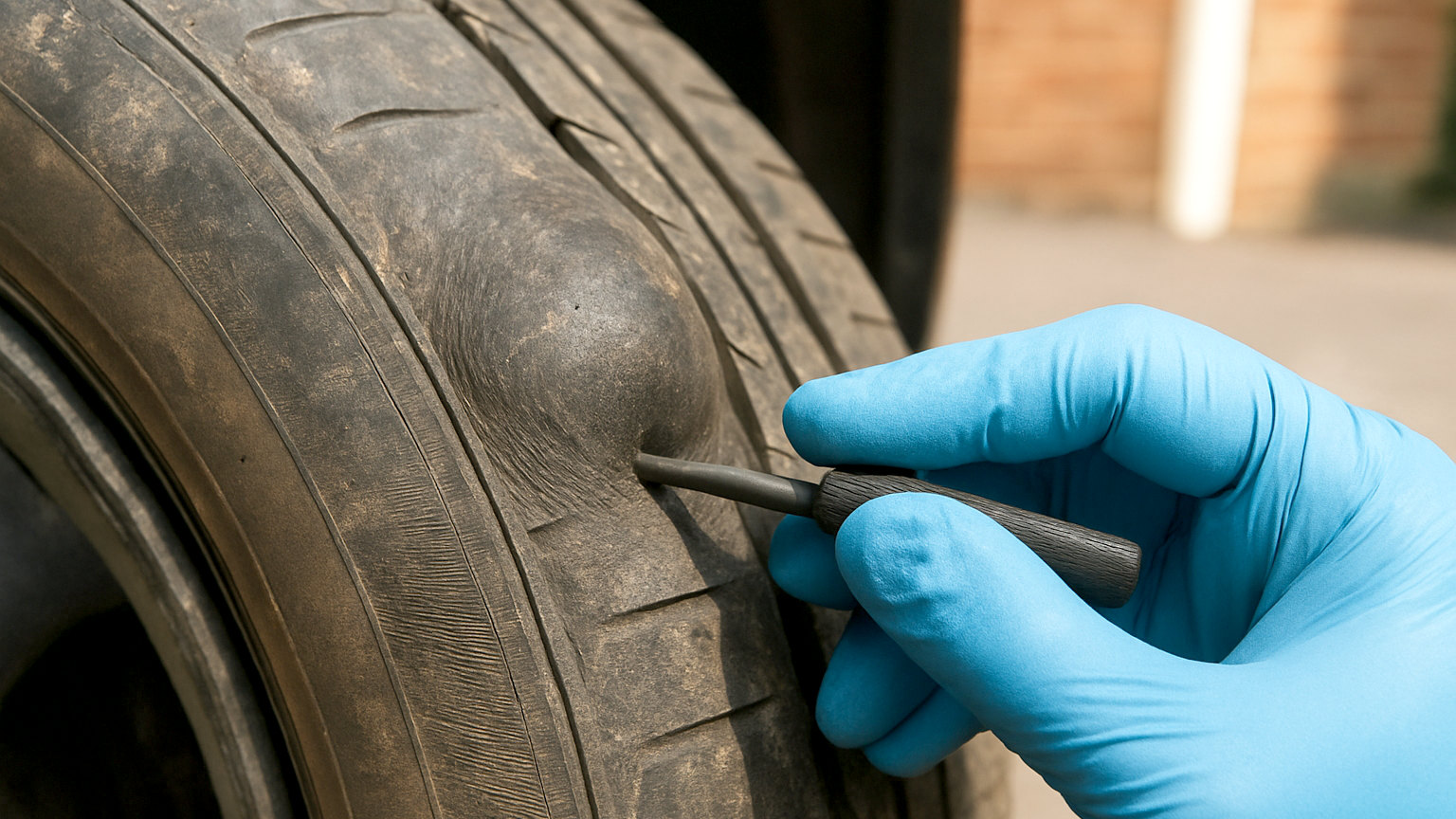
A bulge or swelling in the side of a tyre, often described as looking like an egg under the rubber, is one of the few tyre faults that means the car should not be driven. It indicates that the internal cords forming the structure of the tyre have broken, and the air pressure inside is pushing the rubber outwards through the resulting weak spot.
How is a tyre constructed?
The rubber is only the outer covering. Inside is a casing made of textile cords running from bead to bead, with steel belts under the tread, and that structure is what actually contains the pressure and carries the load. The rubber seals it and provides grip. When cords break, the rubber alone is holding back the pressure at that point, which it was never designed to do.
What causes it?
Almost always an impact. Hitting a pothole or a kerb pinches the sidewall between the rim and the obstruction, and the cords snap under that sudden compression. Underinflation makes it far more likely, since there is less air cushioning the rim. Cold weather increases the risk because rubber is less pliable. Occasionally a manufacturing defect is responsible.
Why does it appear later?
Because the cords break at the moment of impact while the rubber remains intact, so nothing is visible at first. Over the following days or weeks the pressure gradually pushes the weakened area outwards until a bulge becomes obvious. That is why a tyre should be inspected carefully after any significant pothole strike, and why the damage often seems unconnected to any event.
Can it be repaired?
No, under any circumstances. Sidewall damage cannot be repaired because the area flexes continuously with every rotation and carries structural load. There is no patch, plug or sealant that addresses broken cords. The tyre must be replaced, and anyone offering to repair a sidewall bulge should be declined firmly.
How dangerous is it?
Genuinely dangerous. The weakened area can rupture without further warning, producing a blowout, and that is most likely under exactly the conditions that stress it most: high speed, heavy load, hot weather and hard cornering. A front tyre blowout at speed is extremely difficult to control. This is not a fault to monitor for a few weeks.
Where should you look?
On both sidewalls, including the inner face, which is invisible from beside the car and is where a surprising proportion of damage occurs. Turning the steering to full lock exposes the inner sidewalls of the front tyres. Running a hand carefully around each sidewall detects swellings that are hard to see, and it is worth doing after any impact and periodically anyway.
Is it an MOT failure?
Immediately, along with any cut, lump, bulge or exposed cord. Testers inspect both sidewalls of every tyre, which is why damage on the inner face that an owner has never seen is frequently found at the test. It is one of the more common surprise failures and it cannot be argued with, since the defect is structural.
What should you do if you find one?
Fit the spare if the car has one, or arrange for the tyre to be replaced without driving on it. If you must move the car, keep the distance very short and the speed very low. Consider whether a claim against the road authority is worth pursuing if a pothole caused it, photographing the defect and the location, since wheels are frequently damaged in the same incident.
Should the other tyres be checked?
Yes, because whatever caused the damage usually affected more than one wheel. A pothole strike commonly damages both tyres on the same side, and the wheel itself is frequently buckled at the same time. Having all four inspected, and the alignment checked, is sensible after any impact heavy enough to produce a bulge, since the geometry is frequently disturbed at the same time.


