
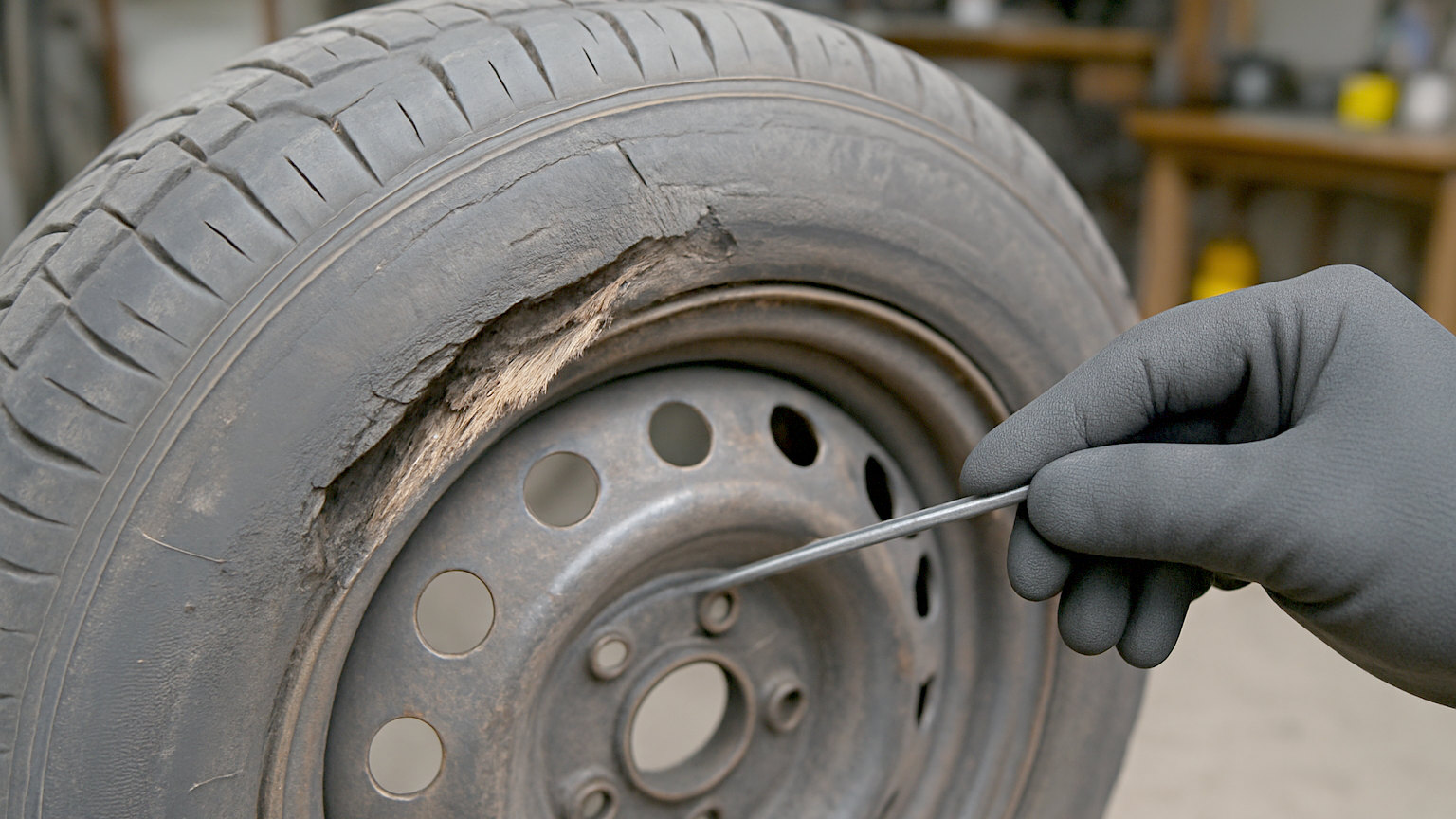
Tyres are consistently among the most common reasons cars fail the MOT, and a large share of those failures come as a surprise to the owner. That is partly because tread wears gradually and partly because several of the defects sit on the inner sidewall, which is invisible unless you turn the wheels or look underneath. A ten minute check beforehand prevents most of them.
What is the tread requirement?
A minimum of 1.6 millimetres across the central three quarters of the tread width and around the entire circumference. That means a tyre worn on one shoulder can be legal in the middle and still fail if the wear extends into the measured band. Testers check at multiple points, so the shallowest area is what counts rather than the deepest.
Which damage causes a failure?
Cuts longer than a specified length or deep enough to reach the cords. Any bulge, lump or tear indicating structural failure. Exposed cords or ply anywhere. Damage from a previous repair outside the permitted area. All of these are inspected on both sidewalls, which is why the inner face matters as much as the one you can see from the pavement.
Can mismatched tyres fail?
Yes. Tyres of a different size, construction type or, in some combinations, structure across the same axle are a failure. Fitting a radial on one side and a crossply on the other is a straightforward failure, and so is a size difference across an axle. Different brands with the same size and construction are generally acceptable, though not ideal for handling.
Does a temporary spare count?
If it is fitted to the car at the time of the test, it must comply with the rules for that position, and a space saver fitted to the front is likely to cause problems. The spare in the boot is not tested, which is why so many are found to be flat or perished when needed. It is worth checking regardless of the MOT.
What about the valve?
A damaged, badly positioned or leaking valve is a failure, and so is a valve that fouls anything as the wheel turns. Rubber valve stems perish with age and crack at the base, which is easy to spot once you look and easy to overlook otherwise. They are inexpensive and should be replaced whenever a new tyre is fitted.
Is the pressure monitoring system tested?
On vehicles first used from January 2012, yes. A tyre pressure monitoring warning lamp that stays illuminated, or that does not work at all, is a failure. That means a system with a dead sensor battery needs attention before the test, and removing the bulb does not help since the lamp must be seen to illuminate during the initial check.
Are underinflated tyres a failure?
Severe underinflation is assessed, and a tyre that is obviously flat or dangerously low will be recorded. More practically, correct pressures help the brake test produce clean results, so checking them before the test is worth doing anyway. It also avoids the tester having to inflate them, which is not their job.
How should you check beforehand?
Measure tread at several points across and around each tyre with a gauge. Turn the steering to full lock to inspect the inner sidewalls of the fronts, and look underneath or use a phone camera for the rears. Check the valves for cracking. Confirm all four match in size and construction. That covers almost everything a tester will look at, and it takes very little time.
Are tyre advisories worth acting on?
Particularly so, since tread wears continuously and an advisory noting three millimetres will be a failure well before the next test. It also means you are driving through a winter on tyres the tester already thought were marginal, which is the season when the difference in wet braking matters most and when the roads are least forgiving of a marginal tyre.


