
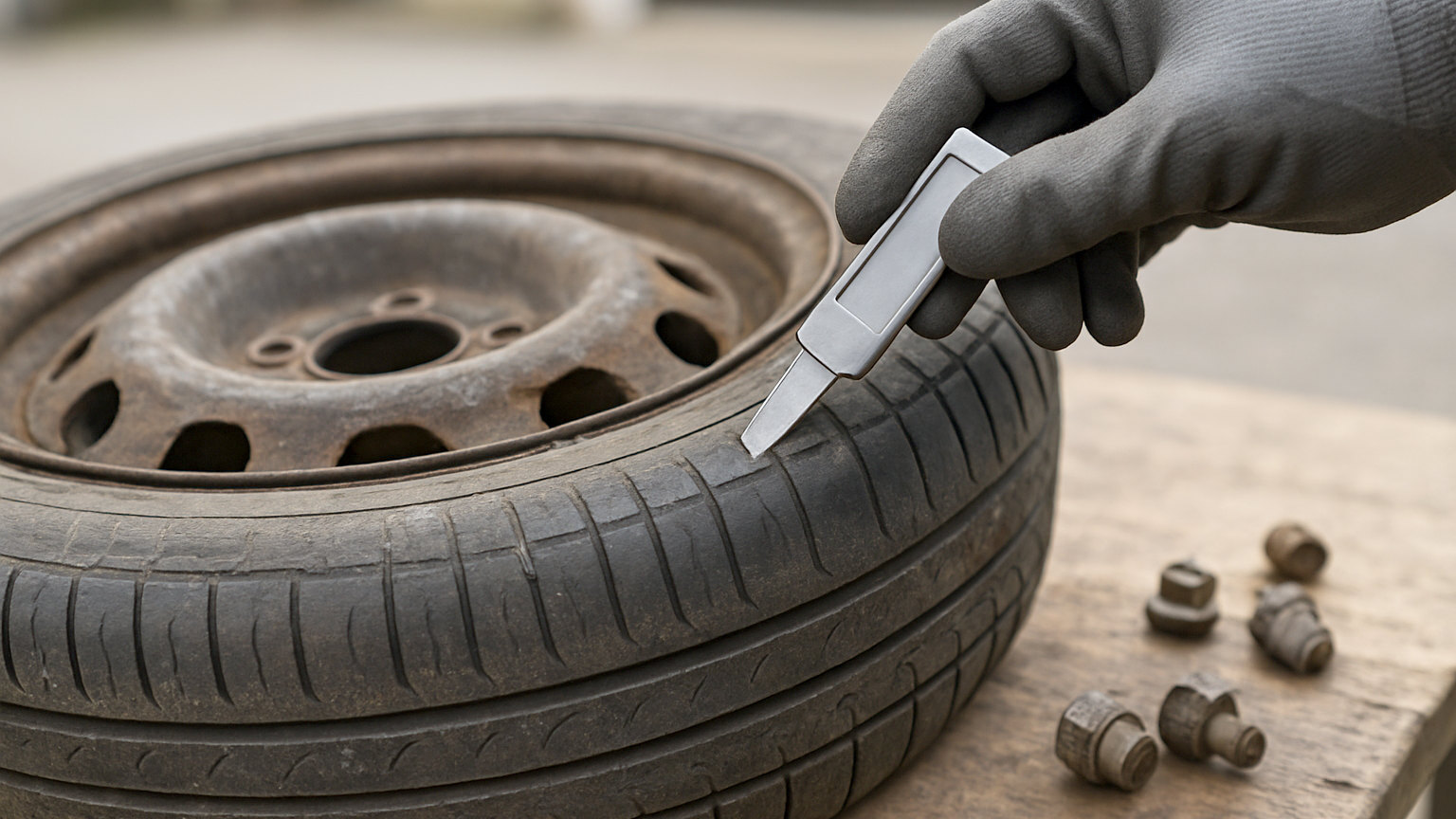
The legal minimum tread depth for cars in the UK is 1.6 millimetres, and it must be met across the central three quarters of the tread width and around the entire circumference. That is the legal floor rather than a recommendation, and the practical point at which most tyres should be replaced is considerably above it, because wet weather performance falls away long before the limit is reached.
What does tread actually do?
It clears water. On a dry road a slick tyre would grip better than a treaded one, which is why racing tyres have no pattern. On a wet road the grooves have to move water out from under the contact patch fast enough for the rubber to reach the surface. As tread depth falls, the volume of water the tyre can displace falls with it, and aquaplaning becomes possible at lower speeds.
Why is three millimetres often recommended?
Because independent testing has repeatedly shown wet braking distances lengthening substantially between three millimetres and the legal limit. A tyre at 1.6 millimetres is legal and it stops far less well in the wet than one at three. Many safety organisations and manufacturers therefore suggest replacement at around three millimetres, which is a judgement about risk rather than a legal requirement.
How do you check it?
A tread depth gauge is inexpensive and accurate, and it should be used at several points across each tyre and at three positions around the circumference, since wear is rarely even. The twenty pence coin test is a reasonable rough check: insert the coin into the main grooves, and if the outer band of the coin is visible, the tread may be close to or below the limit.
What are tread wear indicators?
Small raised bars moulded into the bottom of the main grooves at 1.6 millimetres, positioned around the tyre and marked on the sidewall, often by a small triangle or the letters TWI. When the tread surface becomes level with those bars, the tyre is at the legal limit. They are a useful visual check that needs no equipment at all.
What are the penalties?
Driving with a tyre below the legal limit can result in a fine of up to two and a half thousand pounds and three penalty points, and that applies per tyre. A car with all four below the limit therefore faces a potentially very large penalty and twelve points, which is a disqualification. It is also an immediate MOT failure and can affect insurance in the event of a claim.
Does the whole tyre need to comply?
The legal requirement applies to the central three quarters of the tread width, around the whole circumference. That matters because a tyre worn on one shoulder can still be legal while being clearly unsafe and indicating a suspension or alignment fault. It also means checking only the middle of the tyre misses the wear patterns that tell you something is wrong.
What does uneven wear indicate?
Wear concentrated on both edges suggests persistent underinflation. Wear in the centre suggests overinflation. Wear on one edge only suggests incorrect camber or a suspension problem. A sawtooth feel across the tread blocks suggests incorrect toe. Reading those patterns before fitting new tyres is worthwhile, since the same wear will otherwise repeat on the replacements.
How often should you check?
Monthly is a reasonable habit, alongside checking pressures, and before any long journey. Tread does not disappear overnight, but a developing fault can wear a tyre out remarkably quickly, and a tyre that was fine two months ago may not be now. Checking all four takes a few minutes and it is the single most useful safety inspection an owner can perform.
Does the spare need to comply?
A full size spare must meet the same requirements once it is fitted to the car, so a legal tyre in the boot matters as much as the four on the road. Space saver spares are different, carrying their own speed and distance limits marked on the sidewall. Either way, checking the spare occasionally is worth doing, since discovering it is bald or flat at the roadside is a poor time to find out.


