
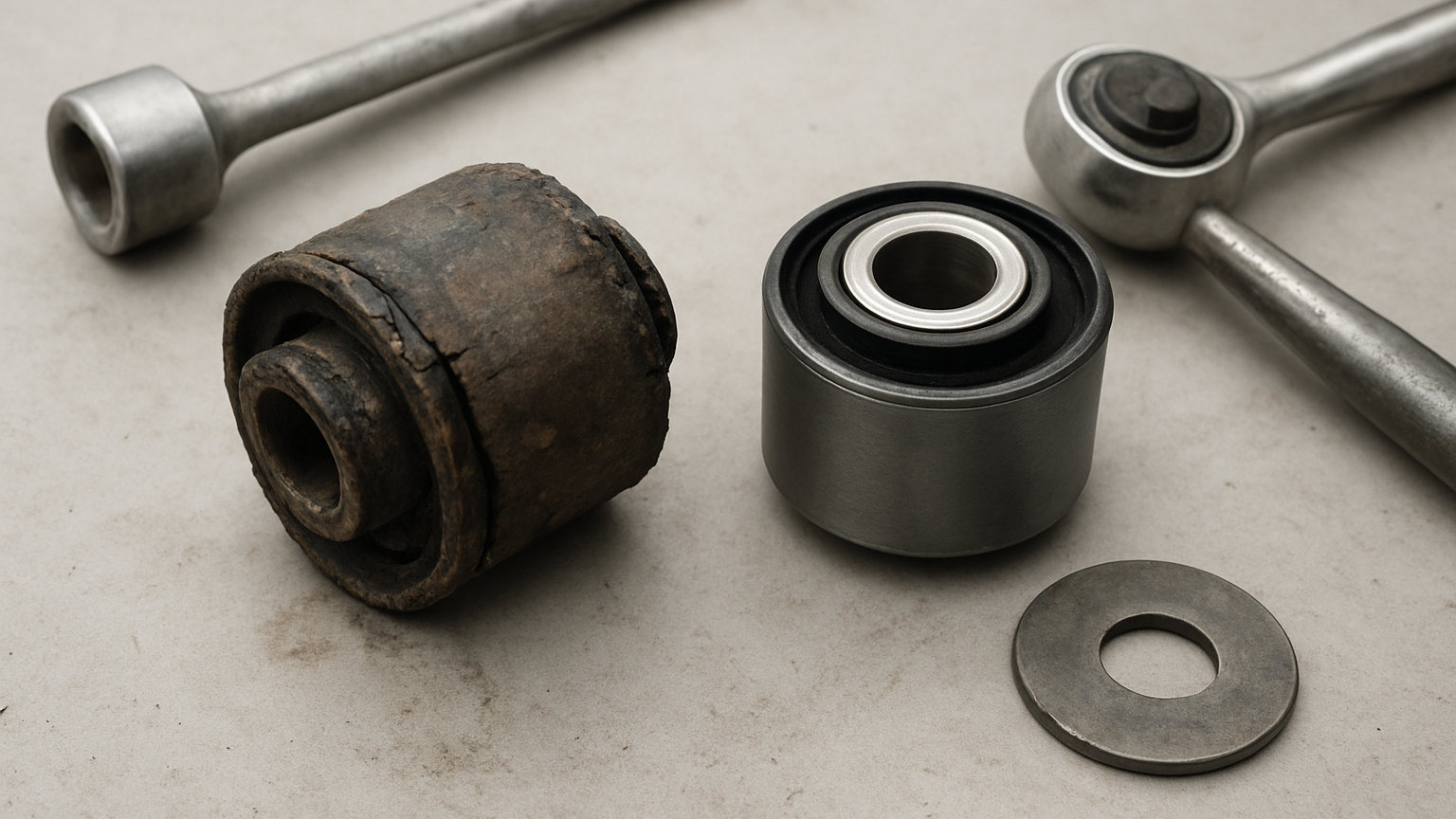
A rear end that feels loose, wallowy or as though it is moving independently of the front is worth taking seriously. The rear axle is where a loss of grip becomes hardest to recover, so anything that reduces rear stability matters more than the equivalent at the front. It is also an area drivers pay less attention to, since there is no direct connection through the steering.
What does it actually feel like?
The back of the car taking a moment to settle after a bump or a lane change. A sensation of the rear moving sideways slightly over uneven surfaces or in crosswinds. On a roundabout, a feeling that the car is rotating more than the steering input asks for. It is subtle enough that many drivers describe it simply as the car not feeling right.
What are the usual causes?
Worn rear dampers, which are almost never inspected. Underinflated or worn rear tyres. Perished rear suspension bushes allowing the axle to shift under load. A rear thrust angle out of square. And a heavily loaded boot without the laden tyre pressures being set, which changes the balance considerably.
Why are rear dampers so often overlooked?
Because their decline produces no obvious symptom at the steering wheel. Front dampers announce themselves through the steering; rear ones simply let the back of the car float. Since they degrade over tens of thousands of miles, the driver adapts continuously. A damper efficiency test on a vibrating plate is the practical way to find out rather than guessing.
Do rear tyres get neglected?
Consistently. Rear pressures are checked less often, rear tyres are balanced less often, and their condition is inspected less often because the wear is slower. Since rear grip is what keeps a car stable, that neglect matters more than the mileage would suggest. Checking all four pressures monthly rather than just the fronts is a small habit worth adopting.
What do worn bushes do?
Allow the rear axle or suspension arms to move under braking, cornering and acceleration, so the effective geometry changes as the loads change. The car therefore behaves differently moment to moment, requiring correction. On cars with rear toe control links this shows up quickly, since a small change in rear toe has a disproportionate effect on stability.
Can the load be responsible?
Frequently. A heavy load in the boot sits behind the rear axle on most cars, which lifts weight off the front and loads the rear beyond what the standard pressures suit. Manufacturers publish laden pressures for exactly this reason, and setting them before a loaded journey makes a real difference to how settled the car feels.
Is it more noticeable in the wet?
Yes, since available grip is lower and any weakness at the rear shows up sooner. A car that feels fine in the dry and unsettled in the wet is worth investigating, particularly if the rear tyres are the more worn pair. That combination is exactly why new tyres are recommended on the rear rather than the front.
What should you check?
Rear tyre pressures and tread against the fronts. Whether the rear tyres match each other. A damper efficiency test on all four corners. And an inspection of the rear bushes and a four wheel alignment including the thrust angle. That covers the causes in order of cost and it usually identifies the problem without going further.
How urgent is it?
More than a front end complaint of similar severity, since rear grip is what keeps the car stable and a loss of it is harder to recover. It is not a reason to stop driving, and it is a reason to have it looked at rather than adapting to it over a winter.
If the rear tyres are the more worn pair, moving the better set to the back at the next change is worth doing regardless of what else is found.


