
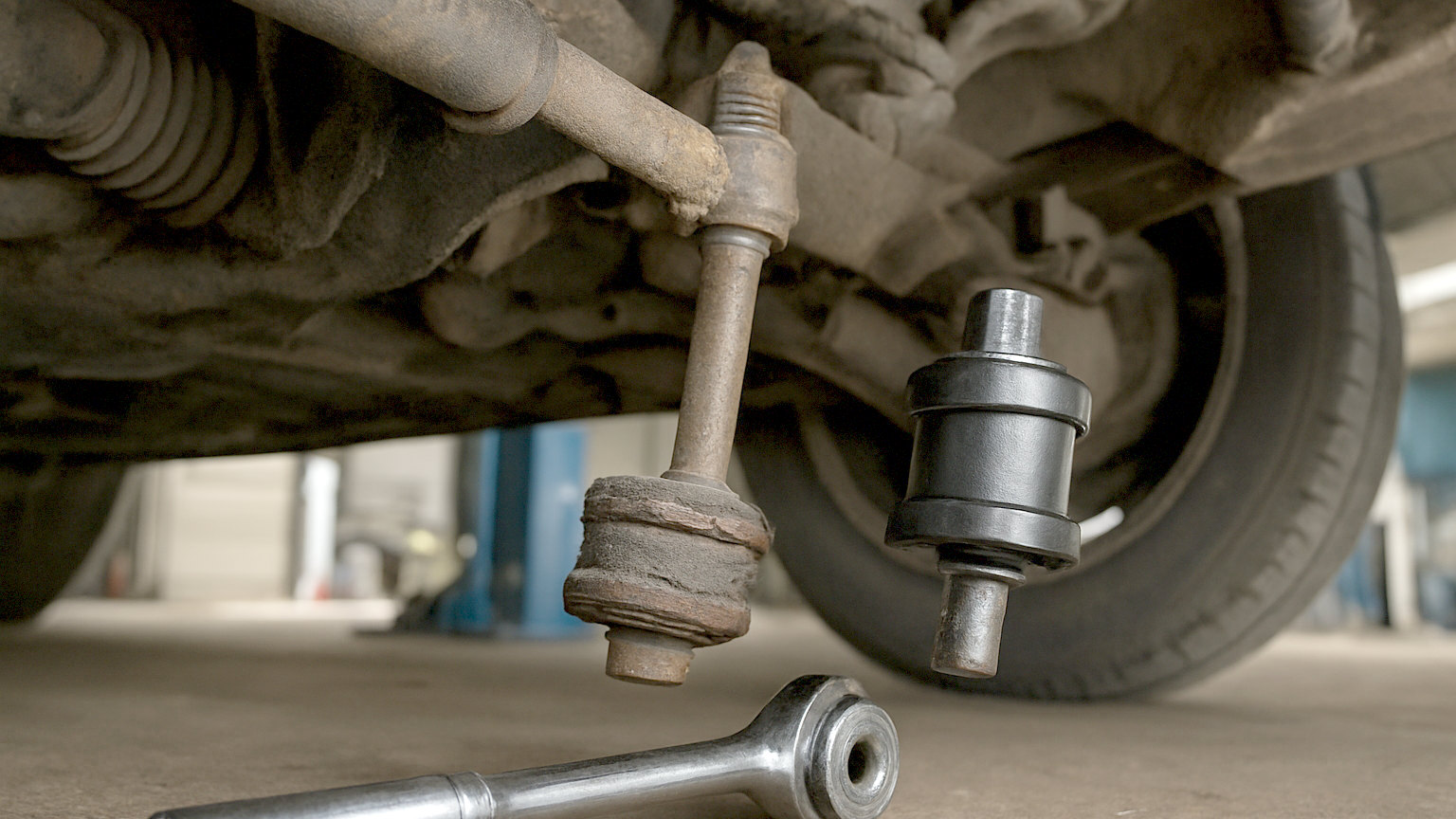
Body roll is the lean of a car towards the outside of a corner as weight transfers, and it is a normal and necessary consequence of having suspension. A car with no roll at all would ride appallingly. What matters is how much roll there is, how quickly the car settles into it, and whether either has changed since the car was new.
Why does a car roll at all?
Because the centre of gravity sits above the roll centre, so cornering forces produce a turning moment that compresses the outside suspension and extends the inside. The springs allow that movement, and how much they allow is a deliberate design choice balancing ride comfort against how much the body moves.
What does an anti roll bar do?
It is a torsion spring across the car connecting the suspension on each side. When both wheels move together it does nothing, so ride comfort over bumps is unaffected. When one side rises relative to the other, as in a corner, it twists and resists, transferring some load across the axle. That reduces roll without stiffening the ride.
Is more roll always worse?
No, and this is worth understanding. Some roll gives the driver useful feedback about how hard the car is working, and a car with very little roll can reach its grip limit with less warning. Comfortable family cars are deliberately softer than sports cars. The question is not whether the car rolls but whether it rolls more than it used to.
What causes excessive roll?
Worn dampers, which allow the body to reach its roll angle quickly and then take time to settle, producing a wallowing sensation. Broken or sagging springs. Worn anti roll bar bushes and drop links, which effectively disconnect the bar and let each side move independently. Perished suspension bushes generally, which let everything move further than intended.
What does a broken drop link feel like?
More roll than usual, particularly noticeable on roundabouts, often with a knocking noise over bumps from the same corner. Since drop links are among the cheapest suspension parts and among the first to wear, they are worth checking whenever a car seems to lean more than it did. Replacing them is inexpensive and the improvement is immediate.
How do dampers affect it?
They control the rate at which roll develops rather than the final angle, which the springs and anti roll bars determine. Worn dampers therefore produce a car that flops into a corner and takes time to settle, then continues moving afterwards. That delay between input and response is what makes a car with tired dampers feel imprecise and unsettling.
Should you fit stiffer anti roll bars?
Only with an understanding of what it does to the balance. Stiffening one end transfers more load across that axle, which reduces its grip relative to the other, so a stiffer front bar increases understeer and a stiffer rear bar increases oversteer. That is a useful tuning tool and it is not a straightforward improvement, and on a road car the standard arrangement is usually right.
What should you check?
Anti roll bar bushes and drop links for play, since they are cheap and commonly worn. A damper efficiency test on all four corners. Springs for breaks and sagging, comparing the ride height side to side. If those all check out and the car simply rolls more than you would like, that is a characteristic of the design rather than a fault.
Does roll affect safety?
Excessive roll delays how quickly the car responds, which matters in an avoidance manoeuvre, and it changes the camber of the outside tyres so they work less efficiently. A car that flops into corners and takes time to settle has less margin than one that stays composed, which is why worn dampers matter beyond comfort.
That is also why a car that has always rolled a certain amount is quite different from one that has started rolling more, and the second is the version worth investigating.


