
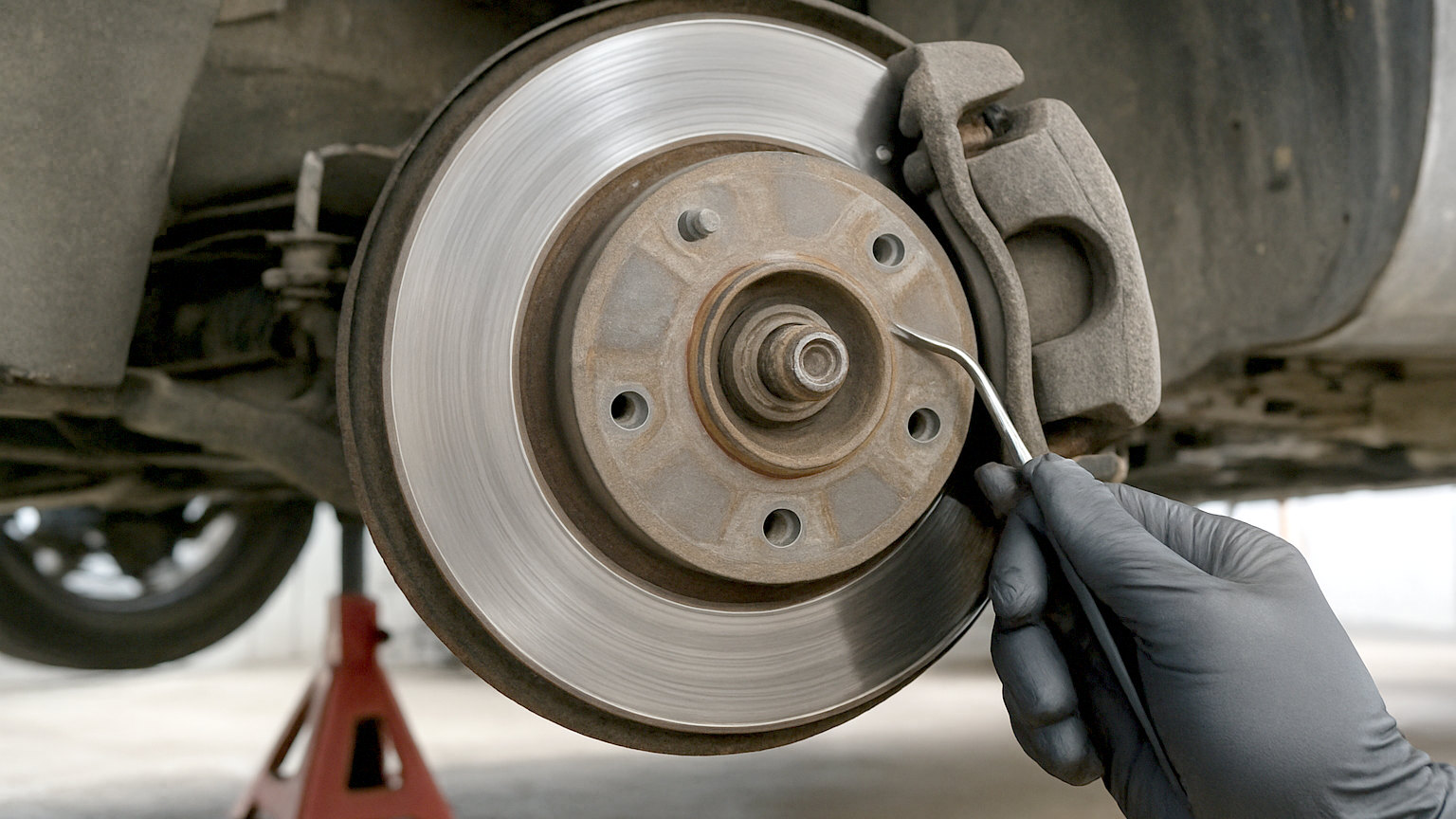
Brake pads give several kinds of warning as they wear, and they arrive in a particular order. The visual warning comes first and requires you to look. The audible warning comes considerably later and is designed to be impossible to ignore. By the time you hear metal grinding, the pads have gone entirely and the discs are being damaged, which is a substantially more expensive outcome.
What thickness counts as worn?
A new pad typically has somewhere around ten to twelve millimetres of friction material on its backing plate. Most manufacturers specify a minimum of around three millimetres, and many garages advise replacement at that point. Anything below two millimetres is genuinely low, and the metal backing plate itself is not far behind. Measuring rather than estimating is what makes this useful.
Can you check them yourself?
Often, without removing a wheel. On many cars the outer pad is visible through the wheel spokes with a torch, and the friction material can be seen against the metal backing plate. Comparing its thickness to the backing plate, which is a known reference, gives a reasonable estimate. For a proper measurement the wheel needs to come off, since the inner pad frequently wears faster and is the one you cannot see.
How does the wear indicator work?
Many pads include a small metal tab positioned so that it contacts the disc once the friction material has worn down to a set thickness. The resulting squeal is deliberate and it is designed to be irritating. It usually appears when braking lightly and disappears under firm pressure, which is a distinctive pattern. Hearing it means replacement is due now rather than at some future service.
What about electronic wear sensors?
Some cars use a wire embedded in the pad which is cut through as the material wears, completing or breaking a circuit and illuminating a dashboard warning. It is a more civilised warning than a squeal and it means exactly the same thing. Those sensors are consumable and should be replaced along with the pads, since a cut sensor will keep the light on.
Are there symptoms you can feel?
Longer stopping distances, which develop gradually enough that most drivers adapt without noticing. A brake pedal that travels further before biting. On very worn pads, a change in feel as the material becomes thin and heats more quickly. None of these is as reliable as looking, which is why an inspection at every service matters more than waiting for a sensation.
Does the fluid level indicate anything?
It does. As pads wear, the caliper pistons extend further to take up the gap, and the fluid to fill that space comes from the reservoir. So a brake fluid level that has fallen slowly over a year, with no leak anywhere, is usually reporting pad wear. That is worth knowing, because it also means topping up a falling level can mask the wear that caused it.
What happens if you leave them?
Once the friction material is gone, the steel backing plate contacts the disc directly. That produces a harsh grinding, it destroys the disc surface within a very short distance, and it dramatically reduces braking performance. What would have been a pad replacement becomes pads and discs, and in bad cases the caliper is damaged too. It is one of the most expensive things to postpone.
Should all four be done together?
Pads are always replaced in axle pairs, never individually, since different friction levels side to side make the car pull under braking. Front and rear are separate decisions, and since fronts wear faster it is entirely normal to replace them alone. What matters is that both sides of an axle are done together with matching pads.
Should you replace them early?
There is a reasonable argument for replacing at three or four millimetres rather than running to the absolute limit, particularly before a long trip or if the car is about to be off the road for winter. Pads are inexpensive relative to discs, and the whole risk in this area is running them down far enough to damage the disc, which turns a modest job into a considerably larger one.


