
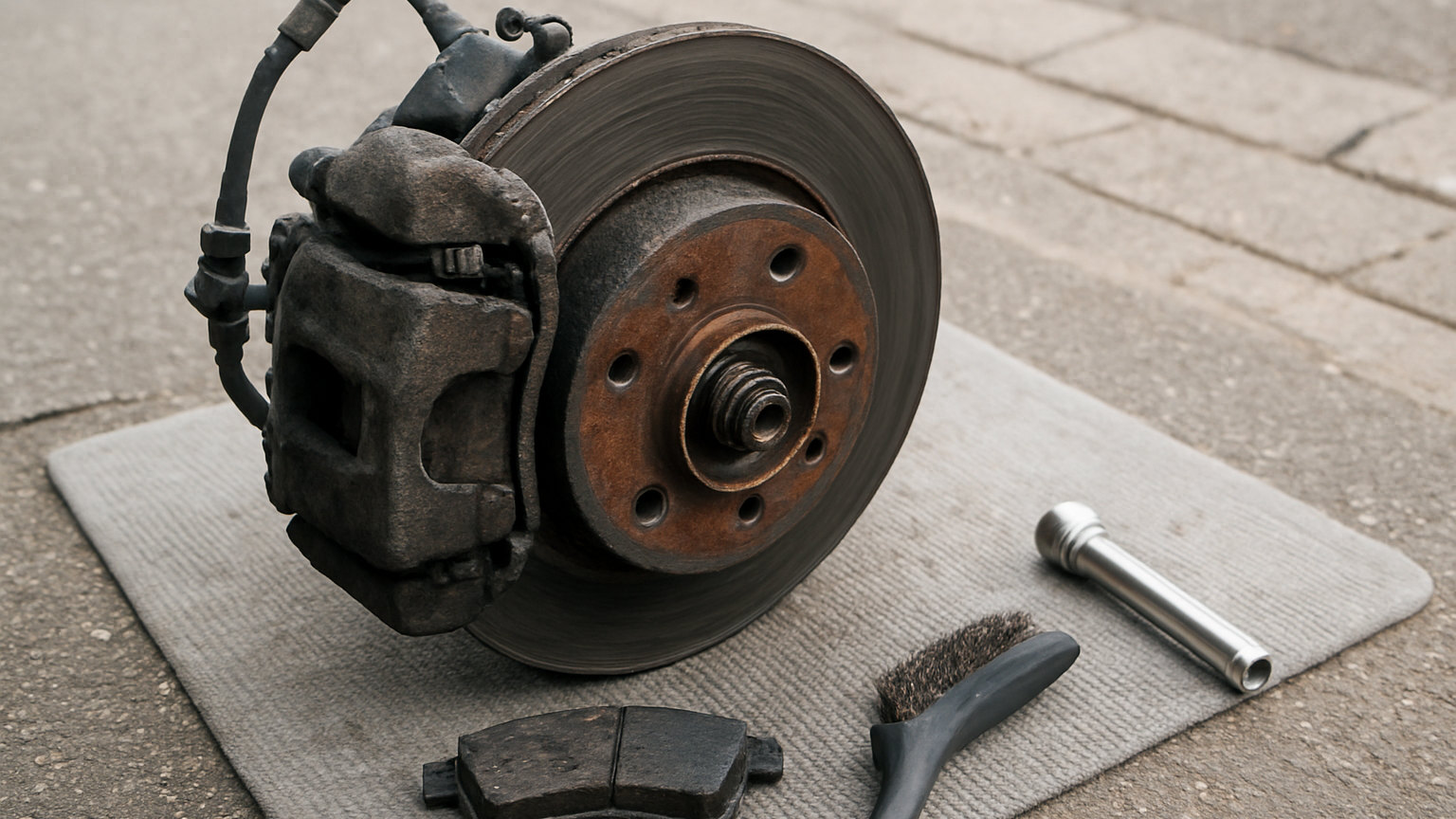
Brake pads that have worn unevenly are reporting a mechanical fault rather than a driving pattern, and the specific pattern of the wear identifies which fault with reasonable precision. Since new pads fitted into the same conditions will wear the same way, reading the old ones before they are thrown away is genuinely worthwhile.
What does one pad worn more than the other mean?
On a sliding caliper, which is the common design, only the piston side pad is pushed directly. The caliper body then slides on its guide pins to pull the outer pad against the disc. If those pins are seized or stiff, the caliper cannot slide, so the inner pad does most of the work and wears far faster while the outer barely wears at all. It is the single most common uneven wear pattern.
How do slide pins seize?
Their rubber boots split, water gets in, and the pins corrode in their bores. Old grease hardens and stops lubricating. Once a pin binds, the caliper stops floating freely and everything downstream follows. Cleaning the pins, replacing damaged boots and regreasing with a proper high temperature brake grease is inexpensive and it should be part of every pad replacement.
What does tapered wear indicate?
A pad thicker at one end than the other, worn at an angle across its face, suggests the caliper is not sitting square to the disc. That can be a bent or worn carrier, a seized pin on one side only, or a pad that has not been able to move freely in its carrier because of corrosion in the abutment. It is worth identifying, because new pads will taper the same way.
What does a seized piston look like?
A piston that will not retract allows the pad to remain in contact with the disc continuously, which produces rapid wear on that pad, a hot wheel, a pull under braking and often a smell. A piston that will not extend does the opposite, leaving that corner contributing little braking. Both are usually caused by corrosion behind the seal, frequently after moisture has entered through a damaged dust boot.
What if one side of the car wears faster?
That points at a caliper fault on the fast wearing side, most often a sticking piston or seized pins causing it to drag. It also produces a pull under braking and uneven disc wear. Comparing the two sides during a pad change is a simple and valuable check, and it is worth asking a garage which side was worse and by how much.
Does pad hardware matter?
Considerably, and it is often overlooked. Most calipers use stainless steel abutment clips or shims that let the pad slide freely in its carrier. Those corrode and swell, trapping the pad so it cannot retract. Replacing the fitting kit with new pads is inexpensive and it prevents exactly this failure, which is why quality pad sets include one.
Can the disc cause it?
Yes. A disc with excessive runout, whether from hub contamination or its own distortion, pushes the pad in and out with each revolution and produces uneven wear as well as judder. Rust or debris on the hub face is a common and easily prevented cause, and cleaning that face before fitting a disc is one of the most important steps in a brake job.
What should be done about it?
Free and regrease the slide pins, replace their boots if damaged, fit a new hardware kit, check the piston retracts smoothly, and clean the carrier abutments back to bare metal. If a piston or pin cannot be freed, the caliper needs replacing or reconditioning. Doing that alongside the pads costs relatively little and it is what stops the new set wearing the same way.
Is it worth photographing the old pads?
Genuinely, yes. A photograph of the four old pads laid out in the positions they came from is a permanent record of what was happening, and it is worth asking for if you are not present. It also gives you something concrete to compare against at the next change, which is how you spot a caliper that has been marginal for two sets rather than one.


