
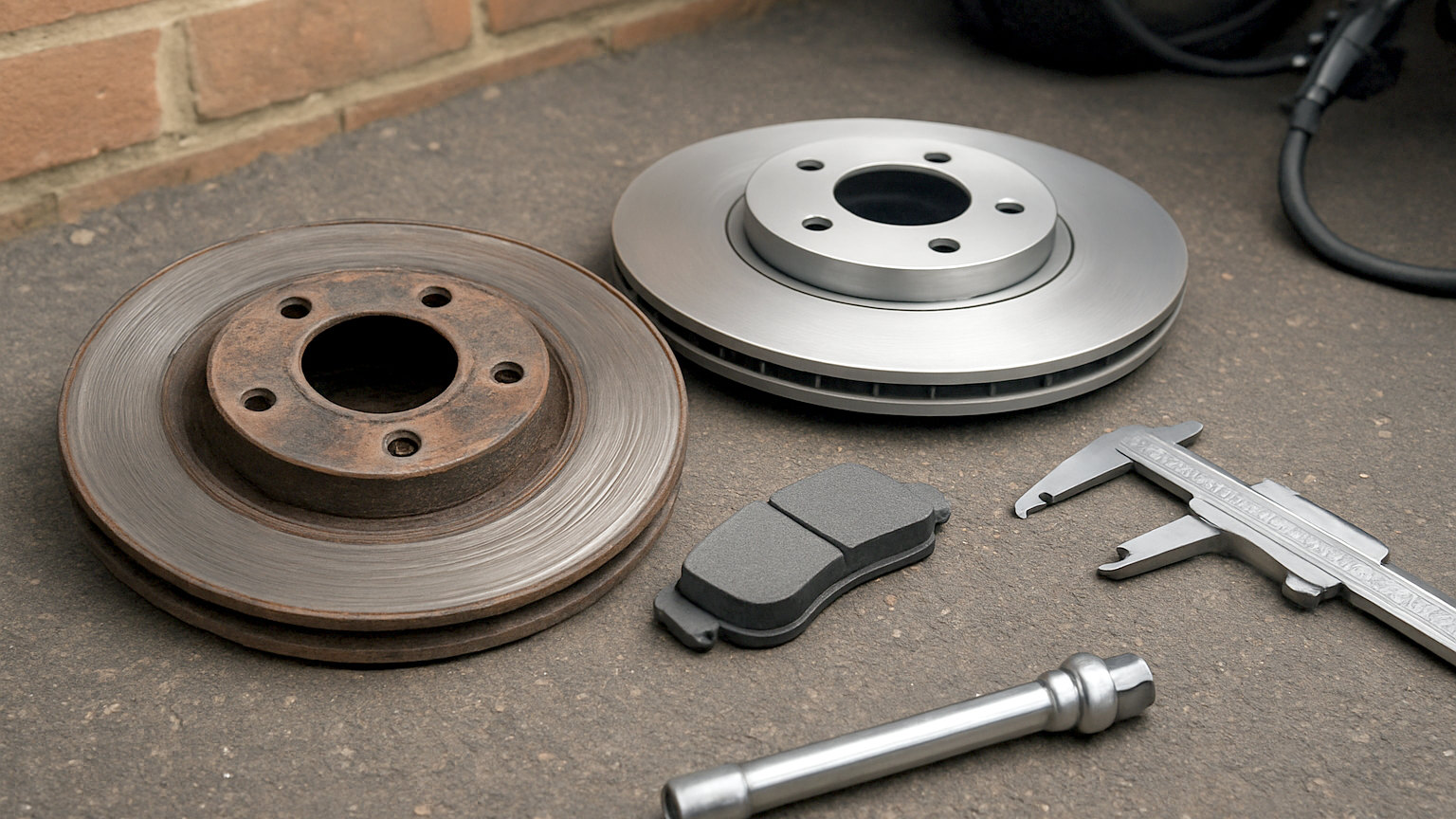
Being told the discs need replacing along with the pads is one of the more common upsell conversations in motoring, and it is sometimes entirely correct and sometimes not. The honest answer depends on the measured thickness and the surface condition, not on a general rule, and knowing what determines it lets you have a more useful conversation about the quote.
When do discs genuinely need replacing?
When they are at or approaching their minimum thickness, when they are deeply scored or grooved, when they are cracked, when there is enough thickness variation to cause judder, or when the surface is heavily pitted with corrosion. Any of those means new pads will not bed properly and the brakes will not perform as they should. In those cases replacement is not an upsell.
When are new pads on old discs acceptable?
When the discs measure comfortably above minimum, the surface is smooth and even, there is no significant lip and no judder. A disc in that condition will happily accept new pads, and there is no engineering reason to replace it. This is a genuine and common situation, particularly where pads have been replaced early or the car does mostly motorway miles.
Why does the surface matter as much as the thickness?
Because new pads have to bed in, which means their surface must mate evenly with the disc. A grooved or scored disc gives them an uneven surface to work against, which reduces the contact area, lengthens the bedding process and can produce noise and vibration. A disc with a mirror smooth glazed surface can also cause poor initial bite, which is why lightly abrading it is good practice.
Is the lip a reliable indicator?
It is a useful rough guide. A lip you can catch a fingernail on suggests meaningful wear, and a pronounced ridge suggests the disc is well into its life. It is not a measurement though, and a micrometer reading against the stamped minimum is what actually settles it. Asking for that figure turns an opinion into evidence.
What about the rule of replacing discs every second set of pads?
It is a workshop convention rather than an engineering requirement, and it is roughly right often enough to have become common practice. Discs typically last around twice as long as pads on many cars, so the rhythm frequently matches reality. It is still worth measuring rather than assuming, since a car used gently on motorways may go three sets of pads and one used hard in town may not manage two.
Should both sides be replaced together?
Always in axle pairs. Fitting one new disc and leaving an old one produces different friction characteristics and different thicknesses across the axle, which makes the car pull under braking. It is not a place to economise, and no reputable workshop will do it.
What if discs are replaced but pads are not?
Generally a poor idea. Used pads have bedded to the profile of the old disc, and putting them against a fresh surface produces uneven contact, poor bite and often noise. Since pads are the cheaper component, fitting new ones alongside new discs is straightforward good practice and should be included in any quote for disc replacement.
What should you ask?
For the measured disc thickness in millimetres and the stamped minimum for comparison, and whether there is any thickness variation. Those two figures make the decision obvious and they are quick for a workshop to provide. A quote that says the discs are worn without any measurement is worth questioning, and a workshop happy to show you the numbers is demonstrating something useful about how it works.
What if you decline the discs?
That is your decision to make, provided the discs are genuinely above their minimum and not damaged. Where a workshop believes they need replacing and you disagree, ask for the measurement and the reasoning to be recorded. If the discs are actually below minimum or cracked, declining is not a reasonable option, since the car will not be safe and will not pass its next test.


