
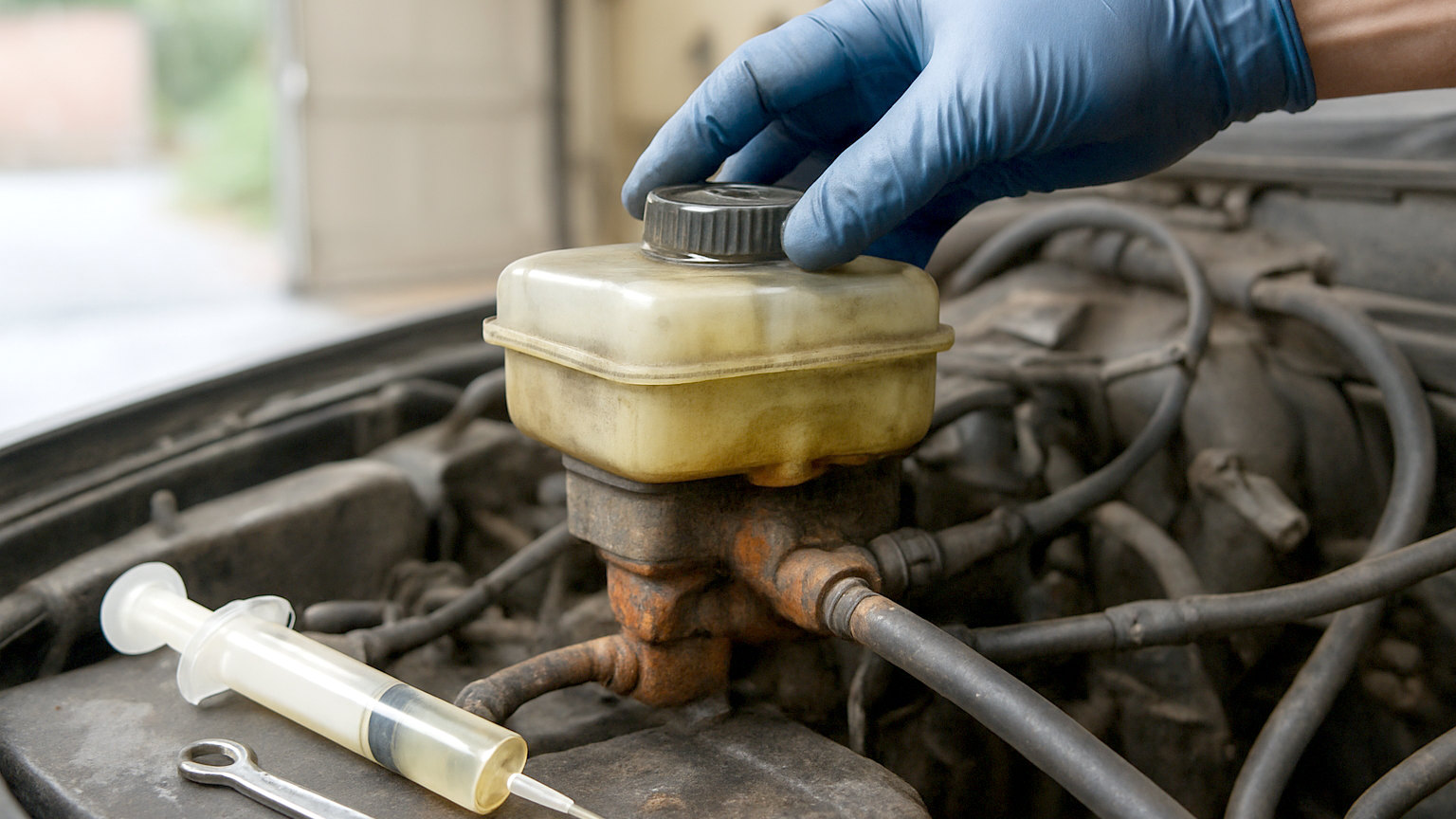
Brake fluid is the most neglected safety critical fluid on a car, largely because it looks unchanged and the car gives no warning. It is hygroscopic, meaning it absorbs moisture from the atmosphere through hoses and seals over time, and that moisture progressively lowers its boiling point. Most manufacturers specify replacement every two years regardless of mileage, and most owners never do it.
Why does moisture matter?
Because braking generates heat, and that heat reaches the fluid at the calipers. Fresh fluid has a boiling point well above anything normal braking produces. Fluid that has absorbed a few percent of water boils at a considerably lower temperature, and once it boils it forms vapour, which compresses. The pedal then goes soft or reaches the floor with no braking behind it.
When does that actually happen?
On a long descent with sustained braking, when towing, on a track, or during any repeated heavy braking that lets heat build rather than dissipate. It is precisely the situation where losing brakes matters most. A car that has never had its fluid changed may go years without ever generating enough heat, and then encounter it on a mountain road on holiday.
What does the DOT rating mean?
A specification covering boiling points and other properties. Most modern cars use a glycol based fluid to a rating of four or higher, with higher ratings generally offering higher boiling points. Silicone based fluid is a different chemistry and is not interchangeable. What matters is using the specification the handbook states, since mixing incompatible types can damage seals.
Can moisture content be tested?
Yes, with an inexpensive electronic tester that measures it in the reservoir, and many garages will check it as part of a service. It is worth asking for, since it turns a guess into a measurement. Bear in mind that fluid in the reservoir is not always the worst in the system, as moisture tends to accumulate at the calipers where heat and hoses are.
Does the colour tell you anything?
Loosely. Fresh fluid is clear to pale amber, and it darkens with age and contamination. Very dark or cloudy fluid is certainly overdue. The difficulty is that moisture content cannot be seen, so fluid that still looks acceptable can have absorbed enough water to have lost a substantial part of its boiling point margin.
What else does old fluid do?
It corrodes the system from the inside. Water in the fluid attacks caliper bores, wheel cylinders, master cylinders and ABS components, and the resulting corrosion is a common cause of seized pistons and expensive ABS unit failures. Regular fluid changes are therefore cheaper than the components they protect, which is the practical argument for doing them.
How is it changed?
By bleeding fresh fluid through each caliper in the sequence the manufacturer specifies, until clean fluid emerges and no air remains. On cars with ABS, some systems require a diagnostic tool to cycle the pump so that old fluid trapped within the unit is replaced. Skipping that leaves degraded fluid in the component most expensive to replace.
Is it worth doing on an older car?
Particularly so, since older cars are more likely to have never had it done and more likely to have corrosion developing. It is among the least expensive safety related jobs available, it protects components that cost a great deal more, and it restores pedal feel noticeably on a car where the fluid is genuinely old.
Does it apply to the clutch as well?
On most cars the clutch shares the same reservoir and the same fluid, so a brake fluid change refreshes both systems. That is worth knowing, because corroded clutch master and slave cylinders are a common failure and old fluid is the usual reason. Bleeding the clutch through at the same time costs very little extra while everything is already open, and it removes one of the more common causes of a clutch pedal going soft on an older car.


