
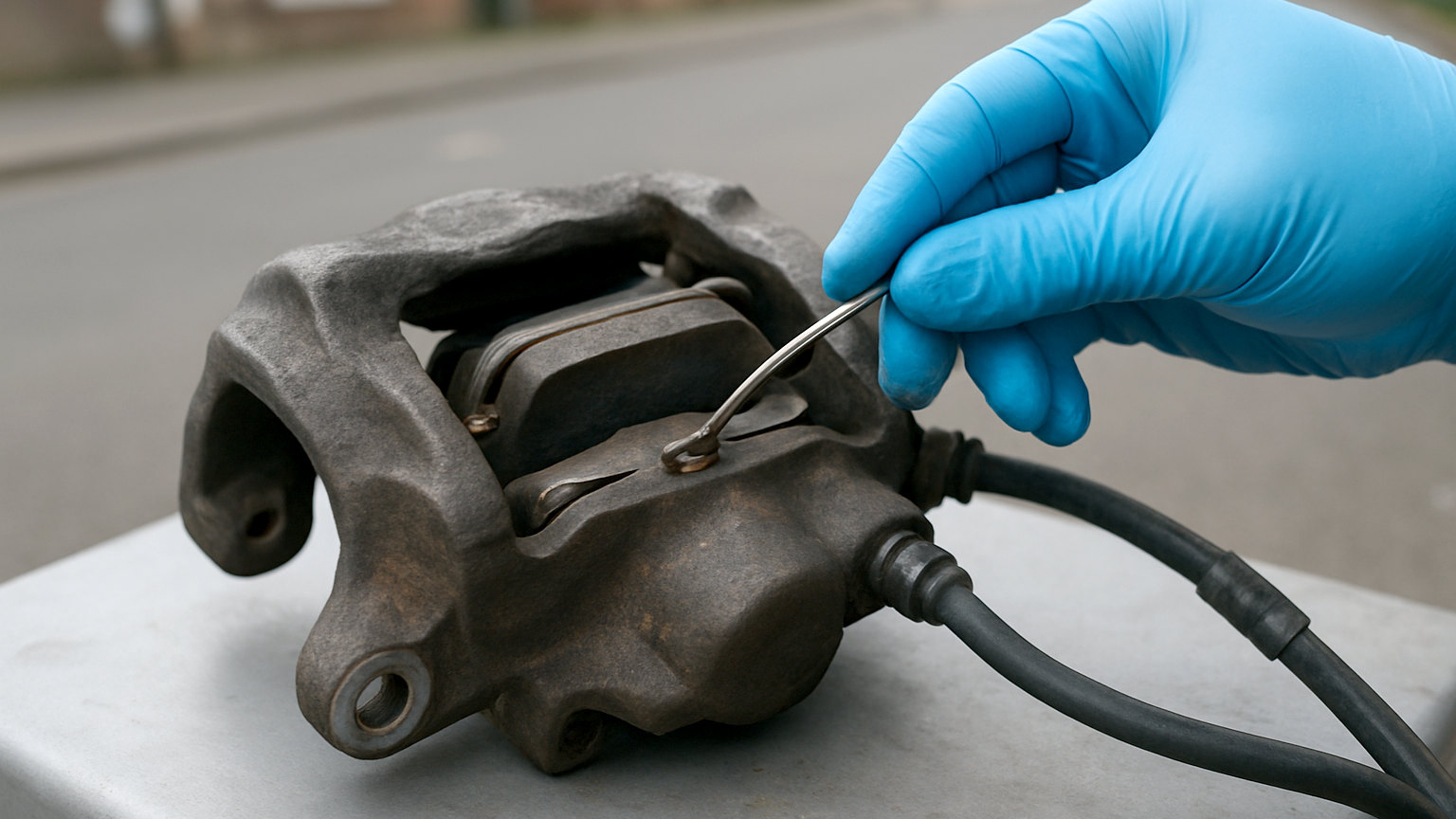
Brakes that squeal, groan or graunch when reversing while behaving perfectly going forwards are a common and genuinely puzzling complaint. The explanation is straightforward once you know how a pad sits in its carrier: reversing loads the pad against the opposite abutment from forward braking, which changes how it is held and therefore how it vibrates.
How does a pad sit in the caliper?
It is not clamped rigidly. The pad sits in a carrier with a small amount of clearance so it can move freely as the caliper floats and as the pad wears. Under braking, friction from the rotating disc pushes the pad against one side of that carrier, called the abutment. In reverse, the disc rotates the other way and the pad is pushed against the opposite abutment.
Why does that change the noise?
Because how firmly the pad is held determines its resonant behaviour. If one abutment is corroded, worn or lacking its stainless clip, the pad is held less securely in that direction. Braking forwards may hold it firmly and quietly while braking in reverse leaves it free to vibrate, which produces the squeal. The pad and disc are identical in both directions; only the support has changed.
Is it a sign of wear?
Usually not of the friction material. It more often points at the hardware, meaning the abutment clips, shims and springs that locate the pad. Those corrode and swell over time, and they are frequently reused rather than replaced during a pad change. A reverse squeal appearing shortly after new pads is a strong hint that the fitting kit was omitted.
What is a pad chamfer?
Many pads have their leading and trailing edges chamfered, which reduces the tendency to vibrate by changing how the pad first contacts the disc. Chamfers are often asymmetric, designed for forward rotation, which is another reason a pad can be quiet in one direction and noisy in the other. Fitting pads the wrong way round, where they are directional, produces exactly this.
Can it be the rear brakes?
Frequently, and it is worth listening carefully to which end it comes from. Rear brakes are lightly used, so their pads glaze and their hardware corrodes more readily, and reversing often involves more rear braking than people realise. On cars with an electronic parking brake acting on the rear calipers, the mechanism itself can also contribute to noise when reversing.
Does it matter?
Rarely in safety terms, since a car that squeals in reverse usually brakes perfectly well. What it does indicate is that something in the caliper is not as it should be, and corroded abutments that trap a pad can eventually stop it retracting properly, which causes dragging and uneven wear. So it is worth investigating as an early sign rather than tolerating indefinitely.
How is it fixed?
By removing the pads, cleaning the carrier abutments back to bare metal, fitting new stainless hardware clips, and applying a thin film of proper brake grease to the pad backing plate edges and the contact points, never to the friction surface. The slide pins should be cleaned and regreased at the same time. It is a modest job that resolves most reverse squeals.
Will it come back?
If the hardware was replaced and the abutments cleaned properly, usually not for a long time. If the old clips were reused, expect it to return within months. That is why asking whether a fitting kit is included is worth doing before agreeing to brake work, since it is an inexpensive part that prevents exactly this complaint.
Is it worth living with?
Many people do, since the braking is unaffected and reversing occupies a small part of any journey. The argument for fixing it is that the same corroded abutments causing the noise can eventually trap the pad so it does not retract, which produces dragging and rapid wear. So it is better treated as an early warning than as a quirk.


