
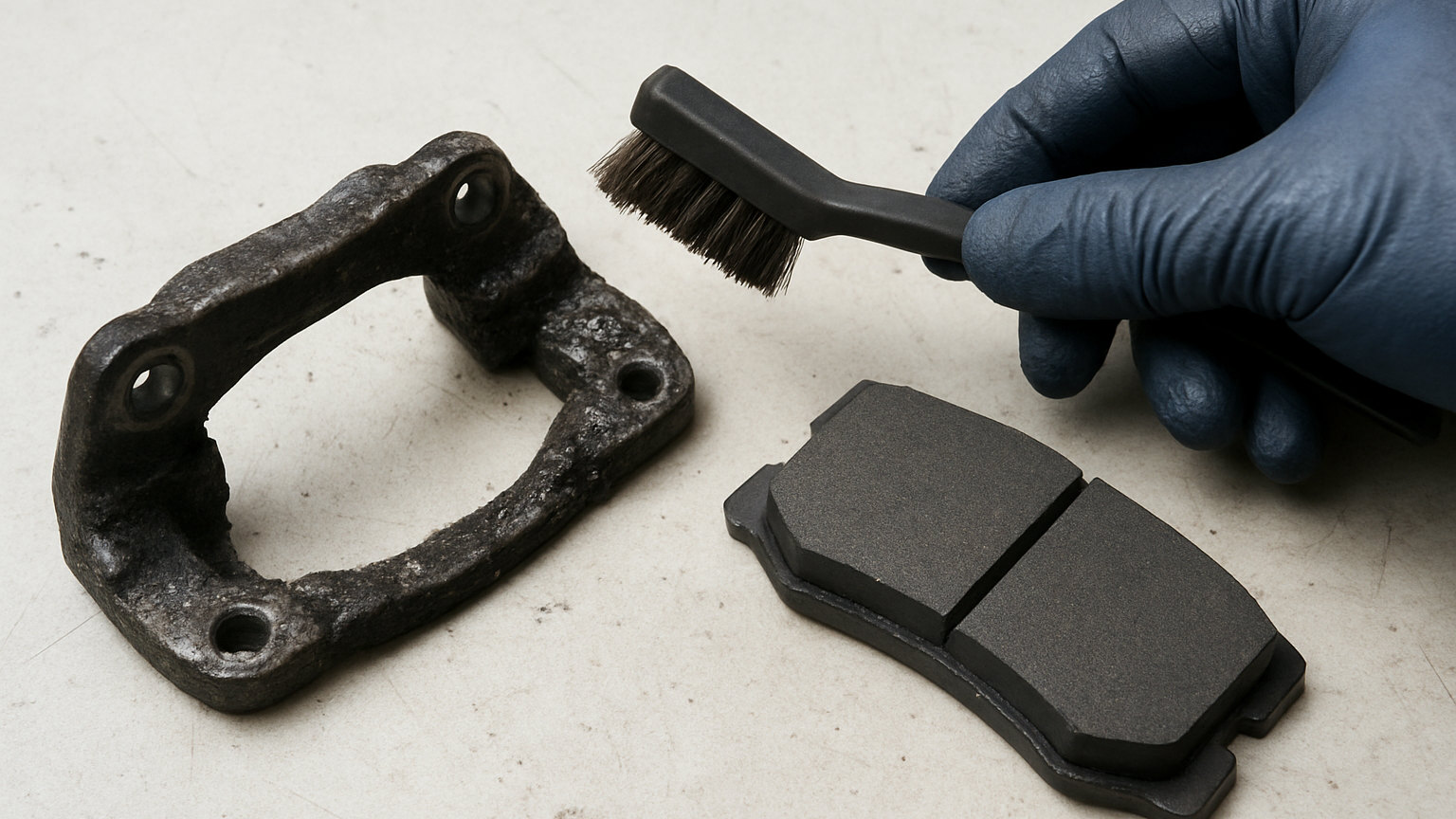
Squealing brakes immediately after paying for new pads is a particularly frustrating outcome, and it is common enough to be worth understanding. In most cases the pads themselves are not defective. The noise is reporting either the material chosen, something omitted during fitting, or a bedding process that has not yet completed, and each of those has a different remedy.
Should new pads be quiet immediately?
Not always. Some light noise during the first few hundred miles is normal while the pad surface conforms to the disc and a transfer layer builds. That should reduce steadily and disappear. What is not normal is a squeal that is present from the first application and remains unchanged after several hundred miles, which indicates something other than bedding.
Was the hardware replaced?
This is the most common cause. Pads sit in the carrier on stainless abutment clips and shims that damp vibration and hold them securely. Those corrode and should be replaced with every pad change. Where old clips are reused, the pad sits loosely and vibrates, which produces exactly this noise. Quality pad sets include a fitting kit, and it should be used rather than left in the box.
Was brake grease applied correctly?
A thin film of proper high temperature brake grease on the pad backing plate edges, the abutment contact points and the slide pins damps vibration and allows free movement. Applying none is a common shortcut and a common cause of squeal. Applying it to the friction surface is far worse, since it contaminates the pad and ruins it, so more is emphatically not better here.
Was the disc surface prepared?
New discs arrive with a protective coating that must be cleaned off before fitting. Existing discs carry a transfer layer from the old pads and should be lightly abraded so the new material can bed evenly. Skipping either leaves the new pads working against an unsuitable surface, which produces both noise and poor initial braking until it eventually wears through.
Is the pad material the problem?
Frequently. Harder semi metallic compounds are noticeably more prone to squeal than the softer organic or ceramic materials many cars are supplied with from new. A car that was quiet on its original pads and squeals on a budget replacement set is usually reporting the material rather than a fault. Fitting pads closer to the original specification generally resolves it.
Do cheap pads squeal more?
As a rule yes, for two reasons. The friction formulation is often more prone to resonance, and the set frequently arrives without the shims and hardware that better sets include. That combination makes noise considerably more likely. Since the labour to fit them is identical whichever pads go on, the saving is smaller than it appears once the job has to be revisited.
Can bedding in cure it?
Sometimes. A series of moderate stops from around thirty miles an hour, allowing cooling between each, helps the surfaces mate and can settle a mild squeal. It will not fix missing hardware or an unsuitable material. If the noise is unchanged after a proper bedding procedure and a few hundred miles, the cause is mechanical rather than a matter of time.
How should you raise it?
Promptly and factually with whoever fitted them, asking specifically whether a new fitting kit was used, whether the abutments were cleaned and whether brake grease was applied. Those questions usually identify the cause during the conversation, and most reputable workshops will recheck their own work. It is a reasonable request rather than a complaint.
Will it eventually go away?
Sometimes, if the cause is bedding or light glazing, in which case a few hundred miles of normal use settles it. If the cause is missing hardware or an unsuitable compound, it will not, and waiting simply means living with it for the life of the pads. A few weeks is a reasonable period to allow before concluding that something needs correcting.


