
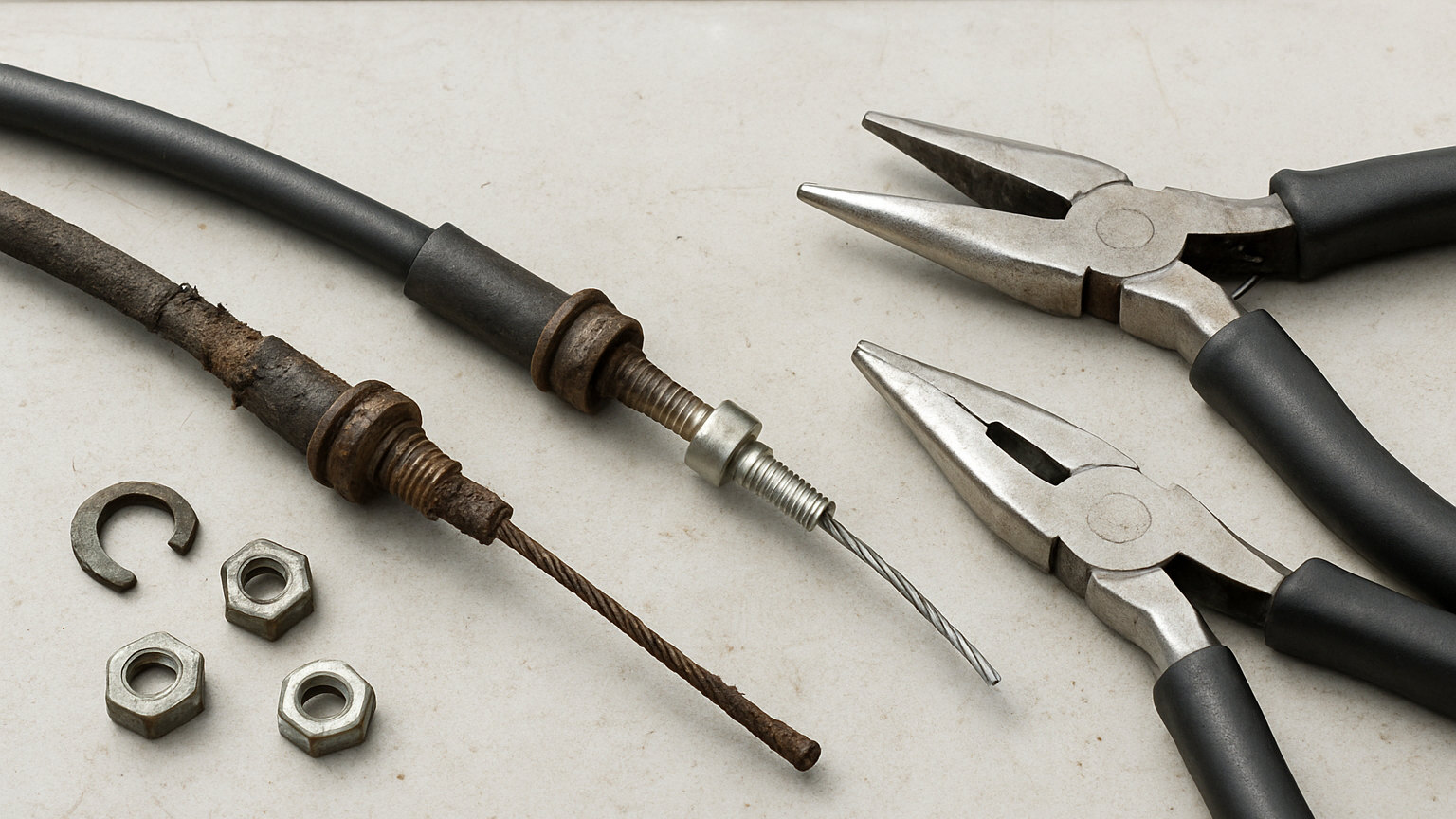
Handbrake noises are less familiar than ordinary brake noises because the system is used differently and, on many cars, is built differently as well. Some sounds are entirely normal operation, particularly on electronic systems, while others indicate cables seizing or friction material worn away. Knowing which is which prevents both unnecessary worry and ignoring something that matters.
How does a handbrake actually work?
On many cars with rear discs, a small drum brake sits inside the centre of the disc, operated by cables, and that is what the handbrake applies. On others the handbrake acts on the main rear caliper through a lever or a screw mechanism. Electronic parking brakes replace the cables with a motor on each rear caliper or a single actuator pulling cables.
What does grinding when the handbrake is applied mean?
On a drum in hat system it usually means the shoes have worn down to their backing, or the linings have come away and are contacting the drum surface directly. Because those shoes are hidden inside the disc, they are rarely inspected and can wear away unnoticed for years. It usually comes with a handbrake that holds poorly and needs more travel.
Why do the cables cause noise?
Handbrake cables run under the car in an exposed position and their outer sheaths crack, letting water in. The inner cable then corrodes and binds, which produces a graunching or twanging as it moves and, more importantly, prevents the brake releasing fully. A partially applied rear brake drags, overheats and wears rapidly, which is a more serious consequence than the noise.
Is clicking normal?
On a conventional lever handbrake, the clicking as you pull it is the ratchet mechanism and is entirely normal. What matters is how many clicks it takes to hold the car. A handbrake that needs noticeably more travel than it used to is telling you the cables have stretched or the shoes have worn, and it will eventually fail its MOT efficiency test.
What noises do electronic parking brakes make?
A whirring or buzzing from the rear as the motors apply and release is completely normal, and most systems make it every time. Some also perform a self test that produces a brief noise after starting. What is not normal is a grinding, a motor that runs for far longer than usual, or a system that fails to release with a warning message.
Why does the rear brake grind after standing?
Because leaving the handbrake applied holds the shoes or pads against the drum or disc, and corrosion forms at that contact point. When you release it, the bond breaks with a bang or a grinding for the first few rotations. After long storage the bond can be strong enough to hold the car, which is why leaving a car in gear rather than on the handbrake is recommended.
Can the drum in hat system be inspected?
Only by removing the rear disc, which is why it is so often overlooked. Since the shoes do very little work, they can last a great many years, but they also collect rust and debris and their adjusters seize. Having them inspected when rear discs are replaced is sensible, and it is worth asking whether it was done rather than assuming.
What should you do about handbrake noise?
Establish whether it accompanies poor holding performance, since that changes the urgency. Test it on a slope and count the travel. A handbrake that grinds and holds poorly needs inspection promptly, both for safety and because it is an MOT test item. A handbrake that clicks normally and holds firmly on a hill is generally behaving as intended.
How is it tested at the MOT?
For efficiency on the roller brake tester, as a percentage of the vehicle weight, and it fails a surprising number of cars. Cable systems stretch and seize, and handbrakes on cars used mainly on level ground quietly deteriorate through lack of firm use. Trying it on a slope occasionally is a reasonable way of noticing before the test does.


