
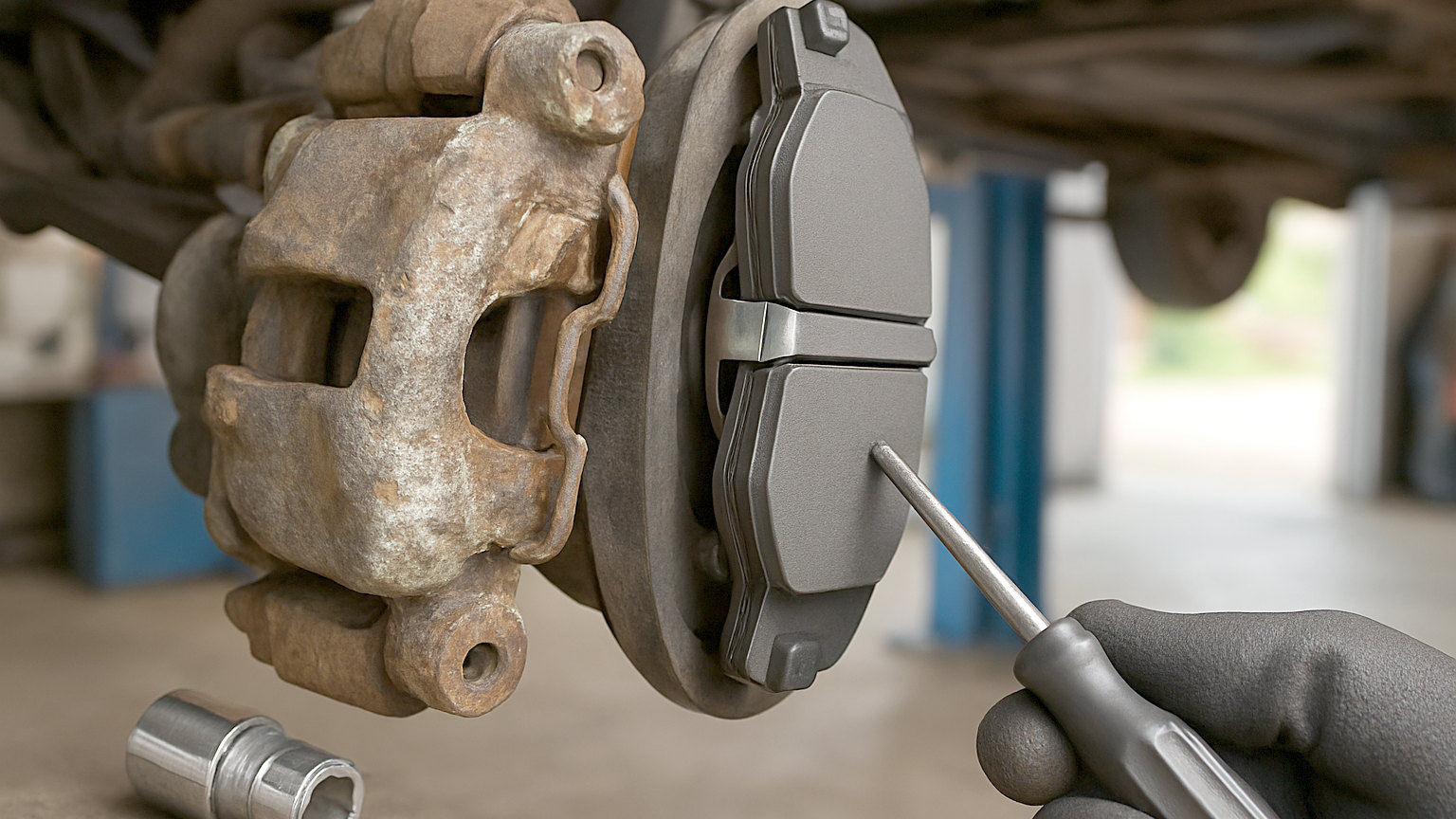
A rattle from the wheel area over rough surfaces that stops instantly when you touch the brake pedal is a genuinely diagnostic symptom. Touching the pedal clamps the pads against the disc, so anything that stops rattling when you do that must be a pad or something adjacent to it that is free to move. It is usually inexpensive to correct.
Why are the pads free to move at all?
Because they must be. A pad has to slide in its carrier as it wears and as the caliper floats, so it cannot be clamped rigidly. Manufacturers fit anti rattle springs and stainless clips that hold the pad under light tension without preventing that movement. When those corrode, collapse or are omitted, the pad has clearance and no tension, so it rattles over bumps.
What is an anti rattle spring?
A small spring steel clip, sometimes a separate part and sometimes integrated into the pad or the shim, that presses the pad against one face of its carrier. Its only purpose is to remove the free play that causes noise. They are inexpensive, they are supplied in quality pad fitting kits, and they are among the most commonly omitted parts in a rushed brake job.
Why does it appear after new pads?
Because the old clips were reused rather than replaced, or the fitting kit was not used. New pads sit in a carrier whose abutments have corroded and been cleaned, so the fit is looser than original, and without fresh hardware there is nothing holding the pad steady. That is why a rattle appearing within days of a brake service usually points at what was left out.
Could it be the dust shield?
Frequently, and it is worth checking because it costs nothing. The thin metal shield behind the disc corrodes and its edge can catch or vibrate against the disc, producing a rattle or scrape over bumps. Bending it gently clear resolves it. A shield that has corroded away entirely is not a safety matter, though it lets more water and grit reach the disc.
What about the caliper itself?
A caliper with worn slide pins or bushes can move enough to rattle over rough surfaces. That is more significant than a loose pad, since the same wear prevents the caliper applying the pads evenly and causes uneven wear. Checking the pins for play, and replacing worn bushes and boots, is worth doing while the pads are out anyway.
Does it matter?
Less than most brake noises, since the braking is unaffected and a rattling pad still works normally. What matters is that a pad free to move is also free to sit at a slight angle, which produces tapered wear, and that the missing hardware allowing the rattle is the same hardware that stops the pad binding later. So it is worth correcting rather than tolerating.
How do you confirm it is the brakes?
Drive slowly over a rough surface and touch the brake pedal lightly without slowing appreciably. If the rattle stops the instant you do, it is brake related. If it continues unchanged, it belongs to the suspension, most likely a drop link or a worn bush. That single test takes seconds and it saves investigating the wrong system entirely.
What is the fix?
Removing the pads, cleaning the carrier abutments, fitting a new hardware kit including anti rattle springs, and applying a thin film of brake grease to the contact points. It takes under an hour and the parts cost very little. If it followed a recent brake service, it is reasonable to ask the workshop to correct it rather than paying twice.
Could it be something else entirely?
Occasionally. A loose wheel trim, a stone caught in the tread or a heat shield that has lost a fixing all rattle over bumps and none respond to the brake pedal. That is exactly why the pedal test is worth doing first, since it separates brake components from everything else in a few seconds.


