
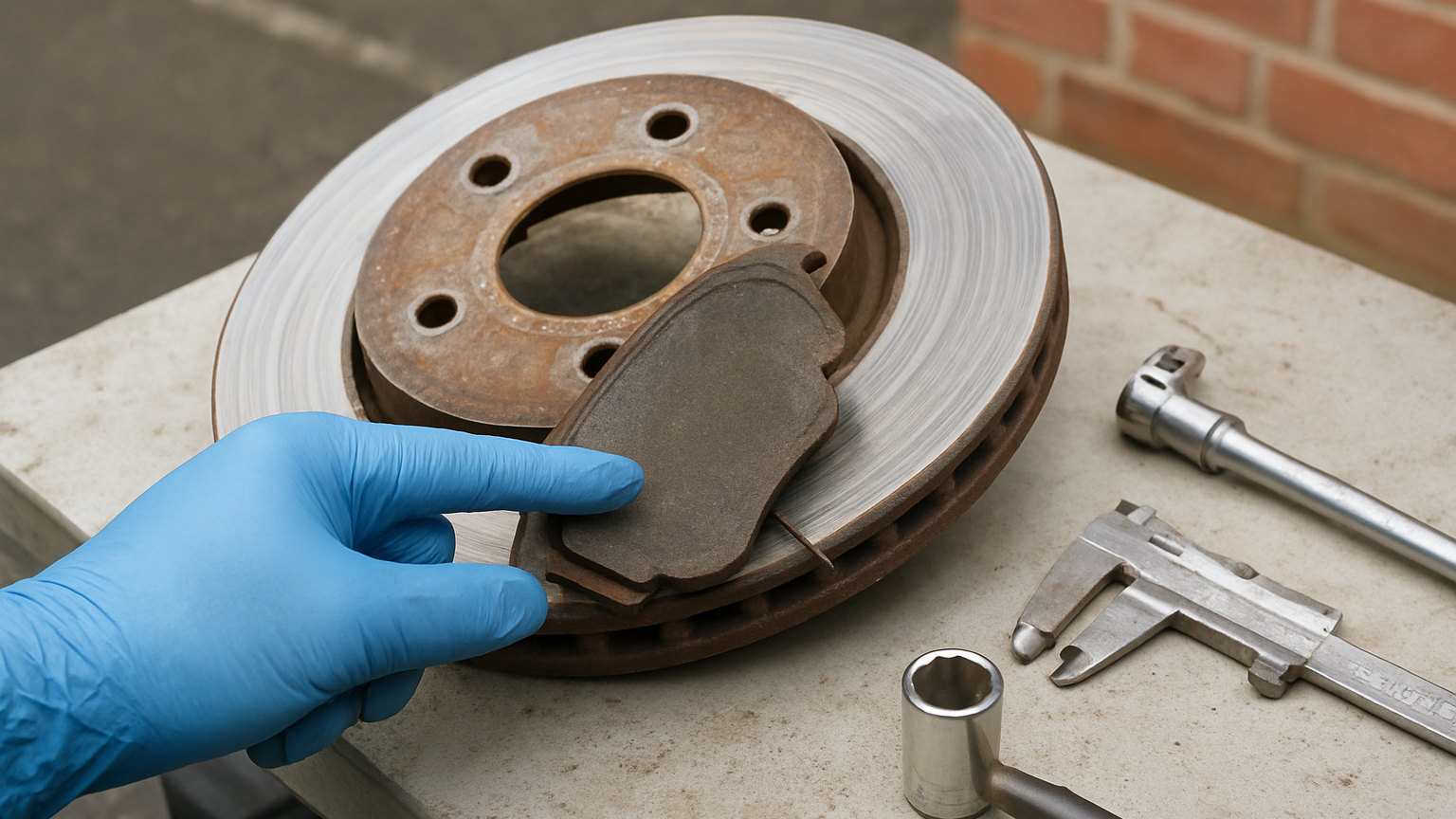
A brake wear indicator is a deliberate warning built into the pad, designed to tell you the friction material has reached its minimum before the backing plate reaches the disc. There are two types, mechanical and electronic, and both do the same job in quite different ways. Recognising the warning matters, because the alternative is discovering the wear through grinding, which is far more expensive.
How does a mechanical indicator work?
A small spring steel tab is riveted to the pad backing plate, positioned so that once the friction material has worn to a set thickness the tab contacts the disc. Metal against rotating cast iron produces a high pitched squeal, and it is deliberately designed to be unpleasant. It is simple, cheap and reliable, and it requires no wiring or electronics whatsoever.
What is the characteristic pattern?
The squeal usually appears when driving without braking, or under light braking, and disappears when the pedal is pressed firmly. That is because pressing hard pushes the pad against the disc and pinches the tab, silencing it. That pattern, noise that stops when you brake properly, is close to diagnostic and it distinguishes a wear indicator from most other brake squeals.
How does an electronic sensor work?
A wire is embedded in the pad at the minimum thickness position, forming part of a circuit. As the pad wears down, the disc cuts through the wire, breaking or completing the circuit and illuminating a dashboard warning. It is more civilised than a squeal and it works whether or not you are paying attention, which is why premium vehicles favour it.
Do the sensors need replacing?
Yes, and it is frequently missed. Once a wear sensor wire has been cut through it cannot be reused, so a new one is required with the new pads or the warning light stays on. Sensors are usually sold separately from the pads, which is why a quote should be checked to confirm they are included on cars that use them.
Are indicators fitted to every pad?
No, and this is worth understanding. Typically only one pad per axle carries an indicator, sometimes only one wheel. If the pad without the indicator wears faster, which happens when slide pins are sticking, the warning may never sound even though the pads are finished. That is why a visual inspection at each service is more reliable than waiting for a noise.
How much life remains when it sounds?
Not much, and it should be treated as a request for action rather than an early notice. Indicators are usually set to trigger at around two to three millimetres of remaining material, which is a matter of a few hundred to a couple of thousand miles depending on use. Continuing to drive for months after it sounds is how discs get destroyed.
Can it sound when the pads are fine?
Occasionally. A tab bent during fitting can contact the disc prematurely. A pad fitted the wrong way round can put the indicator on the wrong edge. And rust building up on the disc edge can catch a tab. Those cases are less common than genuine wear, so the sensible approach is to inspect rather than assume the warning is false.
What should you do when you hear it?
Have the pads measured within the next week or two rather than at the next service. Ask for the remaining thickness in millimetres on all four corners, since that tells you whether the rears need doing at the same time. Acting at this point means replacing pads only, which is exactly what the indicator exists to achieve.
Do all cars have them?
Most do in some form, though not always on every wheel and not always on both pads. Some vehicles rely entirely on the service inspection instead. If you are unsure whether your car has an indicator, the safest assumption is that it does not, and that a visual check of pad thickness is what will tell you when replacement is due.


