
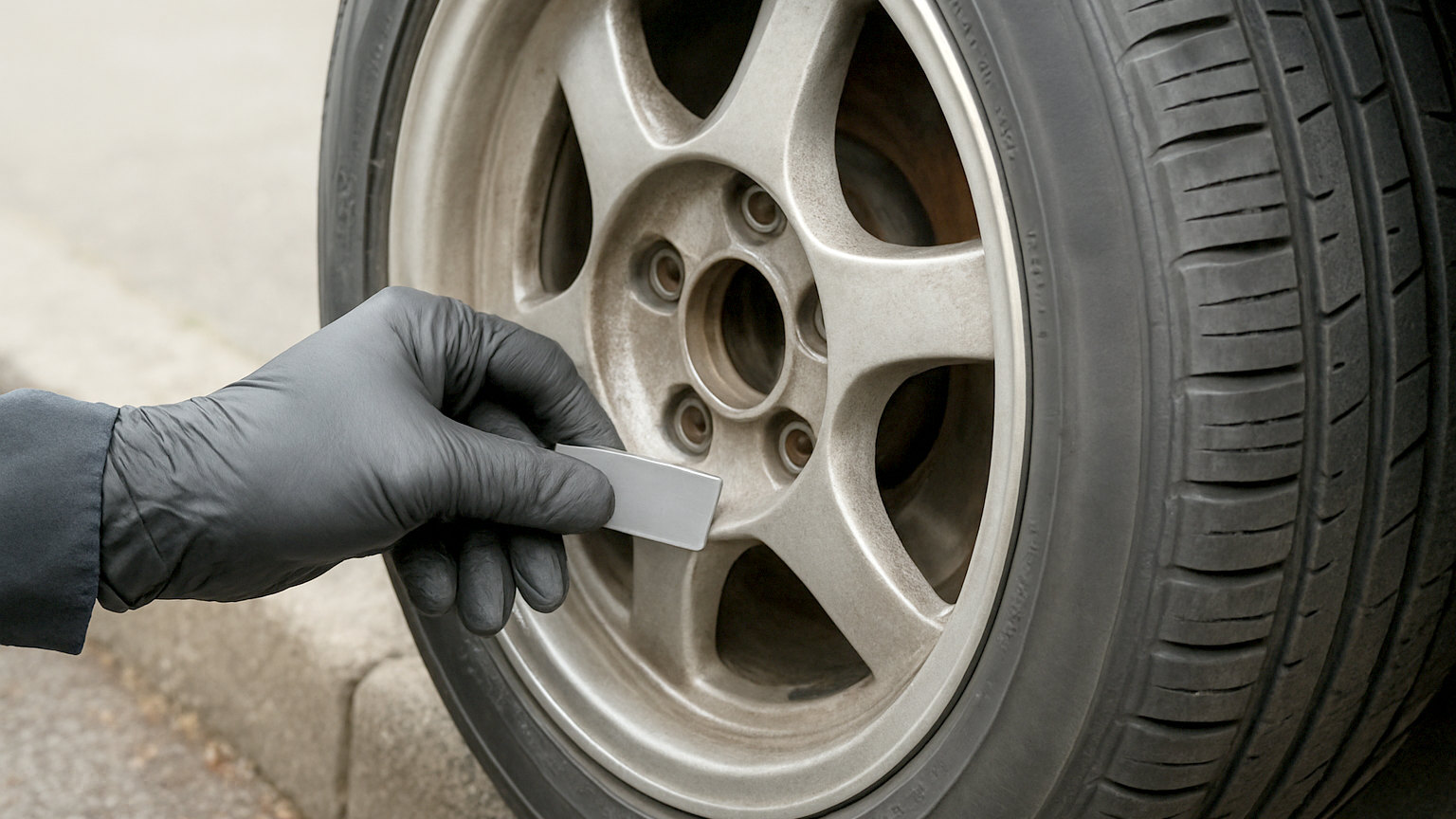
A wheel and tyre assembly is never perfectly uniform. The tyre has a joint where the tread was assembled, the valve adds mass at one point, and manufacturing tolerances mean the material is not distributed evenly. Balancing measures that uneven distribution and corrects it by adding small weights, and it is one of the most routine and most misunderstood operations carried out on a car.
What is the difference between static and dynamic balance?
Static balance concerns whether the wheel is heavier on one side of its axis, which causes it to bounce vertically as it rotates. Dynamic balance concerns whether the mass is distributed evenly across the width of the wheel, which causes it to wobble side to side. A modern balancer measures both and specifies weights for the inner and outer rim accordingly.
Why does balance get lost?
Weights fall off, which is the most common reason. Stick on weights fail when applied to a dirty or wet rim, or after strong wheel cleaning chemicals attack the adhesive. Clip on weights are knocked off by kerbs. Beyond that, the tyre wears unevenly over its life, which changes the distribution of mass, and dirt or snow packed inside the rim adds weight at a random point.
How often should wheels be rebalanced?
Whenever a tyre is fitted or removed, and whenever a vibration appears. Some suggest rechecking every ten to fifteen thousand miles, which is reasonable if the wheels are off for other work anyway. What matters more is having it done when there is a symptom, since a balance that was correct when set stays correct until something changes.
What is road force balancing?
A more capable method that presses a loaded roller against the tyre while it spins, simulating the tyre carrying the weight of the car. It measures not only mass distribution but variation in stiffness and roundness, which conventional balancing cannot detect. It is the answer when a wheel balances perfectly on a standard machine and still vibrates on the road.
Why does mounting matter?
Because a wheel balanced perfectly off the car will still vibrate if it is not mounted squarely. Rust or debris on the hub face prevents the wheel seating flat. Many aftermarket wheels are centred by the bolts rather than by the hub spigot, which is less precise unless the correct spigot rings are used. Cleaning the hub face before fitting is a genuinely important step.
Can a balancer be wrong?
It can if it is poorly calibrated, if the wheel is mounted on the machine with dirt on the cone, or if the operator selects the wrong weight positions. Balancing is a skilled operation despite appearing automatic. If a wheel has been balanced twice by the same machine and still vibrates, having it checked elsewhere is a reasonable next step.
Should all four be balanced?
When investigating a vibration, yes, since rear imbalance is easily overlooked and produces a shake through the seat rather than the wheel. When one tyre is being replaced, balancing that one is normally sufficient. Asking for all four is inexpensive relative to the diagnostic time saved when the vibration turns out to be at the other end of the car.
Does balancing fix everything?
No, and it is worth knowing where its limits are. It cannot correct a buckled rim, a tyre that is out of round, a worn hub bearing, a bent driveshaft or a suspension joint with play. If a vibration persists after correct balancing, the cause is one of those and further balancing attempts will not help.
Why does it matter beyond comfort?
Because an imbalanced wheel applies a rotating force to its bearing, suspension joints and tyre thousands of times a minute. It accelerates bearing wear, produces uneven tyre wear that then makes the imbalance worse, and adds fatigue to suspension components. Correcting it is inexpensive and it protects considerably more expensive parts.


