
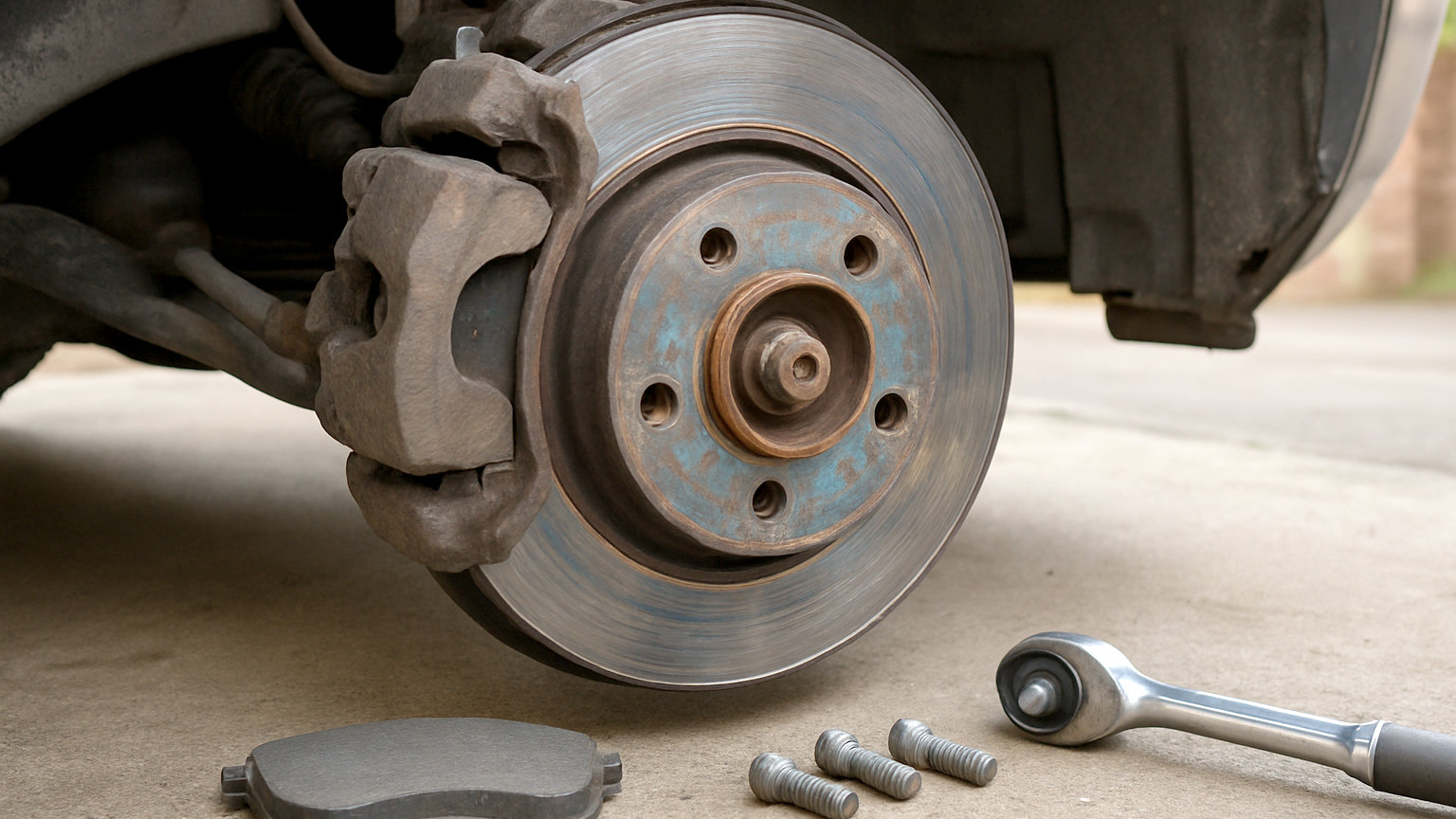
A vibration that appears only when you press the brake pedal and disappears the instant you release it is coming from the braking system. That is unusually definitive as symptoms go, and it narrows the possibilities to a handful of components. The next question is where you feel it, because that separates front from rear about as reliably as any test.
Where do you feel it?
Through the steering wheel usually means the front brakes, since the front hubs are connected directly to the steering. Through the brake pedal and the seat usually means the rear, or both axles together. A pulsing pedal with little steering movement often points rearwards. It is a generalisation rather than a rule, but it is a reliable starting point.
Are the discs actually warped?
Rarely in the literal sense. The usual cause is disc thickness variation, where the disc has worn unevenly so that thicker and thinner sections pass through the caliper as it rotates. The pads are pushed in and out slightly with each revolution, producing the shudder. Genuine buckling from heat happens but it is far less common than the term suggests.
What causes thickness variation?
Uneven pad deposits, most often. When a hot brake is held stationary, such as sitting at traffic lights immediately after heavy braking, friction material transfers onto the disc in a patch. That patch is harder than the surrounding cast iron and wears the surrounding area faster, so a difference in thickness develops and grows. Corrosion after a period of standing can start the same process.
Can it be caused by fitting?
Frequently. Rust or debris on the hub face means a new disc sits fractionally out of true from the moment it is fitted, producing runout that develops into thickness variation within a few thousand miles. Wheel bolts tightened unevenly or with an impact gun rather than a torque wrench can distort a disc. This is why hub cleaning and correct torque matter more than the brand of disc.
Could it be something other than discs?
Yes. A seized caliper slide pin makes one pad drag continuously, which overheats that area of the disc and creates variation. A worn wheel bearing allows the hub to move under braking load. Worn suspension bushes or ball joints let the whole assembly shift when braking force is applied. Each produces judder that only appears under braking while having nothing to do with the discs themselves.
Does it get worse over time?
Almost always, because the process is self reinforcing. A thicker area receives more pad contact, which transfers more material, which increases the difference. What starts as a barely perceptible shudder at motorway speeds becomes a shake through the whole car within a few thousand miles. Catching it early occasionally allows the discs to be saved.
Can discs be skimmed rather than replaced?
They can, using an on car lathe that machines the disc in position on the hub, which also corrects any runout caused by the hub itself. It is a legitimate repair provided sufficient thickness remains above the minimum stamped on the disc. Whether it is economic depends on the car, since on many vehicles new discs cost little more than the machining.
What should be done alongside?
Clean the hub faces thoroughly, check the caliper slide pins move freely and regrease them, fit new pads with the discs, and tighten the wheels with a torque wrench in the correct sequence. Skipping those steps is the most common reason judder returns within a year on a car that has just had new discs fitted.
Can driving habits prevent it?
To an extent. Avoid holding the car on the brake pedal at a standstill immediately after heavy braking, since that is exactly the condition that transfers pad material onto a hot disc in one spot. Rolling forward slightly, or using the handbrake instead, lets the disc cool evenly and genuinely reduces the chance of variation developing.


