
A vibration that appears when you accelerate and disappears the moment you lift off, at the same road speed, is behaving very specifically. Road speed has not changed, so the wheels and tyres are doing exactly what they were doing a second earlier. What has changed is the direction and magnitude of load through the driveline, which points at something with play in it being pushed one way and then released.
What is the most common cause?
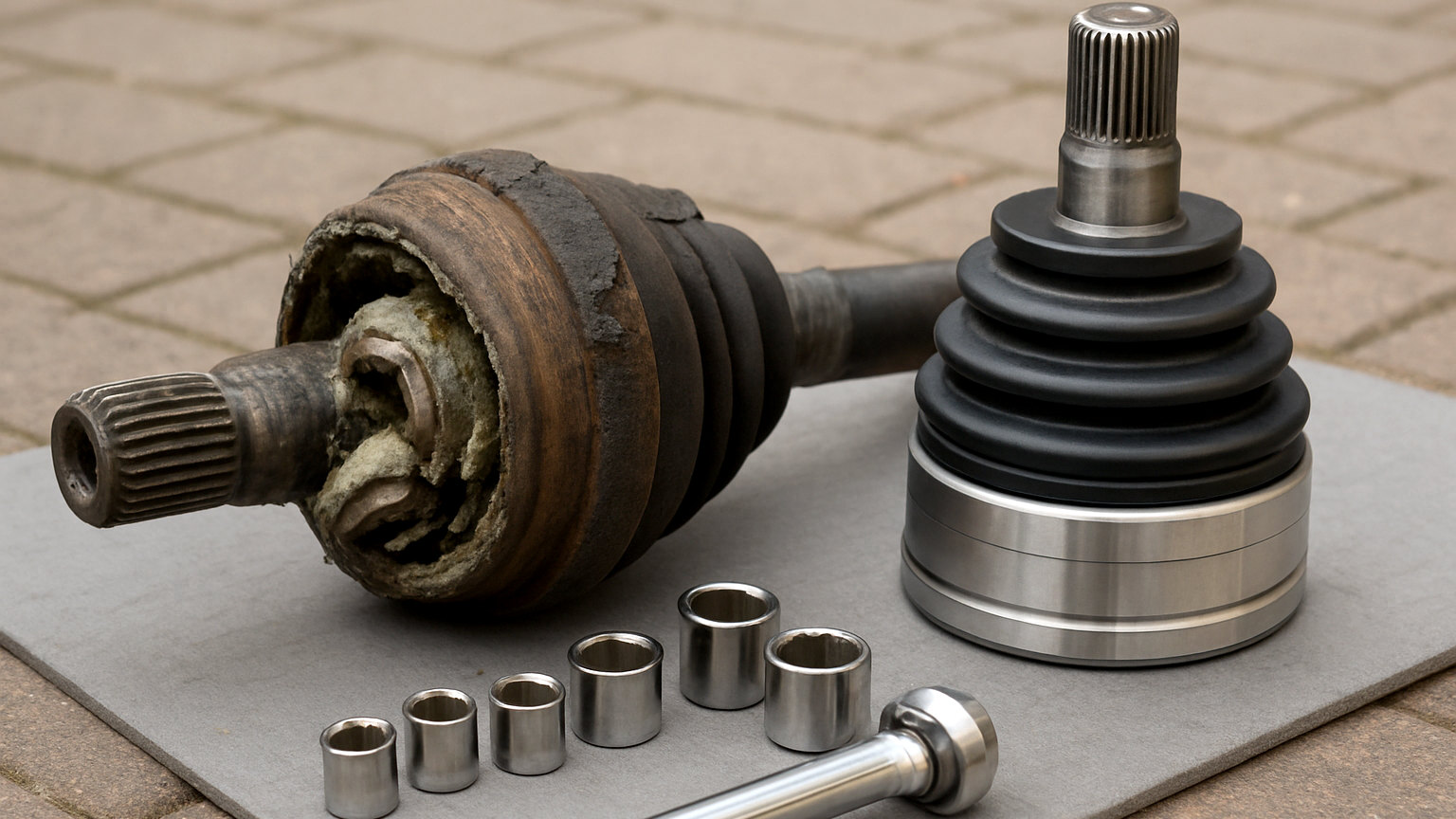
An inner constant velocity joint on a driveshaft, particularly on front wheel drive cars. Unlike the outer joint, which clicks on full lock, the inner joint plunges in and out as the suspension moves and it is the one that produces vibration under load. A worn inner joint gives a shudder under acceleration that smooths out immediately when you lift off.
How do engine mounts cause it?
By allowing the engine and gearbox to move under torque. A perished or collapsed mount lets the whole assembly twist when power is applied, which transmits vibration into the body and can also change driveshaft angles enough to produce their own vibration. It is one of the cheapest possible causes and it is worth checking before anything is dismantled.
How do you check the mounts?
With the handbrake firmly applied and the car in gear, have someone blip the throttle while you watch the engine from a safe distance outside. A small amount of movement is normal; the assembly lifting or twisting noticeably is not. Visible cracking, separation of the rubber from the metal, or a hydraulic mount weeping fluid all confirm it.
Does it happen more in one gear?
Often, and it is informative. Vibration that is worst in a lower gear where torque multiplication is greatest points at a load related fault such as a mount or a joint. Vibration that appears at the same road speed regardless of gear points more towards a rotating component turning at wheel speed. Testing the same speed in two gears is a quick way of separating these.
Could it be the propshaft?
On rear or four wheel drive cars, yes. Worn universal joints, a failed centre bearing or a propshaft that has lost a balance weight all produce vibration that is worse under load. The centre bearing rubber perishes and allows the shaft to move, which is a common failure on higher mileage vehicles and produces exactly this pattern.
Can it be the gearbox or clutch?
Sometimes. A worn dual mass flywheel produces vibration under load at low revs, often with a rattle at idle alongside. A clutch judder appears when taking up drive rather than during steady acceleration, which distinguishes it. A slipping automatic can produce a shudder as the torque converter lock-up clutch slips, usually at a steady cruise rather than under hard acceleration.
Is torque steer the same thing?
No, though it is often confused with it. Torque steer is the tendency of a powerful front wheel drive car to pull to one side under hard acceleration, caused by unequal driveshaft lengths and geometry. It is a characteristic rather than a fault. If the car pulls rather than vibrates, and it has always done so, that is likely what you are feeling.
How is it diagnosed properly?
By inspecting the driveshaft boots for splits and grease, checking each joint for play, examining the mounts, and where appropriate carrying out a road test with a technician feeling for the point at which it appears. Split boots are the clearest early sign, since a joint that has lost its grease will fail, and replacing a boot early is far cheaper than replacing a shaft.
How urgent is it?
Moderately. A worn inner joint will continue working for some time while getting progressively worse, so there is usually time to plan the repair. What should not wait is a split boot, since every week without grease shortens the joint life considerably and turns a cheap repair into a shaft replacement.


