
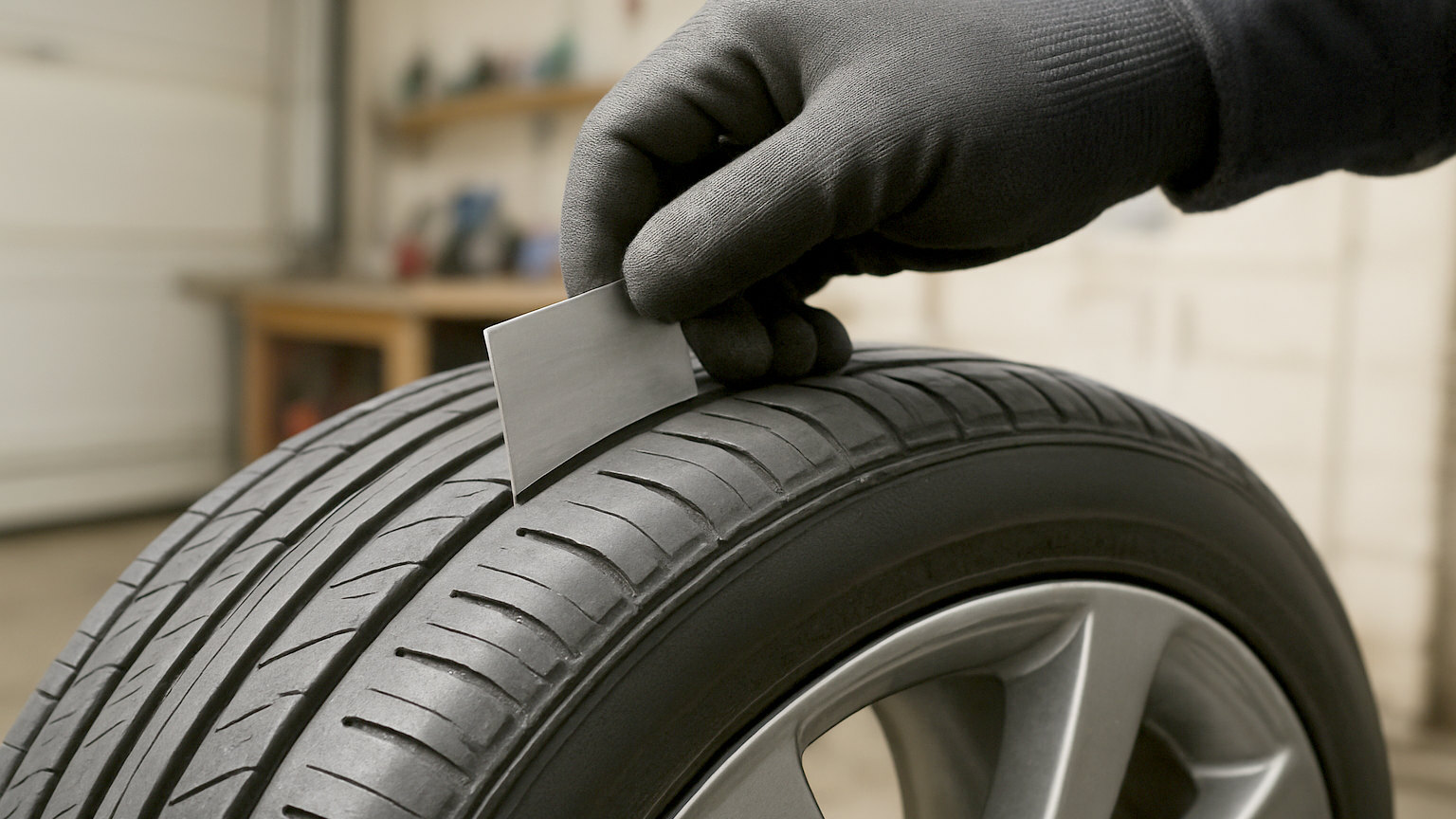
It is a common and frustrating situation: the wheels have been balanced, the printout shows everything within tolerance, and the car still vibrates. The explanation is usually that balancing corrects one thing only, which is the distribution of mass around the axis. A tyre can be perfectly balanced and still be the wrong shape, and no amount of adding weights addresses that.
What does out of round mean?
That the tyre is not a perfect circle, so its effective radius varies as it rotates. The wheel therefore rises and falls slightly with each revolution regardless of how the mass is distributed. It produces a vibration that behaves much like imbalance and cannot be cured by balancing. It can result from manufacturing variation, from damage, or from uneven wear.
What is a shifted belt?
A construction fault where the steel belts inside the tyre have moved out of position, either from a manufacturing defect or from impact damage. It produces a bulge or a distortion that makes the tyre run untrue. Sometimes it is visible as a wobble when the wheel is spun slowly, and sometimes it is only detectable under load. It usually means the tyre must be replaced.
What is road force variation?
A measurement of how much the force between the tyre and the road changes through a revolution, caused by variation in stiffness and roundness rather than in mass. A tyre can be uniform in weight and still have a stiff spot that pushes harder against the road once per revolution. It is precisely what a conventional balancer cannot see.
How does a road force balancer help?
By pressing a loaded roller against the tyre while it spins, simulating the weight of the car. It measures the variation directly and reports it as a figure, and it can also recommend rotating the tyre on the rim so that its stiff spot aligns with any low spot in the wheel, which cancels part of the effect. That process is called match mounting.
Can a tyre develop a flat spot?
Yes, particularly after standing for weeks in cold weather, where the section resting on the ground takes a set. It usually works out within a few miles of driving as the tyre warms and flexes. A flat spot that does not disappear after a proper drive suggests the tyre has taken a permanent set, which is more likely on older or harder compound tyres.
What about damage from a puncture repair?
A repair carried out incorrectly, or a tyre that has been driven on while flat, can suffer internal damage that produces vibration afterwards. Running a tyre at very low pressure destroys the sidewall internally even when it looks acceptable once reinflated. If a vibration appeared after a puncture, the repair and the tyre condition are the obvious suspects.
How do you confirm the tyre is responsible?
By swapping wheels around the car and seeing whether the vibration moves with them. If moving the front wheels to the rear moves the vibration from the steering wheel to the seat, a wheel or tyre is carrying it. That single test costs nothing and it is far more definitive than any number of balance attempts.
What if it is a new tyre?
Manufacturing defects do occur, and reputable manufacturers and retailers will investigate a new tyre that cannot be balanced or that measures poorly for road force. Keep the fitting invoice and raise it promptly rather than living with it, since a claim is far easier to make on a nearly new tyre than on one that has covered ten thousand miles.
Is it worth pursuing?
Yes, because a tyre that is not running true is loading the bearing and suspension repeatedly and wearing itself unevenly in the process. It also makes the car tiring on long journeys. If two balance attempts have failed, asking specifically for a road force measurement is the logical next step rather than a third attempt at the same test.


