
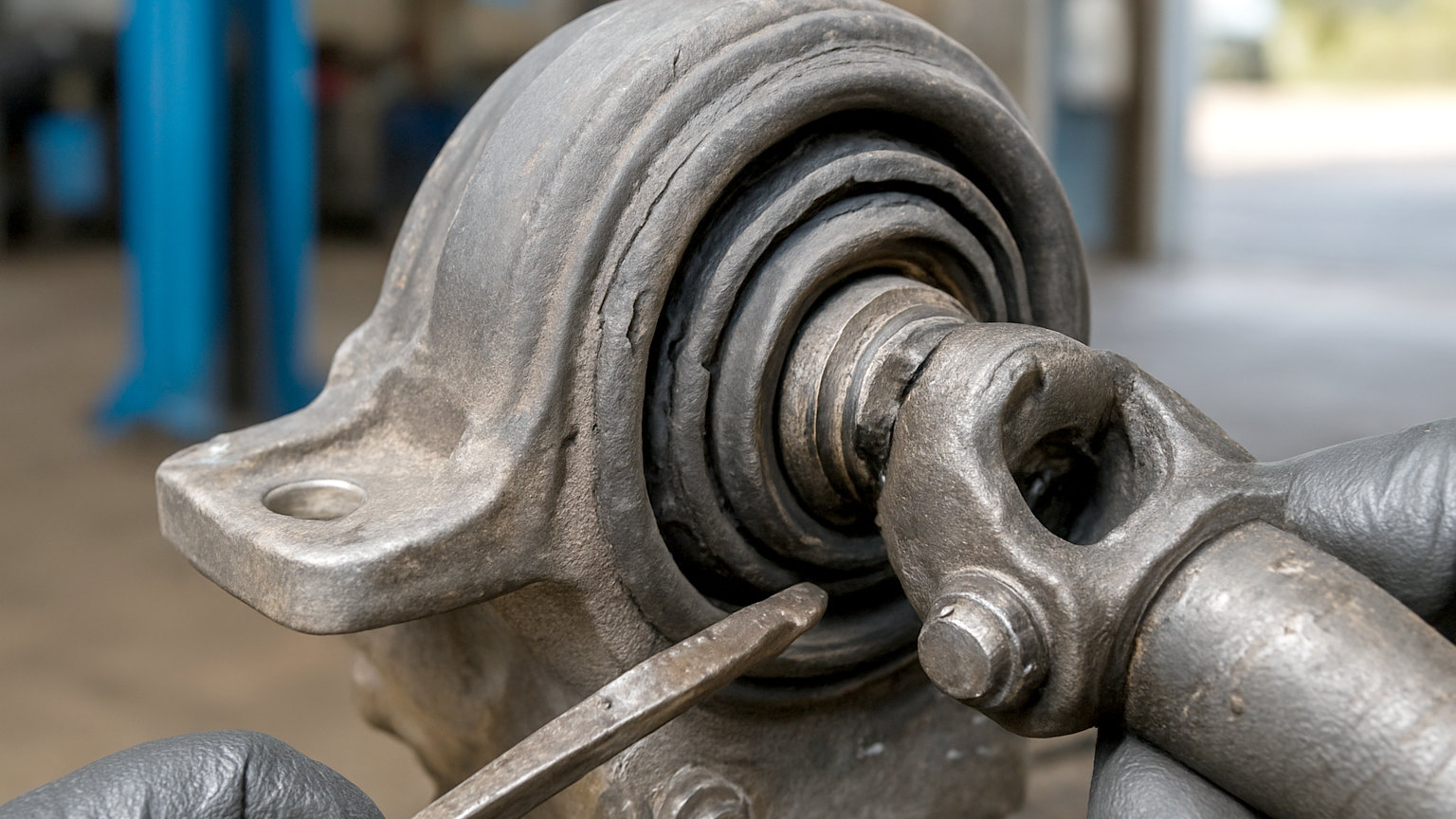
On a rear wheel drive or four wheel drive car, a propshaft runs from the gearbox to the rear differential along the length of the floor. It spins faster than the wheels, it is supported by joints and often a centre bearing, and it is balanced as an assembly. When any of that deteriorates, the result is vibration felt through the floor and seat rather than the steering wheel.
What are the universal joints?
Cross shaped joints with needle roller bearings in each arm, allowing the shaft to transmit drive while the axle moves up and down relative to the body. They are greased and sealed, and on many modern shafts they are not serviceable. When the needle rollers wear or the grease dries, the joint develops play, producing vibration and a clunk when taking up drive.
How do you test a universal joint?
With the car safely raised and in neutral, grip the shaft either side of the joint and try to twist it in opposite directions. Any perceptible movement between the two halves indicates wear. Rust coloured dust around the joint bearing caps is a classic sign that the grease has gone and the needle rollers are running dry, and it is visible without any tools.
What is the centre bearing?
On longer vehicles the propshaft is made in two sections, supported in the middle by a bearing mounted in a rubber carrier bolted to the floor. The rubber perishes with age and heat, allowing the shaft to move, and the bearing itself can wear. Symptoms are vibration at particular speeds, a rumble from under the centre of the car, and sometimes a clunk on pulling away.
Why does balance matter so much?
Because a propshaft rotates faster than the wheels, often three or four times faster, so any imbalance generates force at a much higher frequency. Shafts are balanced with small weights welded to them, and a lost weight, accumulated mud, or a dented tube will produce vibration that increases with speed. Undersealing a propshaft unevenly can also unbalance it, which surprises people.
Are the shaft angles important?
Considerably. Universal joints produce a slight speed variation through each rotation when operating at an angle, and the design cancels that by pairing joints at matched angles. Changing ride height, whether by lowering or by a sagging rear spring, alters those angles and can introduce vibration. A car lowered without considering driveline angles frequently develops exactly this complaint.
What does a failing joint sound like?
A clunk when taking up drive, particularly changing from reverse to forward or lifting off and reapplying the throttle, caused by play being taken up. As it worsens, a vibration develops that increases with speed and is often worse under load. Left long enough, a universal joint can fail completely, which allows the shaft to drop and is a serious event at speed.
Can joints be replaced individually?
On older shafts with serviceable joints, yes, and it is a straightforward repair for a specialist. Many modern shafts have joints that are not designed to be replaced, so the options are an exchange reconditioned shaft or a specialist repair. Propshaft specialists exist precisely for this, and they can also rebalance the shaft afterwards, which a general garage cannot.
How urgent is it?
More than most vibrations. A propshaft joint that fails completely can allow the shaft to contact the road or the underbody at speed, which is genuinely dangerous. Vibration accompanied by a clunk on drive take up should be inspected promptly rather than monitored, and rust dust around a joint is a clear signal that failure is developing.
What should be checked alongside?
The differential and gearbox mountings, since worn ones change the shaft angles and produce similar symptoms. The rear differential oil level and any leak from its input seal. And the exhaust mountings, since a system contacting the propshaft tunnel produces noise easily mistaken for a driveline fault.


