
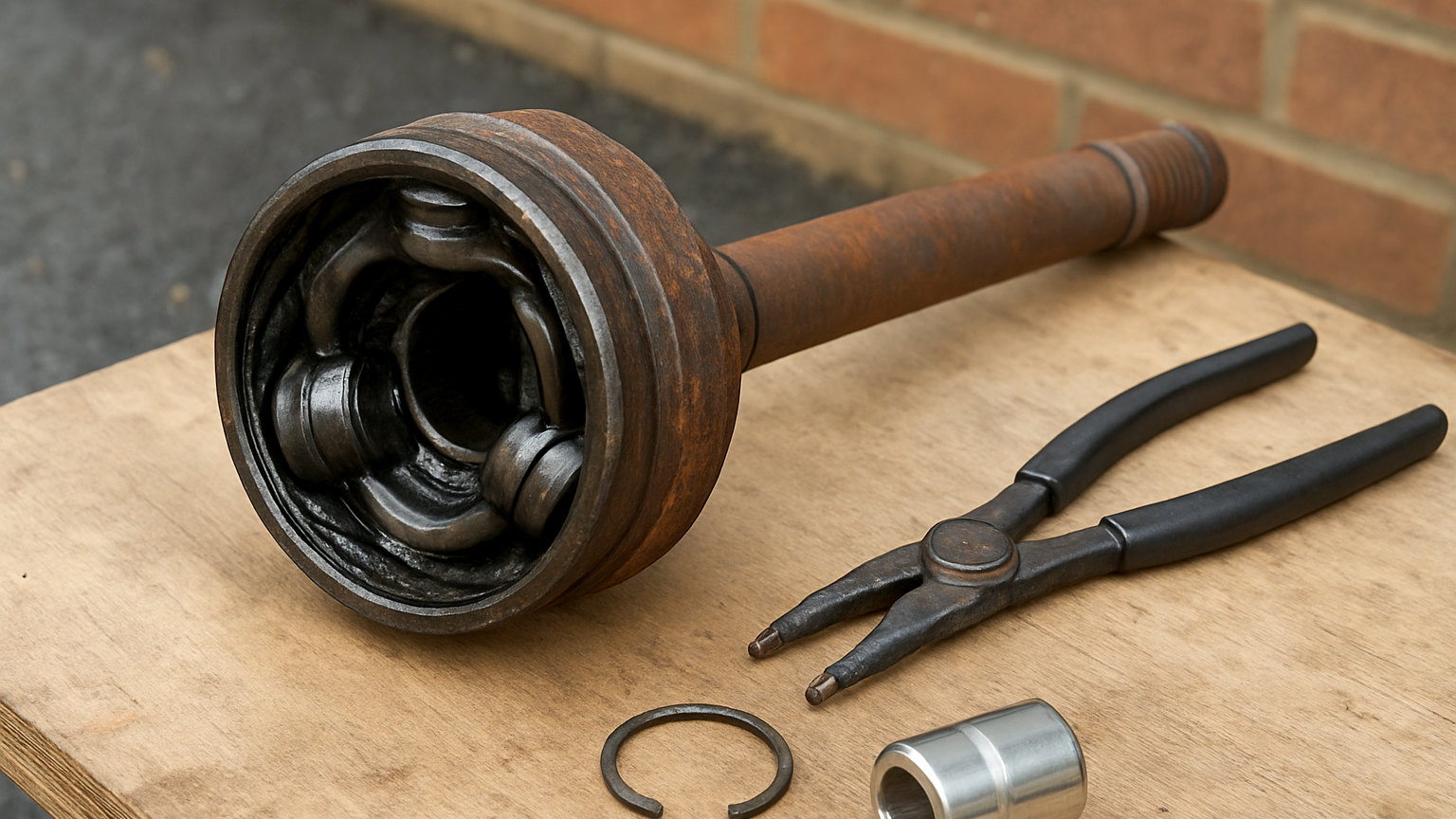
Driveshafts transmit power from the gearbox to the wheels while the suspension moves up and down and, at the front, while the wheels steer. They manage that using constant velocity joints at each end, and those joints produce two quite different symptoms depending on which one is worn. Knowing which is which turns a vague vibration into a specific diagnosis.
What does an outer joint do?
It sits at the wheel end and allows the shaft to transmit drive through the steering angle. When it wears, the classic symptom is a rhythmic clicking or knocking when turning tightly under power, most obvious manoeuvring in a car park or pulling out of a junction. The clicking rate follows wheel speed and it is usually worse turning one way than the other.
What does an inner joint do?
It sits at the gearbox end and, as well as allowing angular movement, it must plunge in and out as the suspension travels, since the distance between gearbox and hub changes. That plunging design is why a worn inner joint produces vibration rather than clicking. The symptom is a shudder under acceleration that disappears the moment you lift off.
Why do the boots matter so much?
Because the joint is packed with grease and sealed by a rubber boot, and the boot is the only thing keeping grease in and grit out. Once it splits, the grease is flung out within days and road contamination enters. From that point the joint is destroying itself. A split boot caught early can be replaced with fresh grease for a fraction of the cost of a new shaft.
How do you spot a split boot?
Grease sprayed around the inside of the wheel arch and along nearby suspension components is the giveaway, and it is often visible without raising the car. Turning the steering to full lock exposes the outer boot for inspection. The concertina folds should be intact with no cracks or tears, and the retaining clips should be present at both ends.
Can a driveshaft be bent?
Yes, usually from an impact or from careless handling during another repair, and a bent shaft produces vibration that increases steadily with road speed rather than appearing in a band. It is less common than joint wear but worth considering, particularly if a vibration appeared immediately after work that involved removing a driveshaft.
Do the shaft angles matter?
Considerably, which is why lowering a car can introduce vibration. Constant velocity joints work efficiently within a designed range of angles, and running them consistently steeper increases wear and can produce vibration under load. Worn engine or gearbox mounts have the same effect by allowing the gearbox to sit lower or twist, changing the angle at the inner joint.
Should a shaft be repaired or replaced?
A split boot caught before contamination is worth repairing with a boot kit and fresh grease. Once a joint is worn, replacing the joint or the complete shaft is the answer, and on many cars a complete shaft, new or reconditioned, costs little more than the individual joint and takes less labour. Reconditioned exchange shafts are widely available and generally good value.
How urgent is it?
A clicking outer joint gives considerable warning and can usually be planned rather than rushed, though a badly worn one can eventually fail and leave the car unable to transmit drive on that side. An inner joint producing vibration is similar. What should not be delayed is a split boot, since every week without grease shortens the joint life dramatically.
What should be checked at the same time?
Both boots on each shaft, the engine and gearbox mounts, and the gearbox output seal where the shaft enters, since disturbing the shaft frequently reveals or causes a leak there. On a car with high mileage it is worth inspecting both shafts even if only one is symptomatic, because they have done the same work.


