
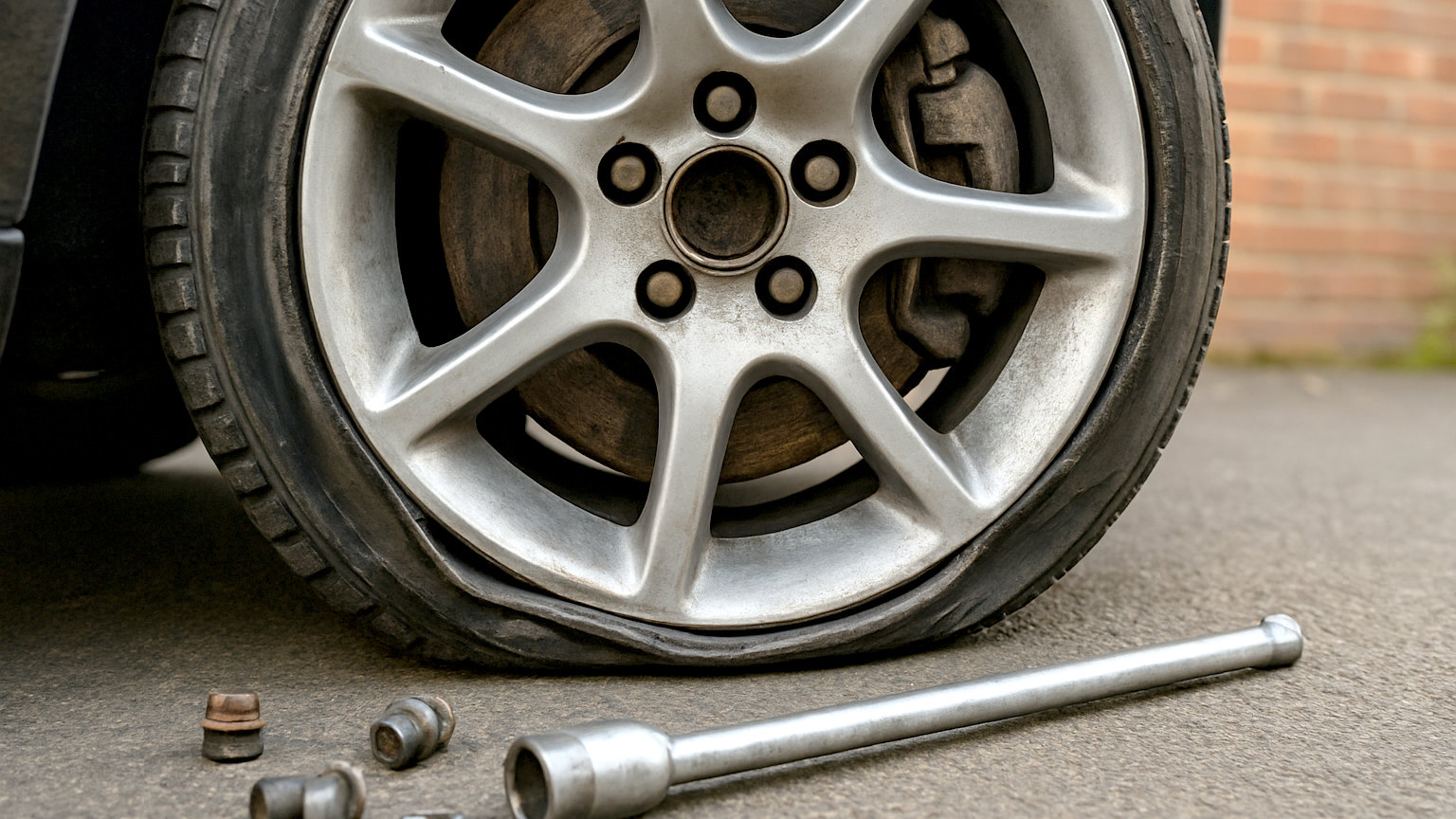
A buckled wheel produces a vibration that no amount of balancing will remove, because the problem is shape rather than mass distribution. The good news is that a modest buckle in an alloy wheel can usually be straightened by a specialist for considerably less than a replacement. The important question is where the line sits between a wheel that can be repaired and one that should not be.
How does a wheel get buckled?
Almost always a pothole or a kerb strike. The rim edge takes a sharp impact and deforms, often on the inner face where it is invisible without removing the wheel. A tyre at low pressure makes it far more likely, since there is less air cushioning the rim from the impact. Cold weather, when alloys are more brittle, increases the risk further.
How do you spot one?
By spinning the wheel slowly, either raised on a jack or on a balancing machine, and watching the rim edge against a fixed reference point. A buckle shows as the edge moving in and out or up and down through the rotation. Because damage often occurs on the inner rim, checking only the outer face misses a great many of them.
How is a wheel straightened?
A specialist mounts the wheel on a machine that measures runout precisely, heats the affected area to make the alloy more workable, and applies controlled pressure with hydraulic rams to bring it back into true. It is a skilled process and a good operator can bring a wheel back within tolerance. It is far cheaper than a replacement on most vehicles.
When should a wheel not be repaired?
When it is cracked, particularly across the spokes, around the bolt holes or through the barrel. Welding a structural crack in a wheel produces a repair whose strength is difficult to verify, and a wheel failing at speed is a serious matter. Severe buckling, multiple repairs to the same area, or damage to the bead seat where the tyre seals are also reasons to replace.
Is welding ever acceptable?
Opinions differ, and the safest position is that cosmetic damage to a non load bearing area may be acceptable while structural cracks are not. The difficulty is that the alloy has already been fatigued around the crack, and heat from welding changes its properties. Anyone offering to weld a cracked wheel should be asked directly what testing follows, and a specialist who declines is exercising sensible judgement.
What about corrosion at the bead?
A common and underappreciated problem. Alloy wheels corrode where the tyre bead seats, which allows slow air loss and makes the tyre sit unevenly. It produces a tyre that repeatedly loses pressure with no puncture to find. Cleaning the bead area and applying a suitable sealant during tyre fitting resolves it, and it is worth asking for on an older set of wheels.
Does refurbishment affect strength?
Cosmetic refurbishment involving stripping and refinishing is generally fine. What is worth avoiding is aggressive shot blasting or acid stripping on an older wheel, and any process involving heat beyond what the alloy tolerates. A reputable refurbisher will handle this correctly, and the cheapest option is not always the one to choose on a component that carries the car.
Should you claim for pothole damage?
It is worth trying where the road authority knew about the defect. Photograph the pothole with something for scale, note the location and time, keep the repair invoices, and report the defect. Claims succeed often enough to justify the effort, particularly where a wheel and tyre have both been damaged and the total is substantial.
What should you check after a repair?
That the wheel has been rebalanced with the tyre refitted, that the tyre has been inspected for internal damage from the same impact, and that a road test confirms the vibration has gone. It is also worth having the alignment checked, since an impact heavy enough to buckle a wheel frequently disturbs the geometry as well.


