
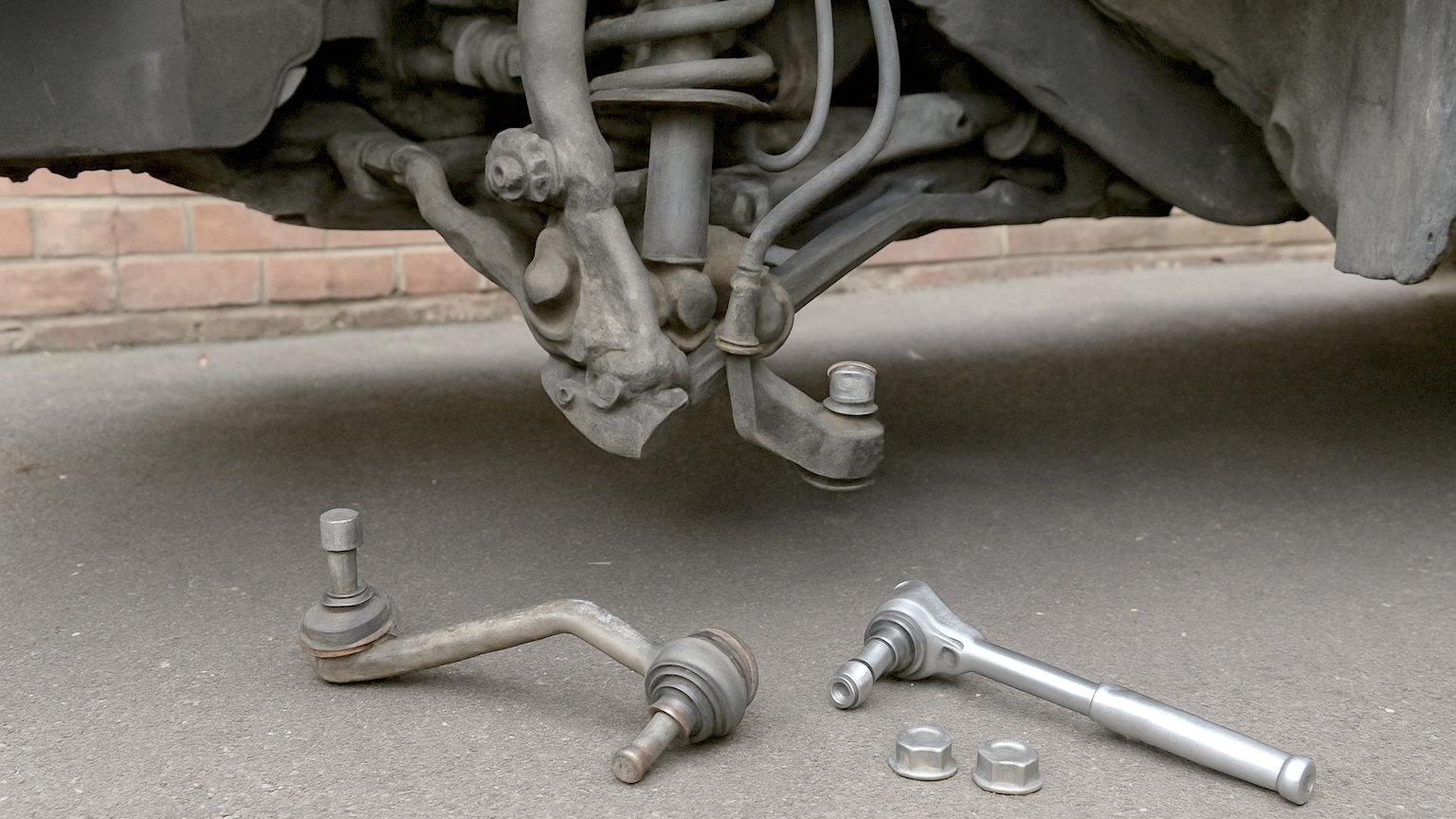
A knock from the suspension over bumps is one of the most common complaints on any car past a few years old, and the good news is that the most frequent cause is also among the cheapest components on the vehicle. The noise happens because something with play in it is being loaded and unloaded rapidly, and the free movement is taken up with an audible impact.
What is the most likely cause?
Anti roll bar drop links, by a considerable margin. They are small rods with a ball joint at each end connecting the anti roll bar to the suspension, they work constantly, and they are among the first things to wear. The noise is a distinct knock or rattle over uneven surfaces, often worse at low speed, and it frequently appears on both sides at once.
How do you check them?
With the car on the ground or with the suspension loaded, grasp the link firmly and try to move it. Any perceptible play in either ball joint means it is worn. A torn rubber boot on the joint is a reliable indicator that the grease has gone and wear has begun. They are inexpensive parts and usually straightforward to replace, though seized fixings can complicate matters.
What does a worn bush sound like?
Duller and heavier than a drop link, more of a thud than a rattle. Suspension arm bushes are rubber, and as they perish or delaminate the arm can move against its mounting under load. It usually comes with a vaguer steering feel and can affect alignment. Front lower arm rear bushes are a particularly common failure and produce exactly this combination.
How does a top mount announce itself?
With a knock or creak from the top of the wheel arch, often heard as much as felt, and characteristically worse when turning the wheel as well as over bumps. Because the front strut rotates within its top mount as the car steers, a worn bearing there produces noise during steering that a drop link does not. That distinction is useful in separating the two.
What about ball joints?
Lower suspension ball joints wear and knock, and unlike drop links they are a genuine safety concern since complete failure separates the wheel assembly from the arm. They are checked by raising the car so the suspension hangs and levering the wheel vertically while watching the joint, or by rocking the tyre at twelve and six o clock. Any play there needs prompt attention.
Could it be something other than suspension?
Yes, and it is worth eliminating. A broken coil spring knocks and often scrapes. A loose exhaust hitting the underbody produces a knock over bumps that sounds structural. Loose items in the boot or under a seat account for a surprising number of investigated noises. A heat shield that has lost a fixing rattles convincingly. All of these are free to check.
Which of these are urgent?
Ball joints and broken springs matter most, since both can fail in ways that affect control of the car. Drop links and top mounts are unpleasant rather than dangerous, though a badly failed top mount changes the steering geometry. Bushes affect handling and tyre wear and will eventually fail an MOT. Nothing on this list improves with time.
How do you locate which corner?
Drive slowly over a speed bump with the windows down and listen, then repeat approaching at a slight angle so one wheel crosses at a time. That usually identifies the corner clearly. A passenger listening from outside as the car is driven slowly over a rough surface is even better, and both approaches are more reliable than trying to judge direction from the driving seat.
What should you expect from an inspection?
A check on a lift with the suspension both hanging and loaded, using a pry bar to reveal play at each joint and bush. Ask which specific component was found rather than accepting a general diagnosis, and ask whether alignment is needed afterwards, since replacing arms or bushes changes the geometry and requires it.


