
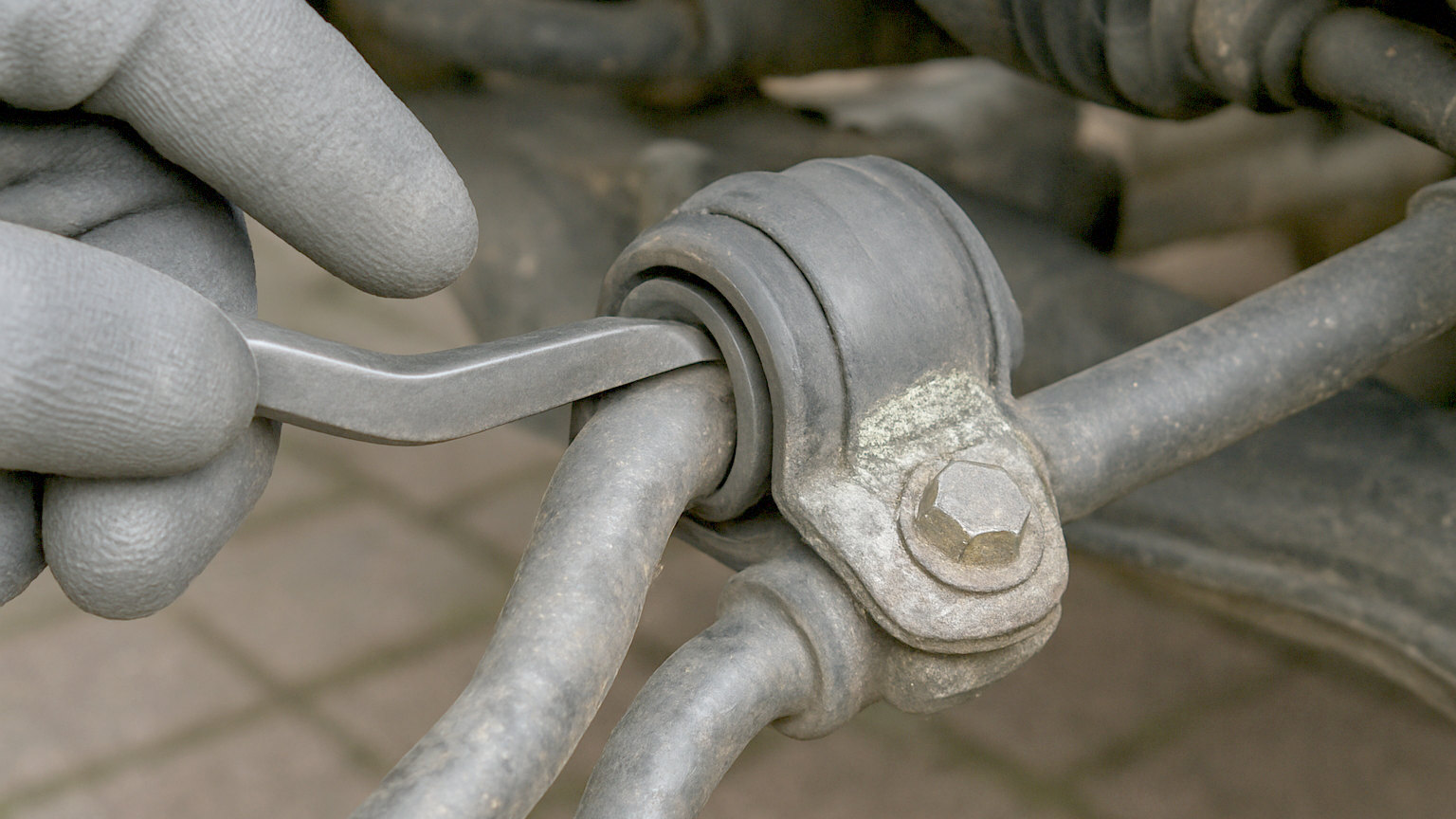
Creaking and groaning from the suspension is different in character from knocking, and it usually indicates something different. A knock means play being taken up sharply. A creak means two surfaces moving against each other under load without adequate lubrication, most often rubber against metal, which is why it appears at low speed where movements are slow enough to hear.
When is it most noticeable?
Manoeuvring at walking pace, going over speed bumps slowly, reversing off a driveway, or turning at low speed. It frequently disappears entirely above twenty miles an hour, partly because the movements are quicker and partly because road noise masks it. That low speed characteristic is what distinguishes it from most other suspension noises.
What causes rubber to creak?
Bushes work by deflecting rubber rather than sliding, but the outer surfaces do move against their housings, and when the rubber hardens with age it can stick and release rather than flexing smoothly. Anti roll bar bushes are the classic example, producing a distinct creak as the bar rotates within them. Suspension arm bushes and spring seat insulators do the same.
Can top mounts creak?
Frequently, and the giveaway is that the noise appears when turning the wheel rather than only over bumps. A front strut rotates within its top mount as the car steers, and a dry or deteriorating bearing produces a creak or graunch from the top of the wheel arch. Having someone turn the wheel while stationary, with your hand on the top mount, usually confirms it.
What about the springs themselves?
A coil spring sits on rubber insulators at each end, and when those perish the spring bears directly on metal and can creak or ping as it compresses and rotates slightly. It also accelerates corrosion at exactly the point where springs break. Perished spring seats are inexpensive and worth replacing when the strut is dismantled for any other reason.
Why is it worse in cold or damp weather?
Because rubber stiffens as it cools, so a marginally dry bush that flexes acceptably in summer sticks and releases in winter. Damp can also wash away what little lubrication remains at a rubber to metal interface. A creak that appears every autumn and eases in spring is describing rubber that has hardened and is close to needing replacement.
Can it be lubricated rather than replaced?
Sometimes, as a temporary measure. A silicone or rubber safe lubricant applied to anti roll bar bushes can silence them for a period, and it is a legitimate diagnostic step since the noise disappearing confirms the source. It is not a repair, because the underlying hardening continues. Never use a petroleum based product on rubber, since it will attack and destroy it.
Could it be something other than suspension?
Worth checking, because creaks travel. Body mounting rubbers, subframe bushes, seat mountings, trim panels rubbing and even a loose exhaust hanger all produce creaks that seem to come from the suspension. Having a passenger listen from different positions inside and outside the car while it is rocked or driven slowly usually narrows it down considerably.
Does a creak matter?
Less than a knock, since it generally indicates hardened rubber rather than play. What matters is what it predicts: rubber that has hardened enough to creak is losing its ability to locate the arm properly, so alignment and tyre wear will follow. Treating a creak as an early warning rather than an annoyance is the useful approach.
What should you do about it?
Have the bushes, top mounts and spring seats inspected rather than assuming it is cosmetic. If the car is otherwise due for suspension work, dealing with the creaking components at the same time makes sense because access is shared. If everything checks out sound, a rubber safe lubricant on the anti roll bar bushes is a reasonable and inexpensive first response.
Is it worth chasing on an older car?
If the creak is the only symptom and everything measures sound, many owners reasonably live with it. If it is accompanied by vague steering or uneven tyre wear, the hardened rubber is affecting more than comfort and replacement becomes worthwhile rather than optional.


