
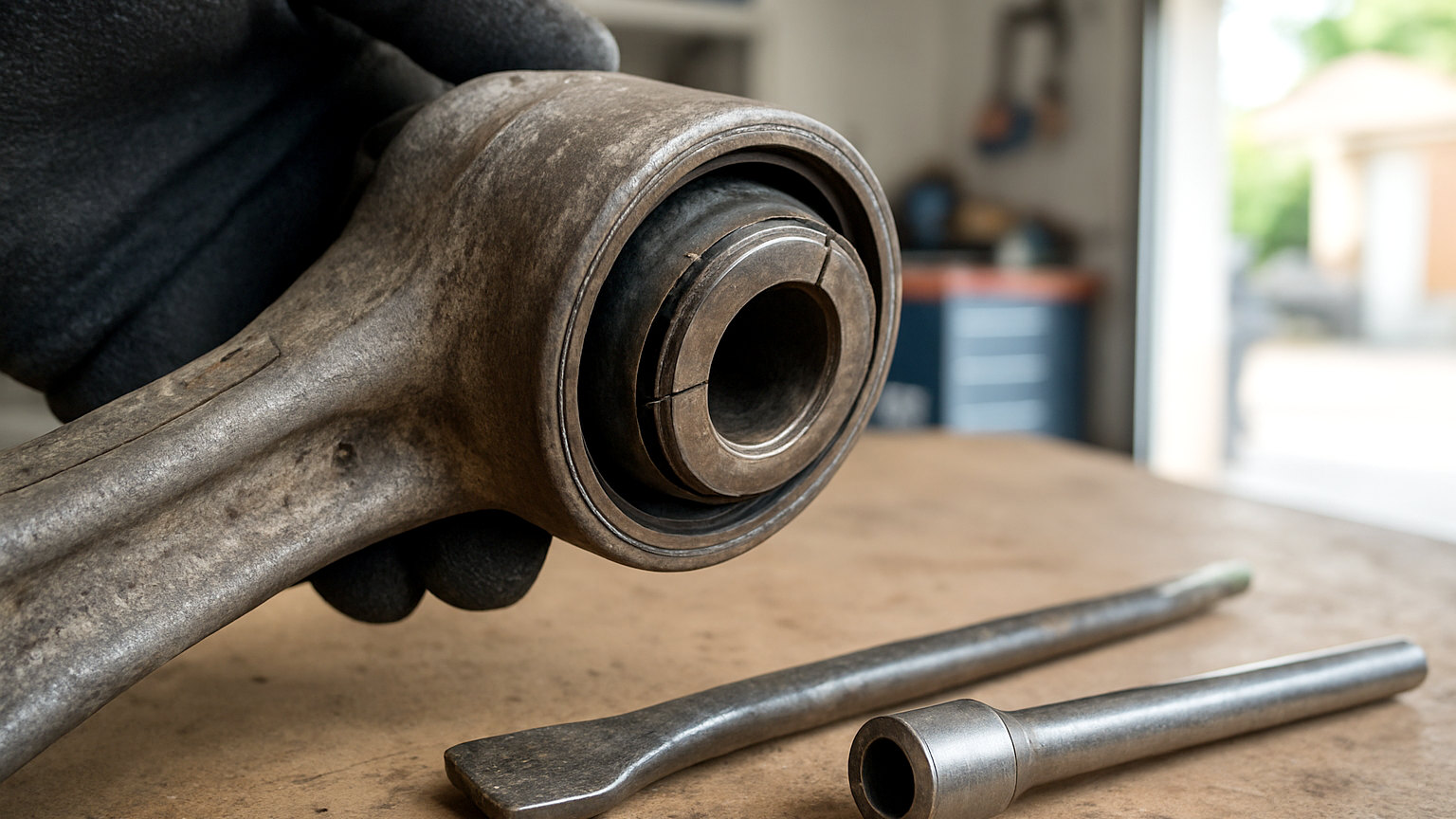
Suspension bushes are among the least glamorous components on a car and among the most influential. Every suspension arm is located by them, and their job is a compromise: hold the arm precisely enough that the geometry stays where the designer intended, while allowing enough movement to absorb road shock and noise. When they fail, both halves of that compromise are lost.
What are they made of?
Most are rubber bonded between an inner and outer metal sleeve, so the arm pivots by deflecting the rubber rather than by sliding. Some are hydraulic, containing fluid filled chambers for better damping of specific frequencies. A few are solid nylon or similar. The rubber type dominates because it isolates road noise well, and it is also the type that perishes.
Why do they fail?
Rubber hardens and cracks with age, ultraviolet exposure and heat, and it can delaminate from the metal sleeves under repeated load. Oil contamination from a nearby leak accelerates it dramatically. Once the rubber has split or separated, the arm moves further than intended under braking, cornering and acceleration, and the suspension geometry changes with every input.
What are the symptoms?
A dull knock or thud over bumps rather than a sharp rattle. Vague, wandering steering that needs constant correction. A car that tramlines and follows ruts. Uneven or feathered tyre wear as the toe angle changes under load. Sometimes a creak or groan at low speed over uneven ground. The steering symptoms often arrive before any noise does.
How are they inspected?
Visually for cracks, splits and voids in the rubber, and by levering the arm against its mounting with a pry bar while watching for movement between the inner sleeve and the outer. A hydraulic bush that has failed often shows fluid weeping from it. The inspection needs the suspension loaded in some cases and hanging in others, which is why a lift makes a real difference.
Can bushes be replaced separately?
Sometimes, and it depends entirely on the design. Some press out and in with the right tools, which is inexpensive in parts and labour intensive. On many modern cars the manufacturer supplies only the complete arm with bushes fitted, which costs more but is quicker to fit and comes with fresh ball joints. Aftermarket bushes are often available even where the manufacturer does not offer them.
Are polyurethane bushes a good upgrade?
They are firmer, last considerably longer and hold the geometry more precisely, which sharpens handling. The trade off is more road noise and vibration transmitted into the cabin, and on a family car that can be an unwelcome surprise. They also need periodic greasing on some designs. For a car used enthusiastically they are a genuine improvement; for a comfortable daily car, rubber is usually the better choice.
Do they affect alignment?
Directly and significantly. A worn bush allows the arm to sit in a different position under load, so the measured alignment on a stationary car may look correct while the geometry under braking or cornering is quite different. That is why alignment carried out on a car with worn bushes rarely cures the handling complaint, and why bushes should be replaced before alignment is set.
Do they fail an MOT?
Excessively worn or damaged bushes are a failure, and testers check them by levering the components while observing movement. A bush with visible splitting or one allowing obvious play will be recorded. Because the wear is gradual, an advisory at one test frequently becomes a failure at the next, which makes it worth acting on rather than deferring.
What should be done afterwards?
A four wheel alignment, since replacing arms or bushes almost always changes the settings. Bolts through rubber bushes should also be finally tightened with the suspension loaded at normal ride height rather than hanging, because tightening them with the arm at full droop pre loads the rubber and tears it within months. That detail is frequently overlooked and it matters.


