
Tyres are the most honest diagnostic tool on a car. They record exactly what the suspension and steering have been doing over thousands of miles, and the pattern of wear points at which component is responsible. Fitting new tyres without reading that pattern first is a reliable way of paying for the same wear again within a year.
What does cupping indicate?
Alternating high and low patches around the circumference of the tread, sometimes described as scalloping, and often accompanied by a rhythmic hum that rises with road speed. It is caused by the tyre bouncing rather than rolling evenly, which means the damper on that corner has lost its control. It is the most reliable single indicator of a worn damper there is.
What does inner edge wear mean?
Excessive negative camber, so the tyre is leaning inwards and running on its inside shoulder. On a car that has not been lowered, that usually means a sagging spring, worn bushes allowing the arm to sit differently, or a bent component after an impact. On the rear of many cars a degree of inner wear is normal by design, so comparing both sides matters.
What does feathering indicate?
Tread blocks worn to a sharp edge on one side and a ramp on the other, which you can feel by running a hand across the tread in each direction. It is caused by the tyre being dragged slightly sideways as it rolls, meaning incorrect toe. Worn track rod ends or bushes produce it, as does alignment that has drifted after a pothole.
What about wear on both edges?
Persistent underinflation, since the centre of the tread lifts away from the road and the shoulders carry the load. Wear concentrated in the centre is the opposite, indicating overinflation. Neither is a suspension fault, and both are corrected by a pressure gauge, which is why checking pressures before investigating anything mechanical is always worthwhile.
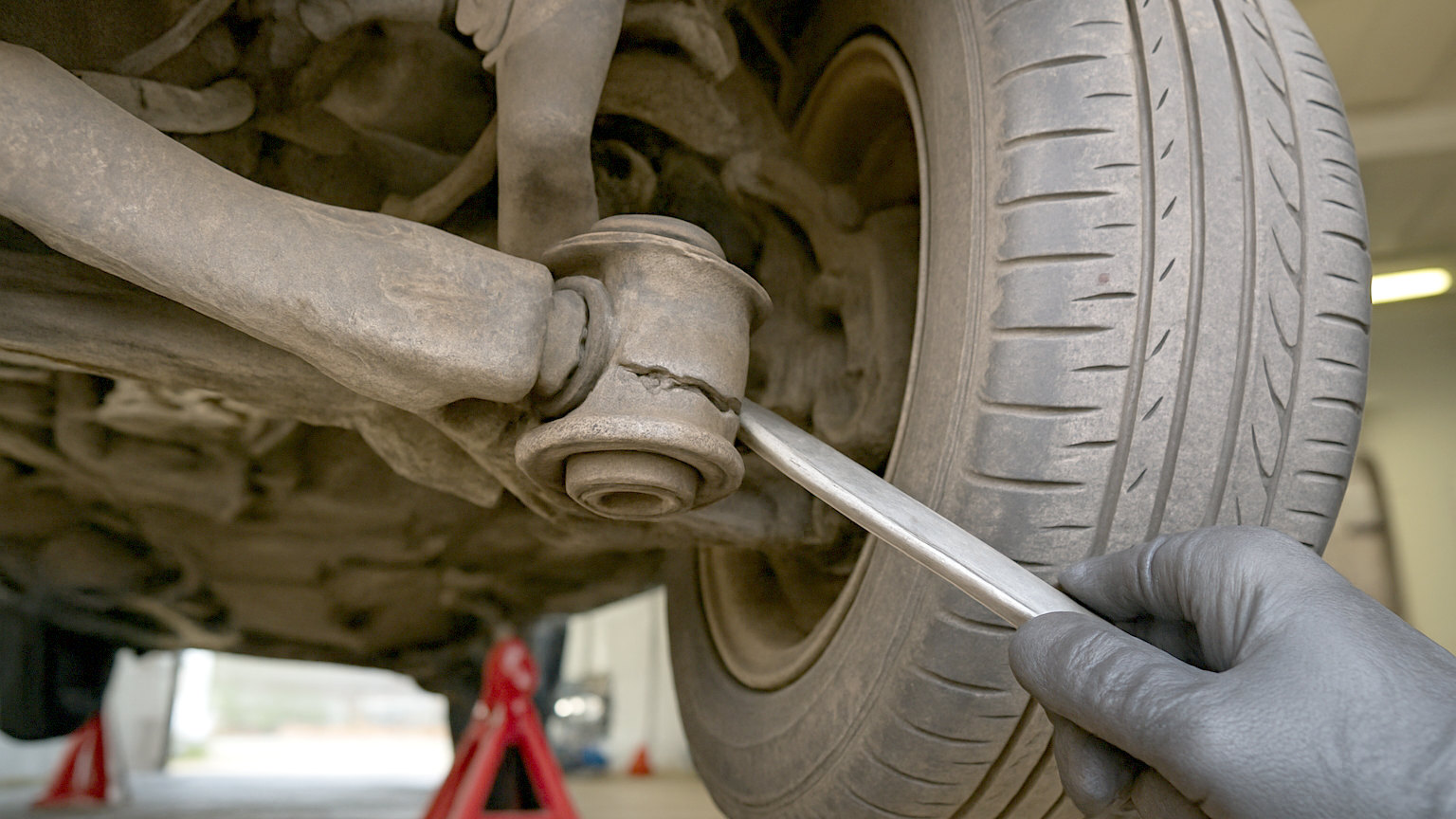
Why do worn bushes cause wear even when alignment measures correctly?
Because alignment is measured on a stationary car with no forces applied. A worn bush holds the arm in the correct position at rest and allows it to move under braking, cornering and acceleration, so the geometry the tyre experiences on the road is quite different from the figures on the printout. That is why alignment carried out before replacing worn bushes rarely solves the problem.
Does a broken spring show in the tyres?
It does, as increased wear on the inner edge of that corner, because the reduced ride height increases negative camber. A car with one corner sitting lower will wear that tyre differently from its opposite number, and comparing the two tyres on an axle is a quick way of confirming that a suspected lean is genuine rather than a trick of the parking surface.
How should you read the pattern?
Look at all four tyres together rather than the worst one. Compare left with right on each axle, note whether the wear is on an edge, in the centre or across the whole width, and run a hand across the tread to feel for feathering. Photographs are worth taking, since a tyre fitter or workshop can interpret them and it prompts the right questions.
What should be done before fitting new tyres?
Have the suspension and steering inspected for play, the dampers assessed, and a four wheel alignment carried out afterwards. Fitting expensive tyres to a car with a worn damper or a failed bush wastes a substantial part of their life. The inspection costs far less than the second set of tyres that would otherwise be needed.
Can worn tyres be saved?
Rarely once a pattern has developed, since the uneven surface tends to perpetuate itself and a cupped tyre continues to be noisy even after the damper is replaced. Rotating them can extend life slightly. The realistic approach is to fix the cause, accept the current tyres are compromised, and expect the replacements to wear evenly.


