
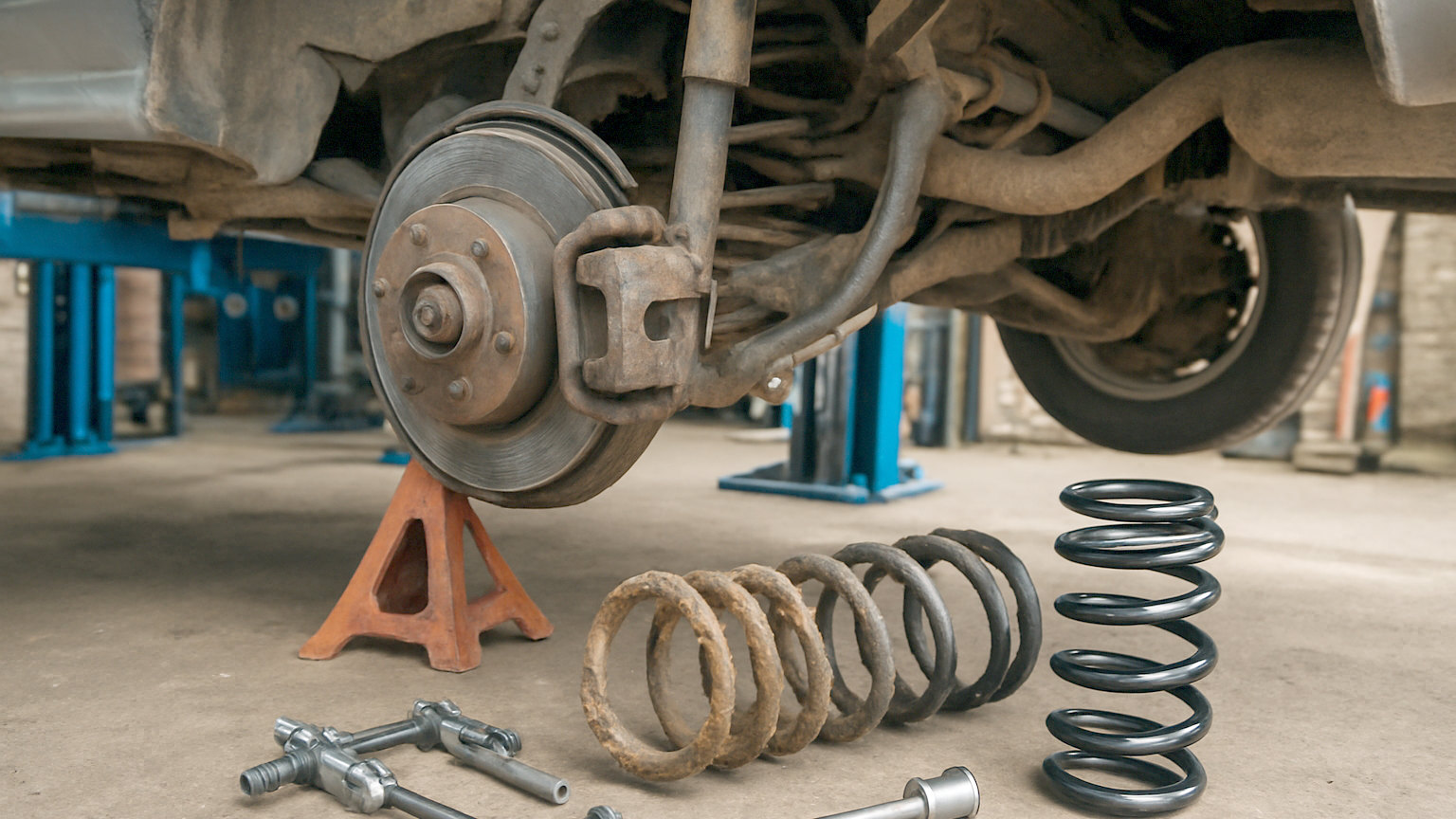
A car that visibly leans, or that sits lower on one corner than the others, is telling you that corner is supporting less load than it should. It is worth taking seriously, because ride height affects suspension geometry, tyre wear and handling balance, and because the most common cause is a spring that has broken or is on its way to doing so.
How do you confirm it properly?
By measuring rather than looking, since parked ground is rarely level and the eye is easily fooled. Measure from the ground to a fixed reference point such as the wheel arch lip, at the centre of each wheel, on flat level ground with the tyres correctly inflated and the fuel load and any luggage as normal. Compare left with right on each axle rather than front with rear.
What difference matters?
Manufacturers allow a small tolerance, so a difference of a few millimetres side to side is usually acceptable. A difference of a centimetre or more is worth investigating. Remember to account for the fuel tank position and anything heavy stored on one side, both of which produce a genuine lean that is not a fault at all.
Why do springs sag?
Steel springs lose a small amount of their free length over many years of cycling, and one that has corroded or been repeatedly overloaded loses more. A sagging spring reduces ride height on that corner and changes the camber, which shows up as accelerated wear on the inner edge of that tyre. It is the gradual version of a broken spring and it produces the same lean without the noise.
How do you check for a break?
Turn the steering to full lock and look into the wheel arch, examining the bottom coils where breaks almost always occur. Look for a gap in the coil spacing, a bright metal fracture face, or an end that has moved out of its seat. On the rear, looking from behind the wheel with a torch usually gives enough view. A break is often accompanied by a knock over bumps.
Could it be a damper rather than a spring?
A conventional damper does not support the car, so a failed one does not change ride height. There are exceptions: coilover and some strut designs where a collapsed internal component alters the assembly length, and self levelling or air assisted dampers which do carry load. On those systems a failure genuinely does produce a sagging corner.
What about air suspension?
A car with air springs that sits down on one corner, particularly after standing overnight, has a leaking air spring or a valve that is not holding. The compressor may run more often than usual as it tries to compensate. It is a different repair from a coil spring but the visible symptom is identical, so establishing which system the car has comes first.
Can bushes or mounts cause it?
Occasionally. A collapsed spring seat insulator lowers that corner slightly. Severely deteriorated bushes or a bent arm following an impact can change the effective geometry. Accident damage to the shell or subframe is another possibility, and it is worth considering if the car has a history and the difference appeared suddenly rather than gradually.
Why does it matter?
Because ride height determines camber and toe on most suspension designs, so a low corner is running incorrect geometry that wears tyres and affects stability. It also alters the load distribution across the axle, which affects braking balance. And a broken spring is an MOT failure and a genuine hazard if the broken end reaches the tyre.
What should be done about it?
Have the springs inspected on both sides of the affected axle and replaced in pairs if either is broken or sagging, since matching rates matter. Have the alignment checked afterwards, because restoring the correct ride height changes the geometry back and the settings need verifying. If the car has air suspension, a leak test rather than a spring replacement is the starting point.


