
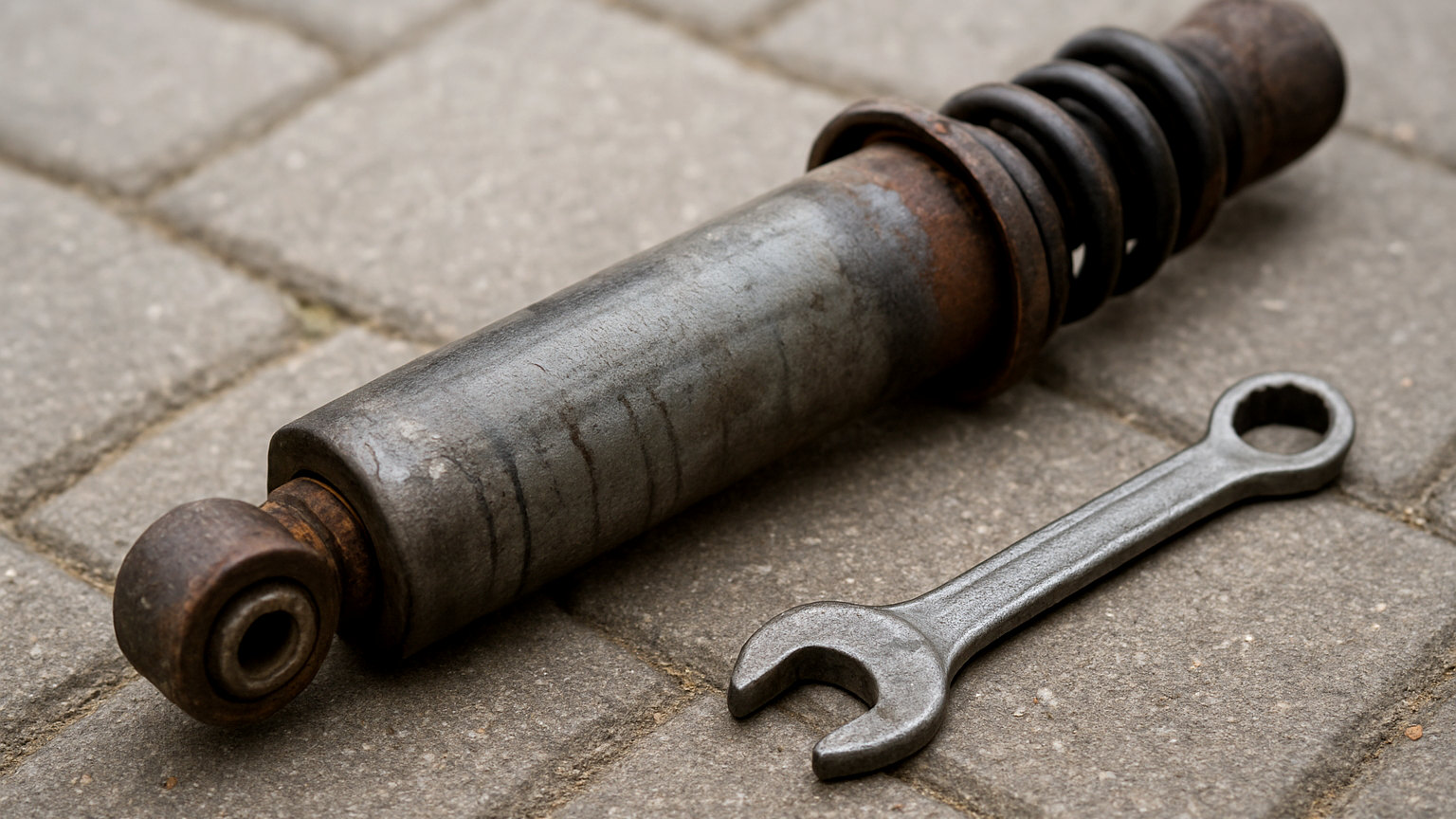
A car that continues moving after the road surface has stopped providing input is describing a loss of damping. The spring stores the energy of a bump and returns it, and without a damper controlling that return the body oscillates until friction eventually settles it. On the road that produces a floating, wallowing sensation that most drivers accept as the car simply feeling old.
Where is it most noticeable?
On motorway undulations, where the car feels as though it is moving on its own between the surface changes. Over crests, where the body rises and takes a moment to settle. On a series of bumps taken in quick succession, where each one arrives before the car has recovered from the last. And in corners, where roll develops slowly and takes time to settle.
Why does it matter beyond comfort?
Because a bouncing tyre is intermittently unloaded, and an unloaded tyre generates neither grip nor braking force. Stopping distances lengthen measurably on uneven surfaces, and stability in an emergency manoeuvre is reduced. It also allows the wheel to move more than intended, which changes geometry momentarily and makes the steering feel vague and delayed.
Is the bounce test reliable?
Only for badly worn dampers. Pushing a corner down and releasing it should produce a return to level with minimal overshoot, and continued bouncing confirms a problem. The difficulty is that a damper can lose a large proportion of its effectiveness while still passing that test, because a static push generates far lower velocities than a real bump does.
How is it tested properly?
On a damper test platform, which vibrates each wheel through a range of frequencies and measures how well the tyre maintains contact with the plate. The result is a percentage figure per corner, and comparing sides reveals imbalance as well as absolute wear. Many garages and tyre centres have one, and it is the only practical way to quantify damping rather than guess at it.
Can it be something other than dampers?
Yes. Sagging springs let the suspension run closer to its bump stops, which changes the ride quality. Worn bushes allow the geometry to move under load, adding to the unsettled feel. Incorrect tyre pressures, particularly overinflation, produce bounce that has nothing to do with the suspension. Checking pressures first is free and occasionally solves the whole complaint.
Why do people not notice it?
Because dampers degrade over tens of thousands of miles, and the driver adapts continuously. There is no sudden failure and no warning light. The usual moment of realisation comes after driving a similar car with fresh dampers, when the difference is immediately obvious. That is precisely why mileage is a better prompt for assessment than any symptom.
Does it affect tyre wear?
Distinctively. Poor damping produces cupping or scalloping, an uneven wear pattern with alternating high and low areas around the circumference of the tread, caused by the tyre bouncing rather than rolling evenly. Finding that pattern is strong evidence for a worn damper on that corner, and fitting new tyres without addressing it simply repeats the wear.
Should all four be replaced?
At minimum in axle pairs, since mismatched damping across an axle affects handling balance and can make the car unpredictable. Where all four are of similar age and mileage, replacing all four restores the intended balance and is usually the better decision. Fitting one damper to cure a leak leaves three tired ones doing a different job, and the car will feel odd rather than repaired.
If budget is the constraint, doing one axle now and the other in a few months is a reasonable compromise, provided the worse axle is dealt with first and the plan is actually followed through.
Is it worth doing on an older car?
Often, and the improvement surprises people. Fresh dampers transform how a tired car rides and handles, reduce tyre wear, shorten braking distances and remove the wandering feel that makes long journeys tiring. Relative to the cost of many repairs, it is one of the more noticeable improvements available on a car that is otherwise sound.


