
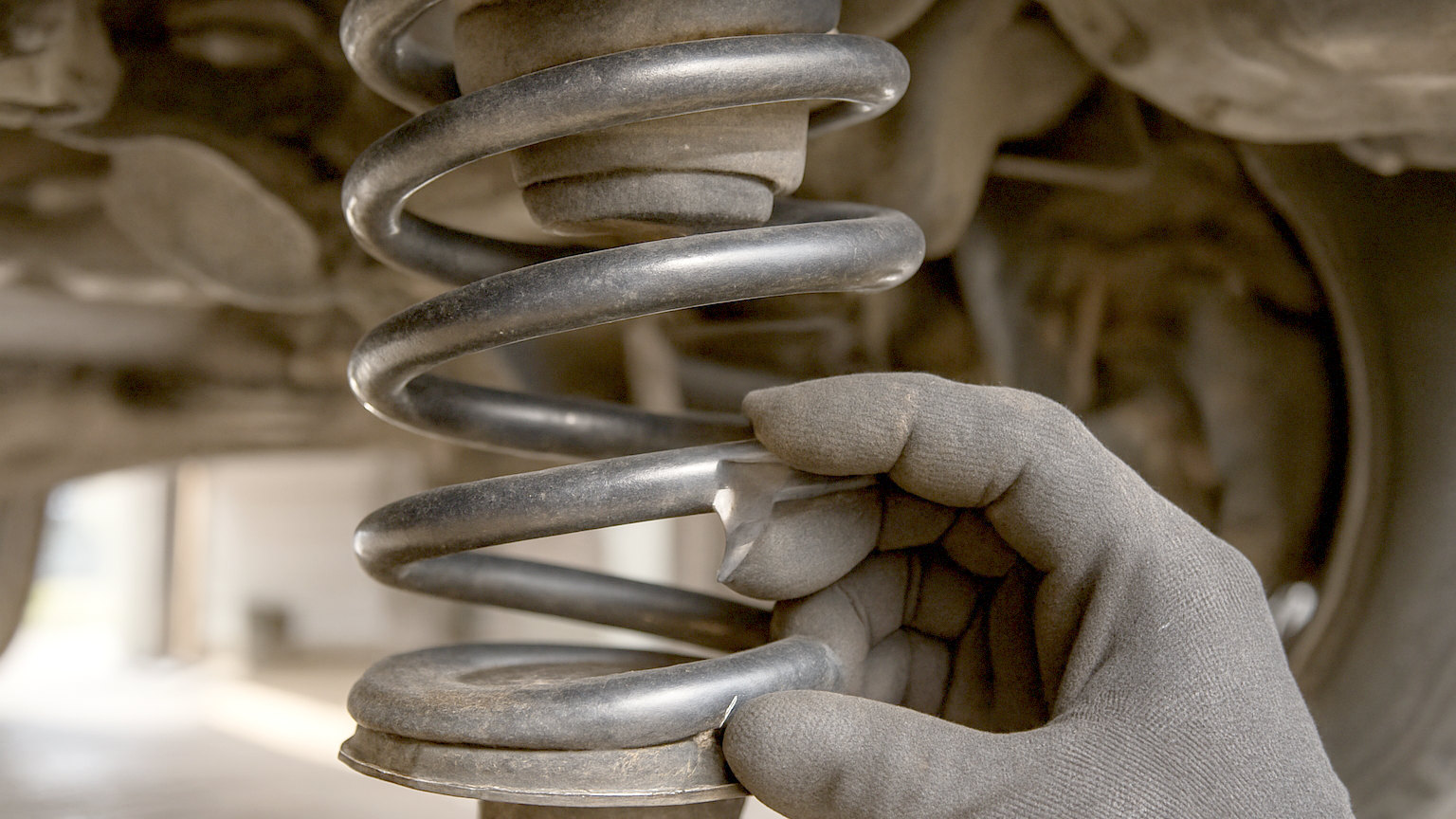
Broken coil springs are far more common than most drivers expect, particularly on cars that have covered a few winters on salted roads. They usually fail at the very bottom of the spring, where water and salt collect and corrosion is worst, and the piece that breaks off is often only a coil or two, which is why the car remains driveable and the fault goes unnoticed.
Why do they break at the bottom?
Because the lowest coil sits in the wettest, dirtiest position on the car, collecting road spray, salt and grit that hold moisture against the protective coating. Once that coating is chipped by stones, corrosion begins and eats into the steel. A spring under constant load with a corrosion pit eventually develops a crack from that point, and the coil snaps.
What does it sound like?
A metallic clunk or knock over bumps, usually from one corner, often accompanied by a grinding or scraping when turning at low speed as the broken end contacts the tyre or the spring seat. Some drivers describe a distinct clang going over a speed bump. The noise typically appears suddenly rather than gradually, which distinguishes it from a bush wearing out.
What are the visual signs?
Turning the steering to full lock and looking into the wheel arch usually exposes enough of the front spring to inspect. Look at the bottom coil where it sits in its seat, and for a gap in the coil spacing that should be even. A broken end often shows bright metal at the fracture. Also check whether the car sits noticeably lower on one corner.
Why is it a safety issue?
Because the broken end is a sharp piece of spring steel adjacent to a tyre. It can rotate and contact the sidewall, and there are documented cases of a broken spring puncturing a tyre at speed. Beyond that, the corner has lost some of its spring rate, which affects handling, braking balance and ride height. It is a straightforward MOT failure.
Is it safe to drive?
Only as far as necessary, and gently. Avoid motorway speeds and heavy loads, and take particular care over bumps and potholes where the broken end can move. If there is any scraping or contact noise from the tyre, the car should not be driven at all until it is inspected, since a sidewall puncture at speed is a serious matter.
Should both sides be replaced?
Almost always. Springs sag gradually over their life, so a new spring on one side and an original on the other produces a car that sits unevenly and handles asymmetrically. They are also the same age and have experienced the same conditions, so the second is frequently not far behind. Most workshops will insist on replacing them in axle pairs.
What else should be checked at the same time?
The spring seats and their rubber insulators, which perish and allow the spring to sit directly on metal, accelerating corrosion. The damper, since it must be removed to change the spring on a strut design and replacing both together saves the labour later. The top mount and bearing. On a strut car the labour is nearly all in the dismantling, so doing everything at once is far better value.
Why is a spring compressor dangerous?
Because a compressed coil spring stores an enormous amount of energy, and a compressor slipping releases it instantly. Serious injuries and fatalities have resulted from this. Cheap compressors are a genuine hazard, and this is one of the jobs where the safety case for handing it to a workshop with proper equipment is strong regardless of mechanical confidence.
Can they be prevented?
Partly. Washing the underside of the car during winter, particularly the wheel arches and spring seats, removes the salt that starts the corrosion. Keeping the spring seat insulators intact helps considerably. Beyond that, springs are a wear item on British roads and a car of a certain age can reasonably be expected to need them.


