
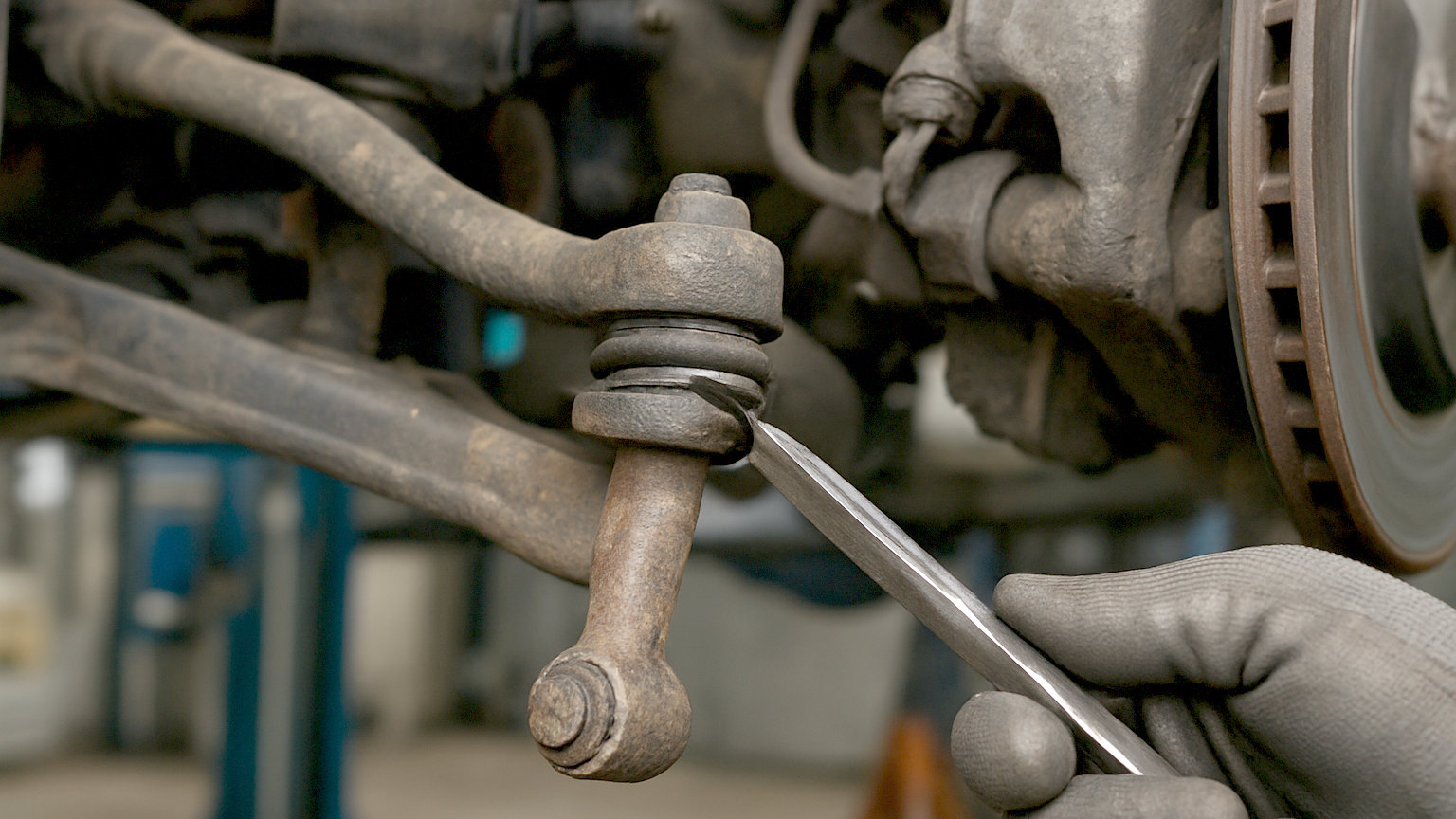
Anti roll bar drop links are small, inexpensive and responsible for a remarkable proportion of the knocking noises that send people to garages worried about their suspension. Because they are among the cheapest components on the car and among the first to wear, checking them before anything else is the sensible starting point for almost any knock over bumps.
What does the anti roll bar do?
It is a torsion spring running across the car, connected to the suspension on each side. When both wheels move together, it simply rotates and does nothing. When one wheel rises relative to the other, as happens in a corner, the bar twists and resists that movement, transferring some load across the axle. The result is less body roll and more predictable handling.
What do the links do?
They connect the ends of the bar to the suspension arms or struts, and they must allow movement in several planes as the suspension travels and steers. Each end therefore has a small ball joint or a rubber bush. Those joints are constantly working, they are small, and they sit low in the wheel arch where salt and water reach them.
Why do they wear so quickly?
Because the loads are high relative to the size of the joints, and because the protective boots are small and easily damaged. Once a boot splits, the grease washes out and grit gets in, and wear accelerates rapidly. On cars used on poor road surfaces they can need replacing every few years, which is unremarkable given their cost.
How do you test them?
Grasp the link and try to move it, feeling for play at either end. With the suspension loaded, levering against it with a bar reveals movement more clearly. A worn link often makes a distinct knock when moved by hand. Because the noise appears over bumps rather than under load, they can be difficult to detect with the car raised and the suspension hanging.
What does the noise sound like?
A sharp metallic knock or rattle over uneven surfaces, most obvious at low speed on rough roads and over speed bumps. It often affects both sides at once, since both have done the same work, and it can sound remarkably like something loose in the car. It generally does not change when steering, which distinguishes it from a top mount.
What about the anti roll bar bushes?
The bar is mounted to the subframe or body in rubber bushes at two points, and those perish too. Worn bar bushes produce a knock or clonk over bumps that is very similar to a drop link, and they are equally inexpensive. They are frequently overlooked because attention goes to the links, so checking both is worthwhile when investigating a knock.
Is it safe to drive with worn links?
In the short term yes, since a failed link does not disconnect the wheel from the car. What it does is disable the anti roll bar on that side, which increases body roll and changes the handling balance, potentially making the car less stable in an emergency manoeuvre. It is an annoyance to fix promptly rather than an emergency.
Is replacement straightforward?
Usually, in principle: two nuts and the link comes off. In practice the fixings are exposed to salt for years and frequently seize or spin, and many links have a hex socket in the end of the stud specifically because this is expected. Penetrating oil applied over several days, and accepting that the stud may need cutting, makes the job far less frustrating.
Should they be replaced in pairs?
Yes. They cost very little, they wear at the same rate, and replacing one usually means returning for the other shortly afterwards. Given that most of the effort is in dealing with corroded fixings rather than the parts themselves, doing both sides at once is straightforwardly better value.
Do they need alignment afterwards?
No, unlike most suspension work. Drop links connect the anti roll bar rather than locating the wheel, so replacing them does not change the geometry. That makes them one of the few suspension repairs with no follow up cost attached.


