
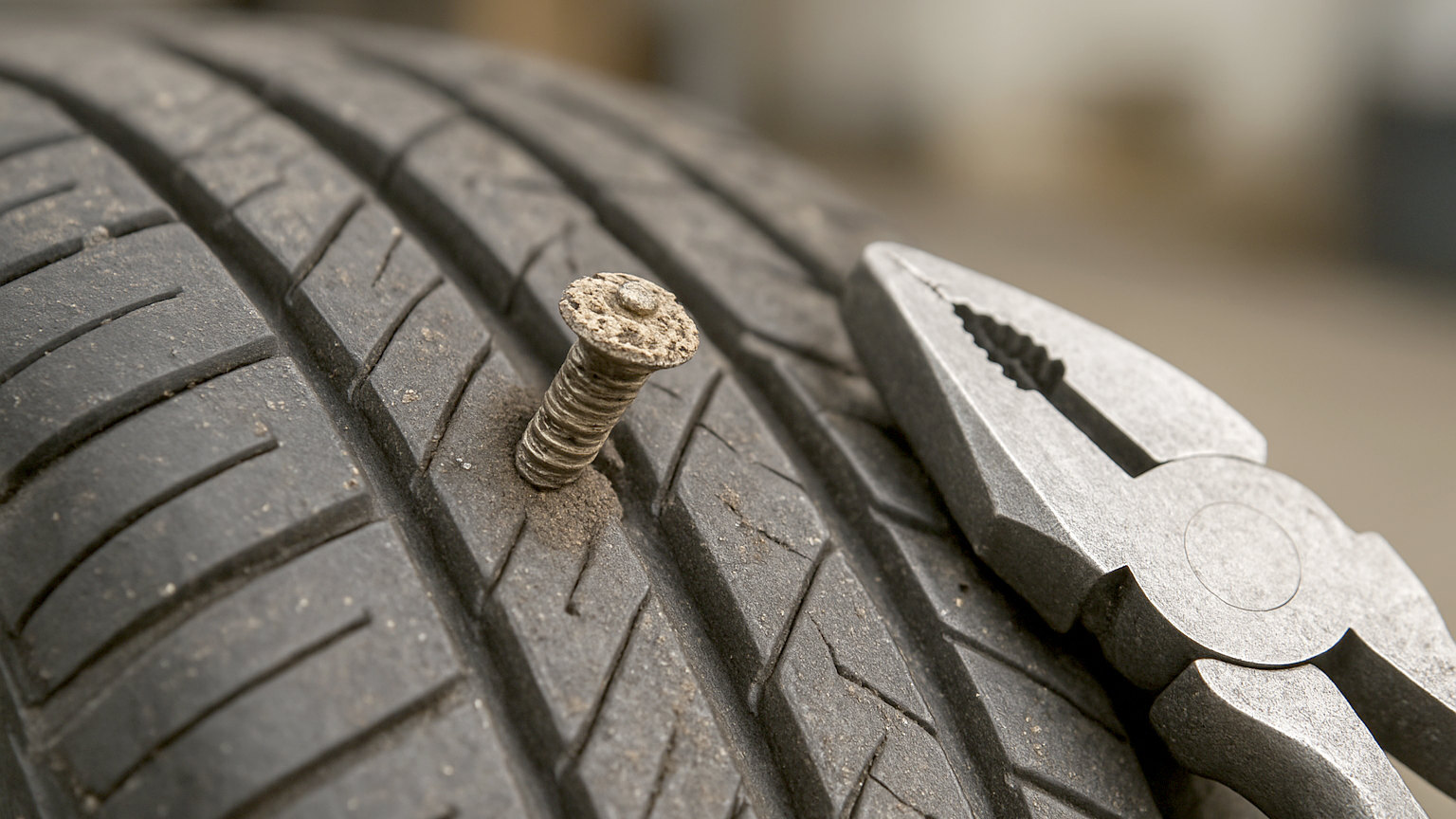
A regular ticking, clicking or tapping that slows as the car slows and stops when the car stops is coming from something rotating at wheel speed. That is a small list of possibilities, and the most common one is so trivial that it is worth checking before considering anything else. It is also one of the few noises where the cause is usually visible without tools.
What is the most likely cause?
A stone or piece of grit lodged in the tyre tread, striking the road once per revolution. It is extremely common, particularly after driving on gravel or a recently chipped road surface, and it produces a tick that is clearly related to wheel speed. Inspecting the tread of each tyre, turning the wheel to see the whole circumference, usually finds it within a few minutes.
Could it be a nail or a screw?
Yes, and this is why the inspection matters rather than assuming it is harmless. A screw or nail picked up in the tread produces exactly the same ticking, and it may be holding air in for now while causing a slow puncture. Finding one means having the tyre inspected properly rather than simply pulling the object out, since removing it can release the air immediately.
What else rotates at wheel speed?
The brake disc and its dust shield, where a stone caught between them produces a scraping or ticking. A wheel trim that has worked loose and is contacting the tyre or the wheel. A brake pad wear indicator just beginning to touch. A damaged wheel arch liner catching the tyre. All produce noise proportional to road speed and all are found by looking.
Does the noise change when braking?
A useful test. A tick that changes or disappears when you brake gently suggests the brake area, since applying the brake clamps the disc and changes the geometry slightly. A tick unaffected by braking is more likely to be in the tyre or the wheel. Similarly, a noise that changes on a gentle bend suggests something being moved by weight transfer.
How do you find which wheel?
Drive slowly with the windows down beside a wall or a line of parked cars, which reflects the sound and makes the side obvious. A passenger listening helps considerably. Failing that, inspect all four tyres and both front dust shields, since the whole check takes under fifteen minutes and needs no equipment beyond a torch and a screwdriver to lever a stone out.
Can it be a driveshaft?
An outer constant velocity joint clicks at wheel speed, but it does so only when turning under power and it is largely absent driving straight. If the ticking is present in a straight line at steady speed, a driveshaft joint is unlikely. That distinction matters, since one is a stone and the other is a driveshaft.
Should you remove a stone yourself?
A stone in the tread, yes, using a blunt tool that will not damage the rubber. Something metallic that has penetrated is different: mark its position, leave it in place and have the tyre inspected, since a repair may be possible depending on where the puncture is and whether the tyre has run soft. Pulling it out at the roadside frequently turns a repairable tyre into a flat one.
Is it worth worrying about?
Usually not, provided you check. The common causes are harmless or trivially fixed. What makes the check worthwhile is the small proportion of cases where the ticking is a screw in a tyre or a brake wear indicator, both of which matter and both of which are far cheaper to deal with early than late.
What if you cannot find anything?
Check the inner face of each tyre as well as the outer, since debris and damage there are invisible from the side you normally see. If nothing turns up, have the wheels removed and inspected properly, because a wear indicator just beginning to contact is easy to miss and it is telling you the pads are nearly finished.


