
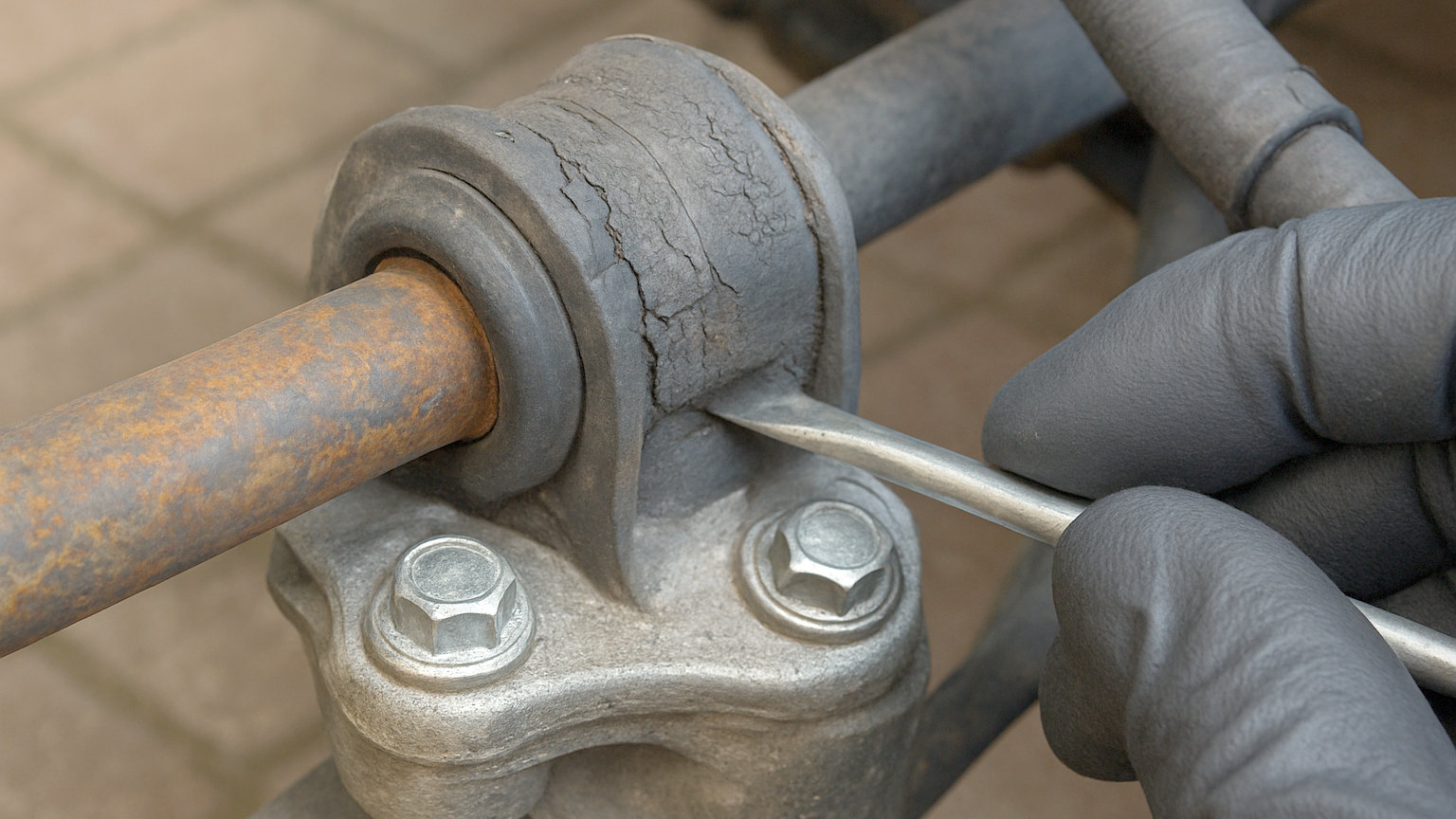
Squeaking over bumps is different in character from knocking, and it usually means something different. A knock is play being taken up sharply. A squeak is two surfaces moving against each other under load without adequate lubrication, which is why it shows up at low speed where movements are slow enough for the stick and release cycle to be audible.
When is it most obvious?
Manoeuvring at walking pace, going over speed bumps slowly, reversing off a driveway, or turning into a car park. It frequently disappears entirely above twenty miles an hour, partly because the movements happen too fast to produce the same effect and partly because road noise masks it. That low speed characteristic is a strong indicator that you are dealing with a squeak rather than a mechanical knock.
Why does rubber squeak?
Suspension bushes work by deflecting rubber rather than sliding, but the outer surfaces do move slightly against their housings, and hardened rubber sticks and releases rather than flexing smoothly. Anti roll bar bushes are the classic example, producing a distinct creak as the bar rotates within them over uneven ground. Suspension arm bushes and spring seat insulators behave the same way as they age.
Could it be the top mounts?
Very possibly, and the giveaway is whether the noise appears when steering as well as over bumps. A front strut rotates within its top mount as the wheels turn, so a dry or deteriorating bearing squeaks or graunches during steering. Turning the wheel lock to lock while stationary with the engine running, and listening at the top of each wheel arch, usually identifies it in a minute.
What about the body rather than the suspension?
Worth considering, because body noises travel and mislead. Subframe mounting rubbers, body mounts on cars with a separate chassis, seat mountings and seat belt anchor points all creak as they age. Trim panels rubbing against each other produce squeaks that seem to come from underneath. Having a passenger press firmly on suspect trim while driving over the same rough surface often silences it immediately and confirms the source.
Why is it worse in cold or damp weather?
Because rubber stiffens as it cools, so a marginally dry bush that flexes acceptably in summer sticks and releases in winter. Damp also washes away what little lubrication remains at a rubber to metal interface. A squeak that appears every autumn and eases in spring is describing rubber that has hardened and is approaching the end of its life, rather than a component that has failed suddenly.
Can it be lubricated?
As a temporary measure and as a diagnostic. A silicone or rubber safe lubricant applied to anti roll bar bushes frequently silences them for a period, and the noise disappearing confirms the source, which is useful information. It is not a repair, since the underlying hardening continues. Never use a petroleum based product on rubber, because it attacks and destroys it, turning a squeak into a failed bush.
Does a squeak matter?
Less than a knock, since it usually indicates hardened rubber rather than play. What it predicts is what matters: rubber hard enough to squeak is losing its ability to locate the arm precisely, so vaguer steering, uneven tyre wear and eventually an MOT advisory follow. Treating a squeak as an early warning rather than an irritation is the useful approach.
How should it be investigated?
By having the bushes, top mounts and spring seats inspected on a lift, with the suspension both loaded and hanging. If everything measures sound, attention moves to body and trim mountings. If the car is due for other suspension work, dealing with the squeaking components at the same time makes sense, since access is shared and the labour is already being paid for.
Can you narrow it down yourself?
Bouncing each corner of the car by hand while listening will often reproduce a suspension squeak without moving at all, and it identifies the corner immediately. Doing the same with a passenger pressing on interior trim separates a body noise from a suspension one.


