
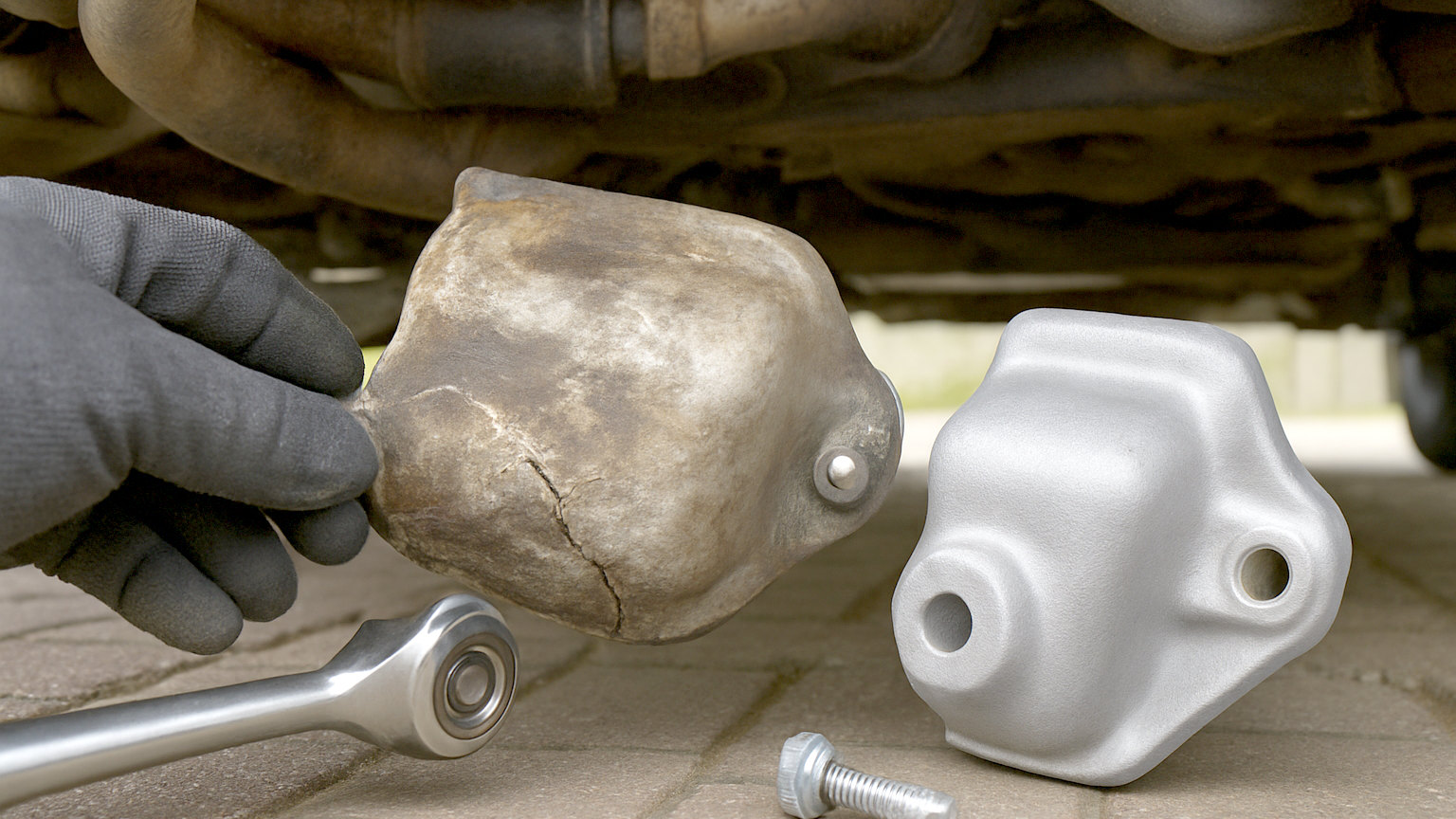
A metallic rattle from underneath a car sounds alarming and is very often one of the cheapest faults on the vehicle. Heat shields and exhaust mountings account for the large majority of them, and both produce a noise out of all proportion to their significance. Establishing which before assuming something structural has failed usually takes a few minutes on a level surface.
Why do heat shields rattle?
They are thin metal panels fitted above the exhaust to protect the floor and fuel lines from heat, held by small fixings that corrode and eventually break. Once a shield is loose at one corner it vibrates against the exhaust or the floor, producing a buzz or rattle that typically appears at a particular engine speed where the panel resonates. It often comes and goes, being loudest at one rev range and silent above and below it.
How do you find a loose shield?
With the car cold and safely raised, work along the exhaust route tapping and pushing each shield with a gloved hand. A loose one moves and rattles under light pressure. Look for missing fixings, which leave an obvious hole, and for a shield that has corroded around its mounting point. Many rattles can be reproduced simply by shaking the shield while the car is stationary.
Can it be repaired simply?
Frequently, yes. A large penny washer and a self tapping screw or a jubilee clip around the shield and the exhaust pipe are both accepted repairs and cost very little. Where the shield has corroded badly it can sometimes be removed entirely, though that is worth thinking about, since it is there to keep heat away from the floor and any fuel or brake lines running nearby.
What do failed exhaust mountings sound like?
A duller knock or clonk rather than a buzz, usually over bumps and when pulling away or lifting off, as the system swings and contacts the underbody. The rubber hangers perish and split with age and heat, allowing the exhaust to hang lower than intended. Checking them is straightforward: push the exhaust upwards and sideways by hand while it is cold and watch for excessive movement or contact.
Could it be the exhaust itself?
Yes. Catalytic converters and diesel particulate filters contain a ceramic substrate, and when that breaks up the fragments rattle inside the casing. The characteristic test is tapping the converter body gently with a rubber mallet when cold and listening for loose material moving inside. That is a considerably more expensive finding than a heat shield, and it usually comes with other symptoms such as reduced power.
What about undertrays and splitters?
Plastic undertrays are held by many small clips and screws, and losing a few leaves a panel flapping at speed or dragging at low speed. It produces a rattle or a scraping that varies with road speed rather than engine speed. A quick look underneath usually reveals a panel hanging down, and refitting it with the correct clips is inexpensive compared with the damage a trailing panel can do.
Could it be something loose in the car?
More often than people expect, and it is free to check. A jack or a tool kit not secured properly in the boot, a spare wheel that has loosened, or items under a seat all produce rattles that appear to come from underneath. Emptying the boot and driving the same road is a sensible first step before spending time under the car.
Does it matter?
A loose heat shield is an annoyance rather than a hazard, though a shield that detaches completely can drag or fall off. A failed exhaust mounting allows the system to strain its joints, which leads to a blowing exhaust and eventually a broken pipe. A rattling catalytic converter matters considerably more. Given how cheap the common causes are to correct, none of them are worth living with for long.


