
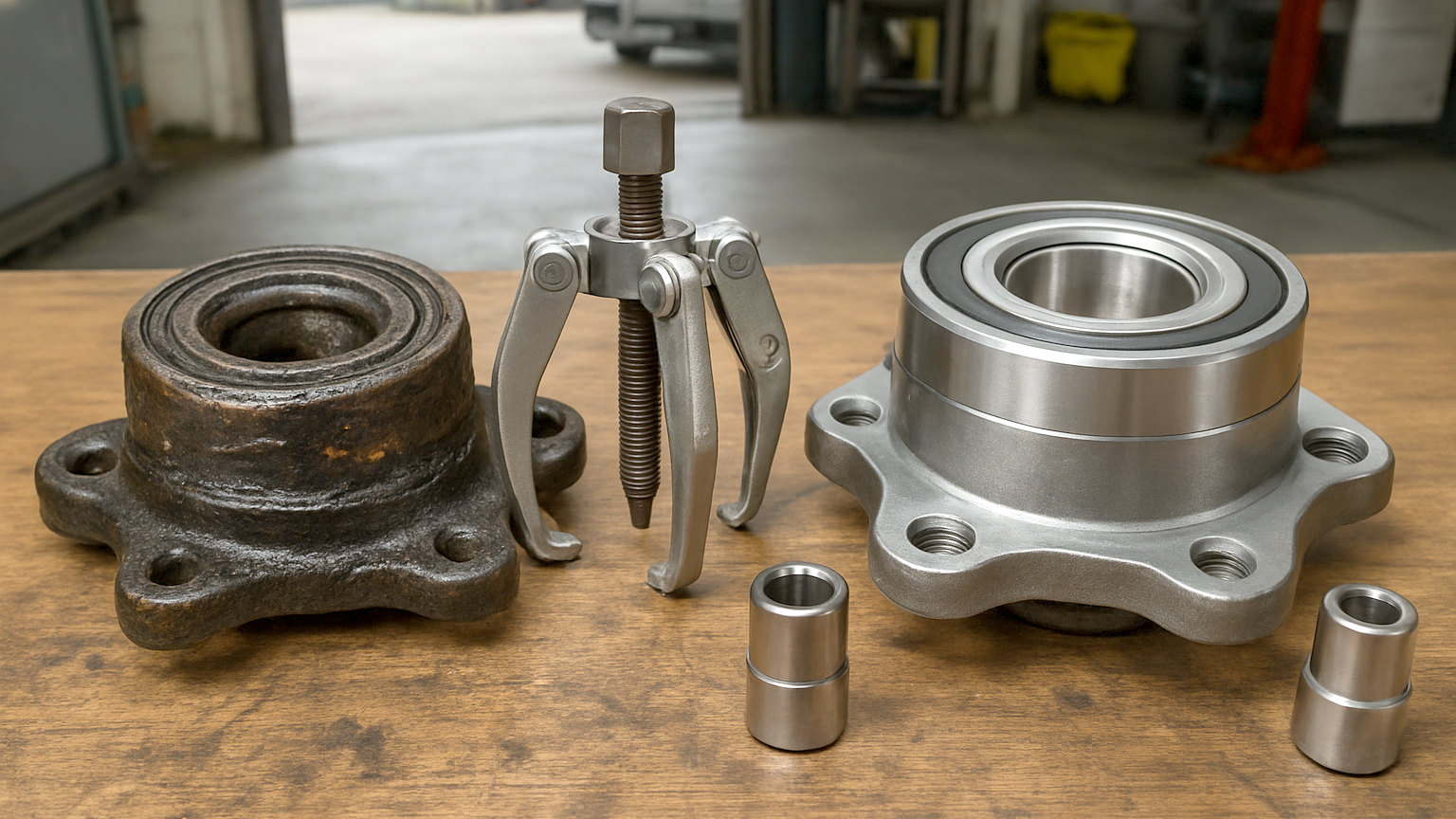
A hum, drone or roar that rises in pitch and volume with road speed is one of the most common noise complaints, and it has two dominant causes that sound remarkably alike. A worn wheel bearing and a worn or noisy tyre produce a similar note, and the difference between an inexpensive tyre change and a bearing replacement makes it worth separating them properly before spending anything.
What is the cornering test?
The single most useful check, and it needs only a quiet road with gentle sweeping curves. Drive at a steady speed where the noise is clear, then take a long gentle bend one way and then the other. Cornering transfers weight onto the outside wheels, so a failing bearing on the loaded side becomes noticeably louder, while the noise eases when weight moves off it. A noise that changes clearly with direction is a bearing until proved otherwise.
Why does tyre noise sound so similar?
Because it is also generated at wheel speed and it also rises with road speed. Uneven tyre wear, particularly the scalloped or feathered patterns caused by worn dampers or incorrect alignment, produces a rhythmic roar that most people describe as a bearing. The distinguishing feature is that tyre noise usually changes noticeably with the road surface, becoming much quieter on smooth new tarmac and louder on coarse chippings, while bearing noise is far less affected.
How can you confirm it is the tyres?
By swapping them around. Moving the front wheels to the rear and driving the same road again is definitive: if the noise moves from the front of the car to the rear, it has travelled with the tyres. It is a straightforward job with a jack and a torque wrench, and it costs nothing but an hour. Run a hand across the tread of each tyre too, feeling for a sawtooth edge that indicates feathering.
What does a bearing sound like as it worsens?
It typically begins as a faint hum at motorway speed that most people attribute to the road surface. Over weeks it becomes a distinct drone across a wider speed range, then a rumble, and eventually a grinding or growling that can be heard at low speed with the window down. Once it reaches that stage there is usually also play in the hub, which is easily found by rocking the wheel.
How do you check for play?
With the wheel raised, grip the tyre at twelve and six o clock and rock it firmly. Any knocking or perceptible movement suggests bearing wear, though it is worth having someone press the brake pedal while you repeat it, since that eliminates a worn ball joint from the result. Spinning the wheel by hand and listening for roughness or rumble is equally revealing on a badly worn bearing.
Could it be something else entirely?
Occasionally. A differential with worn bearings produces a drone on rear and four wheel drive cars, usually varying between acceleration and coasting. A gearbox bearing hums in every gear including neutral. A dragging brake produces a roar accompanied by a hot wheel. And roof bars or a roof box generate a drone at motorway speed that surprises people who have forgotten they are fitted.
How urgent is a wheel bearing?
It should be dealt with rather than tolerated. A bearing that has begun to rumble will continue deteriorating, and in the worst case it can seize or allow enough movement to affect steering and braking. It is also an MOT failure once play is detectable. Most give months of warning rather than failing suddenly, so there is usually time to plan the work rather than abandon a journey.
What should you check first?
Tyre pressures and tread condition, since underinflated or unevenly worn tyres are the cheapest explanation and cost nothing to inspect. Then the cornering test to establish whether the noise responds to weight transfer. Then rock each wheel for play. Those three steps take under an hour and they usually identify which of the two causes you are dealing with before any money changes hands.


