
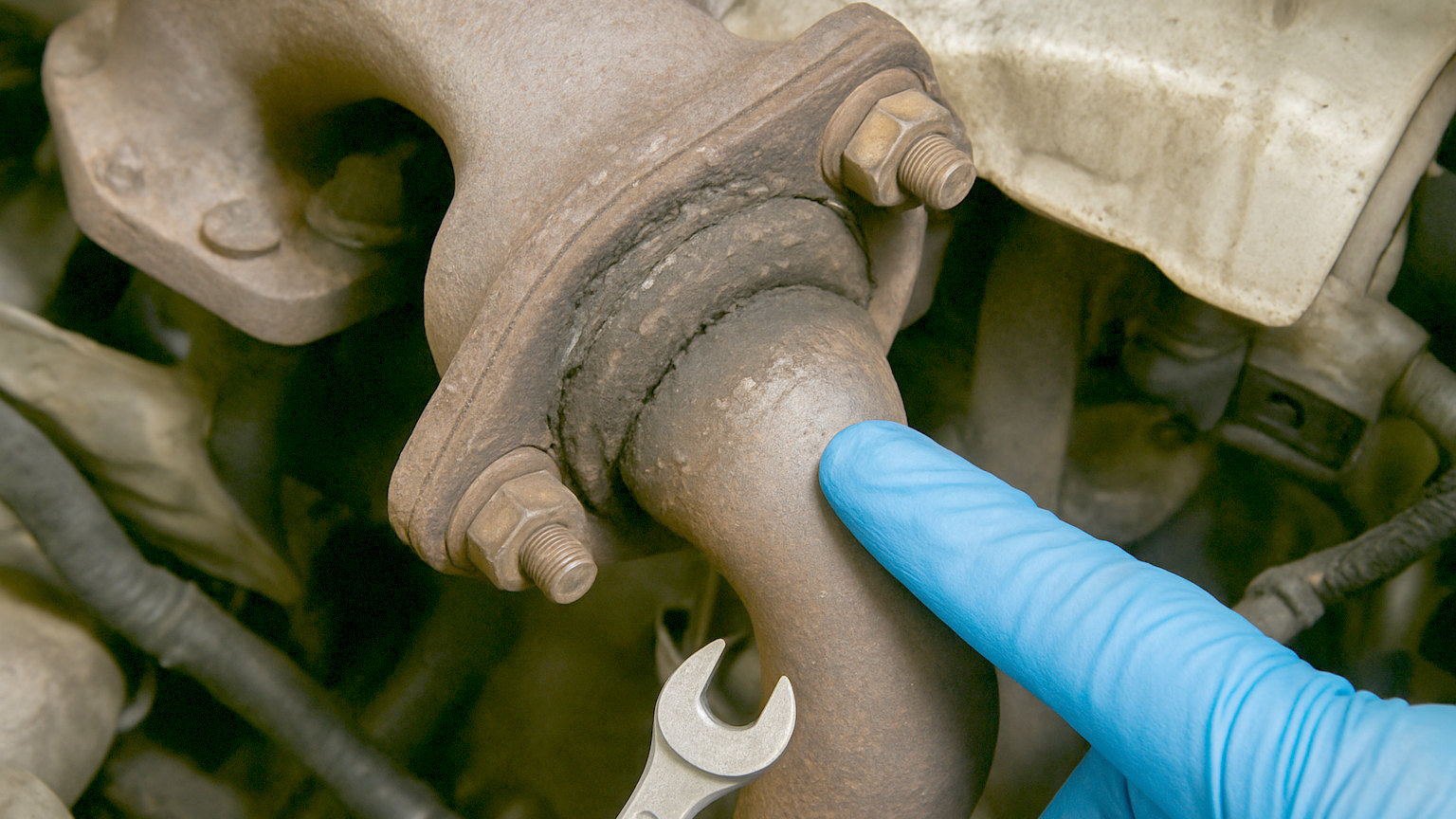
A blowing exhaust announces itself with a rasping, puffing or droning note that rises with engine speed and is usually loudest under acceleration. It means gas is escaping before it reaches the silencer, and the position of the leak determines both how it sounds and how much it costs to put right. It is also, at any position, an MOT failure and potentially a safety matter.
Where do exhausts usually leak?
At the joints and at the point where corrosion has eaten through the pipe. Common places are the manifold to downpipe joint, the flexible section behind it, the joints between sections, and the seams of the silencer boxes where condensation collects. Cars used for short journeys corrode from the inside far faster, because the exhaust never gets hot enough to dry out the water that combustion produces.
Why does a manifold leak sound like ticking?
Because it is closest to the engine and the gas escapes in individual pulses rather than as a continuous flow. A cracked manifold or a failed manifold gasket produces a sharp ticking that rises with engine speed and is frequently mistaken for a valve train noise. The distinguishing feature is that it is usually loudest when the engine is cold and quietens as the metal expands and closes the gap.
What is the flexible section?
A braided flexible joint fitted just behind the manifold on many cars, allowing the exhaust to move with the engine without stressing the pipework. It is one of the most common failure points, since the braid corrodes and splits, and it produces a distinct rasping blow under acceleration. On some cars it can be replaced separately, and on others it comes as part of a larger section.
Why do exhausts corrode from the inside?
Because burning fuel produces water, and on a short journey the exhaust never reaches a temperature high enough to evaporate it. That water sits in the low points of the system, mixes with acidic combustion products and rots the steel from within. This is why a car used for a daily two mile commute needs exhausts far more often than one doing regular motorway miles.
Can a blowing exhaust be repaired?
A small hole or a leaking joint can often be repaired with exhaust paste and a bandage or clamp, which is a legitimate temporary measure. What cannot sensibly be patched is a section that has corroded generally, since a repair simply moves the leak along by a few inches. A cracked manifold needs replacing or, in some cases, professional welding, and a failed flexi section should be replaced properly.
Does it affect how the car runs?
It can. A leak before the oxygen sensor lets air into the exhaust stream, which the sensor reads as a lean condition, so the engine management adds fuel it does not need. That produces poor economy, a fault code and potentially damage to the catalytic converter. A leak in that position therefore matters for more than the noise it makes.
Why is it a safety issue?
Because exhaust gas contains carbon monoxide, which is odourless and dangerous, and a leak ahead of the rear of the car can allow fumes to enter the cabin through body seals and grommets. Any smell of exhaust inside the car should be treated as urgent, driven with a window open and inspected promptly. It is the one aspect of a blowing exhaust that justifies immediate action.
Will it fail an MOT?
Yes. A leaking exhaust, a system that is insecure, a missing or ineffective silencer producing excessive noise, and a missing catalytic converter where one was fitted are all failures. Since the whole system is inspected anyway, a blow that has been building for months will be found. Repairing it beforehand avoids a retest and is usually cheaper than the alternative.
How can you make an exhaust last?
Regular longer journeys, since a properly hot exhaust dries out completely and the corrosion that kills most systems comes from water sitting inside it. Beyond that, replacing perished mounting rubbers promptly prevents the system straining its own joints.


