
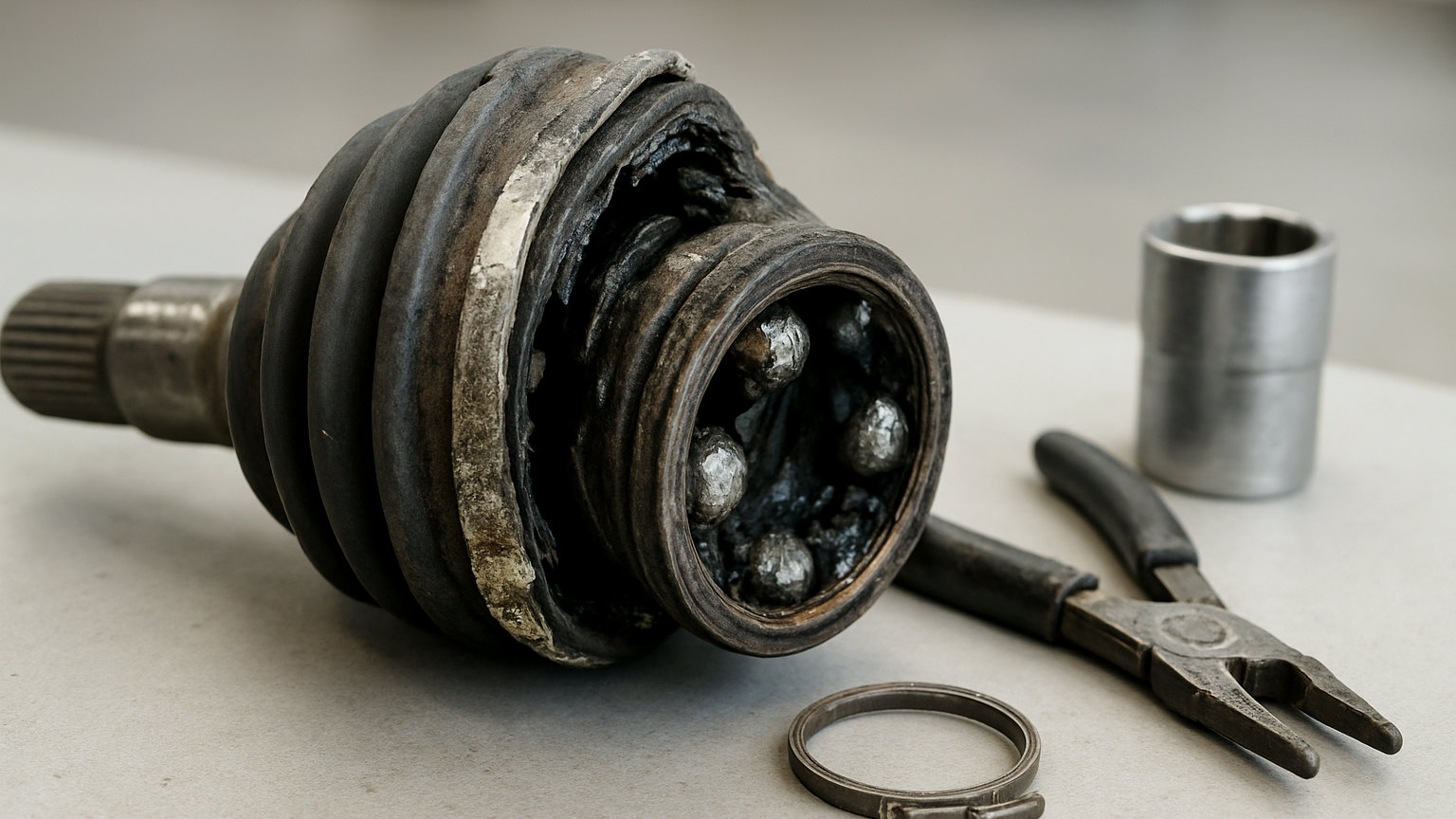
A rhythmic clicking or knocking that appears when turning tightly under power, and stops when you straighten up or lift off, is among the most specific noises a car produces. It names a single component with unusual confidence, and it gives generous warning before anything actually fails. The important part is what caused it, because that determines whether the repair could have been avoided.
What is actually clicking?
The outer constant velocity joint on a driveshaft, which allows the shaft to transmit power to the wheel while that wheel steers through its arc. Inside are ball bearings running in machined grooves, and as those grooves wear the balls move slightly before taking up drive. At full steering lock the joint is working at its greatest angle, so the play produces an audible click once per revolution of the wheel.
What are the recognisable features?
The clicking rate follows wheel speed rather than engine speed, so it slows as you slow down. It is usually far worse in one direction than the other, since the joint on the outside of the turn is more heavily loaded. It appears under power and largely disappears on a trailing throttle. Manoeuvring in a car park or pulling out of a junction is where most people first notice it.
Why does the boot matter so much?
Because the joint is packed with grease and sealed by a rubber concertina boot, and that boot is the only thing keeping grease in and grit out. Once it splits, the grease is flung out within days and road contamination gets in, after which the joint destroys itself relatively quickly. Almost every clicking joint began with a split boot that went unnoticed.
How do you spot a split boot?
Grease sprayed around the inside of the wheel arch and across nearby suspension components is the clearest sign, and it is often visible without raising the car. Turning the steering to full lock exposes the outer boot for inspection. Look for cracks in the concertina folds, tears near the clips and any missing retaining clip. It takes two minutes and it is worth doing at every service.
Can a boot be replaced instead of the joint?
If it is caught before contamination has done its work, yes, and it is far cheaper. A boot kit with fresh grease and clips costs a fraction of a driveshaft. Once the joint has started clicking, the damage is done and a new boot will not reverse it. That is precisely why the boot inspection is worth more than the noise, since by the time you hear the click the cheap option has gone.
What is the difference from an inner joint?
The inner joint sits at the gearbox end and plunges in and out as the suspension moves. It does not click on lock; when it wears it produces a vibration or shudder under acceleration that disappears when you lift off. So clicking on lock means the outer joint, and vibration under power means the inner. The two symptoms are distinct and each names a different end of the same shaft.
Could it be something other than a driveshaft?
Occasionally. A worn top mount bearing produces a creak or graunch when turning, though it usually appears at any steering angle rather than only at full lock, and it does not require power. A stone caught in a brake dust shield produces a rhythmic scrape. A loose wheel trim can click. All are worth ruling out, since all are far cheaper.
How urgent is it?
Not immediate, but not indefinite either. A clicking joint typically gives months of warning before it becomes severe, and it does eventually fail, at which point the car loses drive on that side. Since the noise only gets worse and never improves, planning the repair is preferable to waiting, and having both driveshaft boots inspected at the same time is sensible since they are the same age.


