
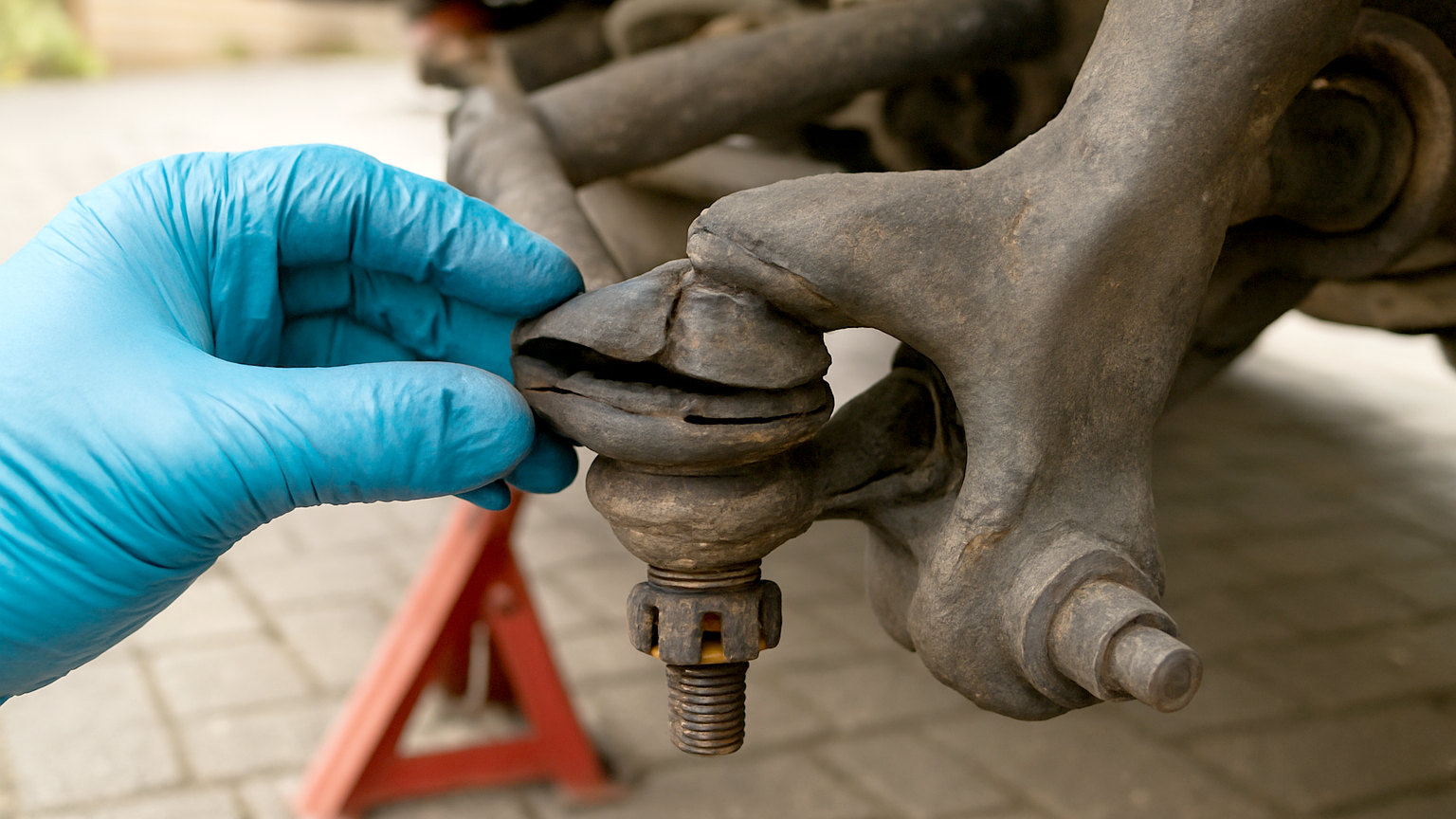
A track rod end is a small ball joint at the outer end of each steering rod, connecting the rack to the steering arm on the hub. It has to transmit every steering input while allowing the wheel to move up and down with the suspension and to swivel through its steering arc. It is a simple component in a hostile position, and it is one of the most commonly replaced parts on any car.
How is it constructed?
A hardened steel ball on a tapered stud sits in a socket with a bearing surface, packed with grease and sealed by a rubber boot. The taper is pulled into the steering arm by a nut, so the joint is clamped rather than merely bolted. That taper is why removing them often requires a splitter or a sharp shock, and why they should never be hammered directly on the thread.
Why does the boot matter so much?
Because it is the only thing keeping grease in and water out. Once the rubber splits, usually from age and ozone rather than impact, the grease washes away and grit and salt enter. From that moment the joint is wearing rapidly, and a torn boot is therefore an early warning rather than a cosmetic issue. It is also an MOT failure in its own right regardless of whether play has developed.
What are the symptoms of wear?
A knocking or clunking from the front when turning at low speed or crossing uneven surfaces. Vague steering that requires constant correction. Uneven tyre wear, since the toe setting changes as the joint moves under load. In advanced cases a rattle over every bump. The noise is often described as coming from the suspension, which is broadly where it originates.
How is it tested?
With the wheel raised, gripping the tyre at three and nine o clock and pushing and pulling alternately while watching the joint. Any perceptible movement between the stud and the socket indicates wear. A second person rocking the wheel while you watch or place a hand across the joint makes marginal cases obvious. Testers use turning plates and a pry bar for the same purpose.
What happens if one fails completely?
The joint separates and that wheel loses its steering connection entirely, pointing wherever the forces take it. It is one of the genuinely dangerous mechanical failures, particularly at speed, and it is why these joints are inspected so carefully at the MOT. Complete failure is rare because wear gives plenty of warning, which is exactly why the warning should not be ignored.
Should both sides be replaced together?
Usually sensible. They are inexpensive, they have done the same mileage in the same conditions, and the alignment has to be reset either way. Replacing one and returning for the other a few months later means paying for alignment twice. If one has failed early through a split boot while the other is sound, replacing only the failed side is reasonable.
Why must alignment be reset afterwards?
Because the track rod end screws onto the rod, and its position determines the toe angle of that wheel. Replacing it changes that setting even if the fitter counts the threads carefully. Driving on incorrect toe scrubs tyres out within a few thousand miles, so alignment is part of the job rather than an optional extra, and any quote should include it.
Is it a job worth doing yourself?
It is within reach with the right tools: axle stands, a ball joint splitter and a torque wrench. The complications are seized threads, which frequently need heat or penetrating oil over several days, and the fact that alignment must be checked afterwards regardless. Marking the original position and counting turns gets you close enough to drive to an alignment centre.
How long should they last?
Typically well over a hundred thousand miles if the boots remain intact, and a fraction of that once one splits. That makes the boots worth inspecting at every service, since spotting a tear early and replacing the joint before the wear develops is straightforward, while ignoring it leads to a knocking front end and a failed test.


