
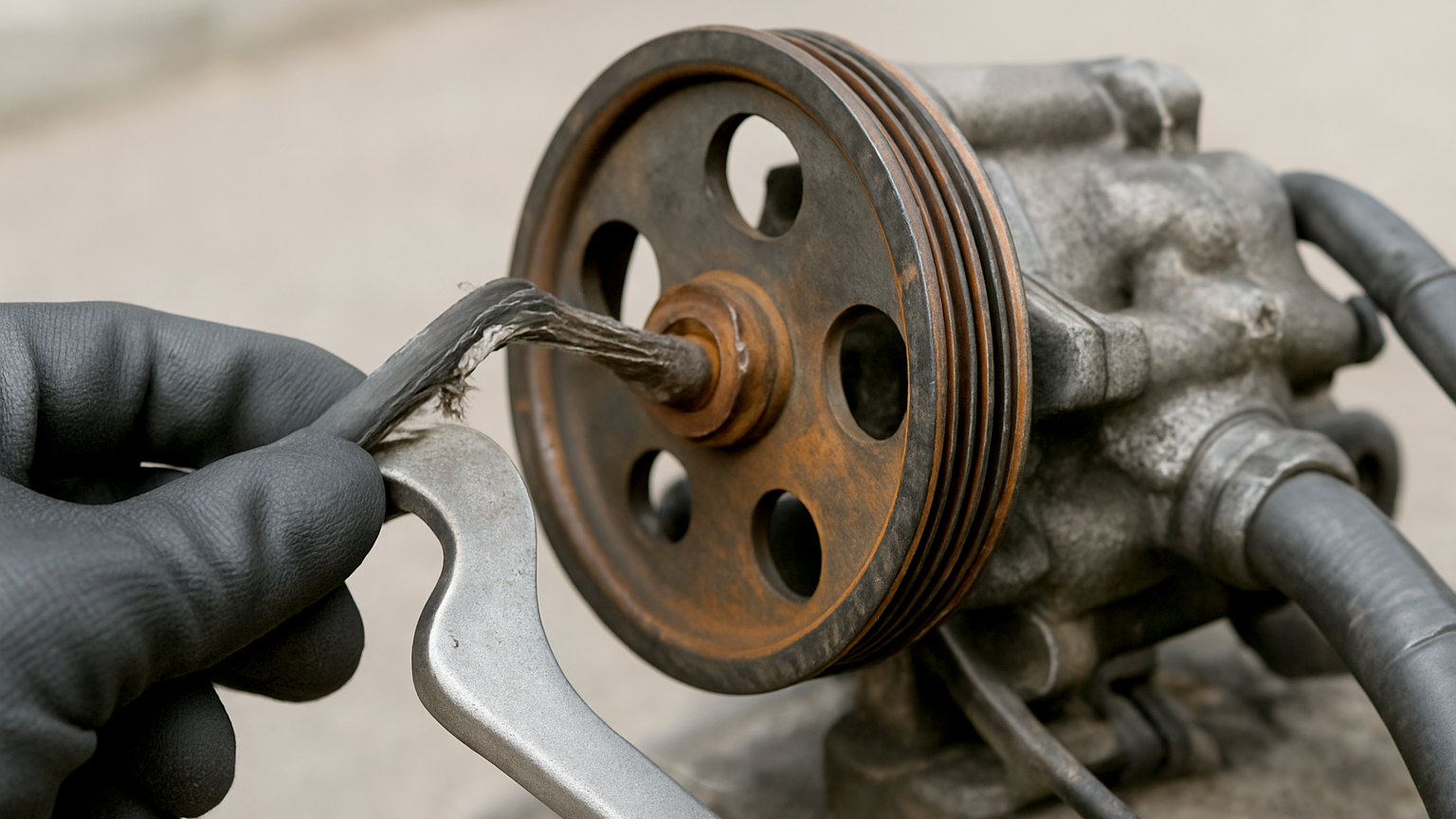
Steering that has become noticeably heavier is reporting one of two things: the assistance system has stopped helping, or something in the mechanism has become stiff enough to overcome it. Whether the change arrived suddenly or crept up over months is the single most useful piece of information, because those two patterns point in completely different directions.
What does a sudden change mean?
An assistance failure, almost always. On a hydraulic system that means a snapped auxiliary belt, a failed pump, a burst hose or a sudden loss of fluid. On an electric system it means the motor or its control module has shut down, usually with a warning light. The car remains steerable in every case, since the mechanical connection is unaffected, but it requires considerably more effort.
What does a gradual change mean?
Something stiffening rather than failing. A steering rack whose internal seals and bearings have worn and tightened. Track rod ends or ball joints corroding on their pins. A steering column universal joint seizing. Suspension bushes hardened with age. Each adds a small amount of friction, and the total creeps up so slowly that drivers adapt without noticing until they drive another car.
Could it be something trivial?
Check the tyres first, because it costs nothing. Significantly underinflated front tyres make steering markedly heavier at low speed, and a slow puncture that has gone unnoticed produces exactly this complaint. Very wide or unusually worn tyres also increase effort. It is the cheapest possible explanation and it is worth eliminating before anything is dismantled.
What should you check on a hydraulic system?
The fluid level first, in the reservoir under the bonnet, and the condition of the fluid while you are there. Then the auxiliary belt, looking for glazing, cracks or a belt that has snapped entirely. A belt driving the steering pump also drives other things, so a broken one usually brings additional symptoms such as a charging warning or overheating.
Why does low fluid cause it?
Because the pump moves fluid to provide assistance, and a low level lets it draw air instead. Aerated fluid cannot transmit pressure properly, so assistance becomes weak, inconsistent or absent, usually accompanied by a whine that gets louder on lock. Since these systems are sealed, a low level always means a leak, and topping up is a temporary measure rather than a repair.
What happens on electric systems?
Electric power steering uses a motor on the column or the rack, controlled by a module that decides how much assistance to give. When a torque sensor, the motor or the module fails, the system defaults to no assistance and illuminates a warning. It can also reduce assistance temporarily if the motor overheats after prolonged low speed manoeuvring, which recovers after a rest.
Why does low battery voltage matter?
Because an electric steering motor draws substantial current, and the module will disable the system rather than operate on an unreliable supply. A failing battery or alternator therefore produces heavy steering alongside other unrelated warnings. This is a genuinely common cause and it is why any electric steering fault should begin with a battery and charging test rather than a steering diagnosis.
Is it heavy in both directions?
A useful distinction. Effort that is noticeably heavier turning one way than the other, on a hydraulic system, suggests an internal fault in the rack valve rather than a general loss of pressure. Heaviness in both directions equally points at the pump, the belt, the fluid or the electric motor. Mentioning which applies narrows the diagnosis considerably.
Is it safe to drive?
The car steers, but low speed manoeuvring becomes genuinely difficult and an emergency avoidance manoeuvre requires far more effort and time than you would expect. Anyone with limited upper body strength may struggle to park safely. Treat it as a fault to fix promptly rather than to live with, and be particularly cautious in car parks and junctions until it is resolved.


