
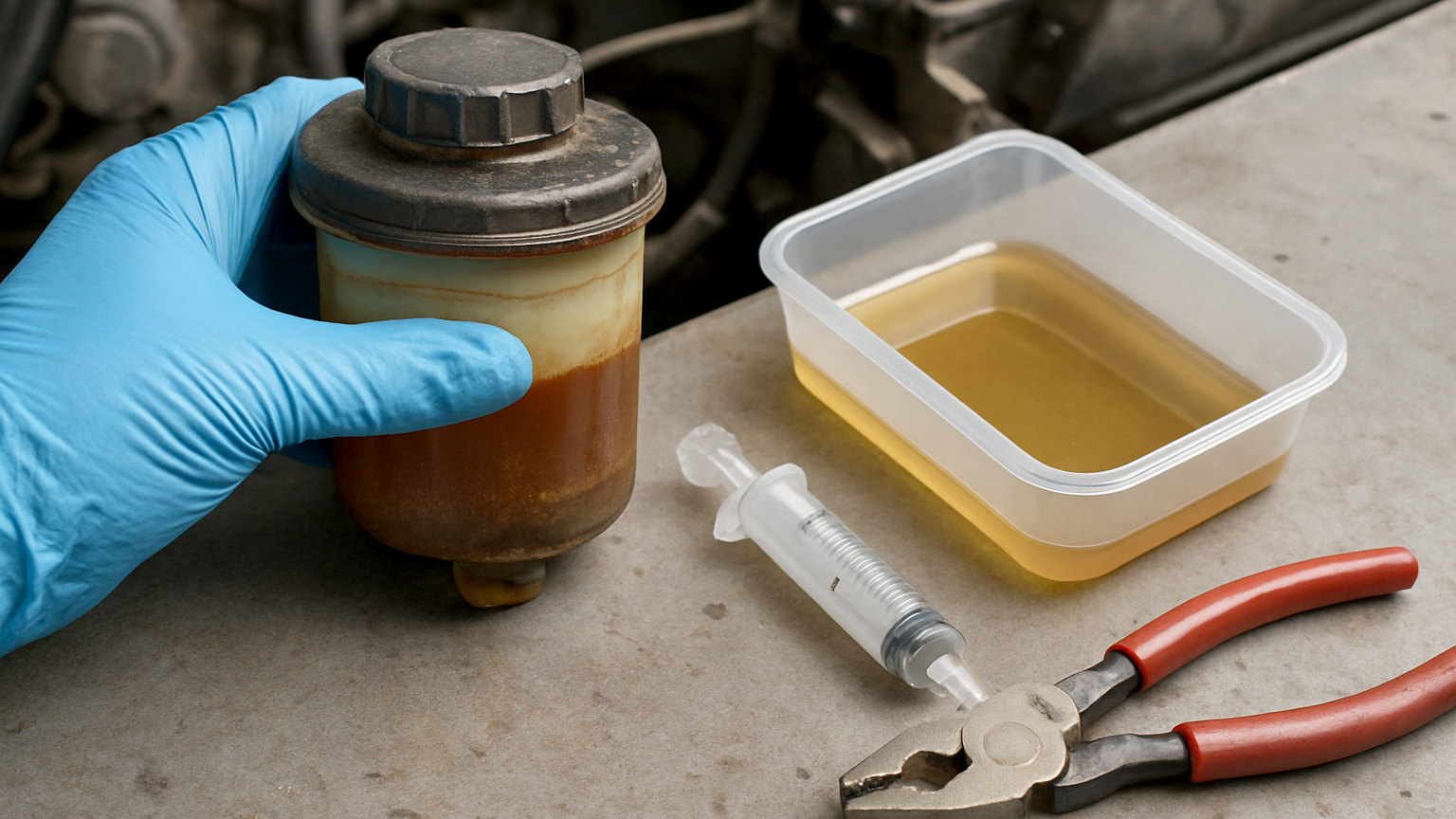
Power steering fluid is one of the most neglected fluids on a car, largely because most manufacturers publish no replacement interval for it at all. It works as a hydraulic medium transmitting pressure, as a lubricant for the pump and rack, and as a coolant carrying heat away from both. Like any fluid doing three jobs at high temperature, it degrades.
What happens as it ages?
It darkens, its additives deplete and it accumulates fine particles worn from the pump vanes and rack seals. Degraded fluid lubricates less effectively, which accelerates pump wear, and the abrasive particles it carries circulate through every component in the system. The characteristic dark brown or black colour with a burnt smell indicates fluid that has been overheated repeatedly.
Which fluid does your car need?
This matters more than people expect. Some systems specify a dedicated power steering fluid, others use automatic transmission fluid, and some require a particular manufacturer specification. They are not interchangeable despite several being red. Using the wrong type can attack the seals, causing leaks and noise. The handbook or a marking on the reservoir cap states which applies.
How do you check the level correctly?
Most reservoirs have separate cold and hot level markings, since the fluid expands considerably when warm, so check against the appropriate one. Many have a small dipstick built into the cap. The engine should be off and the car level. Since the system is sealed, a level that has fallen means a leak, and topping up is a temporary measure rather than a fix.
What does foamy fluid indicate?
Air in the system, which produces a whining pump and inconsistent assistance. Air enters through a low level or through a leak on the suction side that draws air in without letting fluid out. Foamy or cloudy fluid should not be ignored, since aerated fluid cannot transmit pressure properly and it accelerates wear inside the pump considerably.
Should it be changed?
There is a good argument for it on any car past about eighty thousand miles, or where the fluid is visibly dark. The pump and rack are expensive components and the fluid is not, so refreshing it is cheap insurance. It is also worth doing after any repair that introduced contamination, and essential if the wrong fluid has been added at some point.
How is it changed?
The simplest method is to draw the fluid out of the reservoir with a syringe, refill with fresh, and repeat over several days of driving, which gradually dilutes the old fluid. A more thorough approach disconnects the return line and pumps fresh fluid through while the old is expelled, with the engine running and the steering turned. That requires care to avoid running the pump dry.
Should the system be flushed with a cleaner?
Generally not. Chemical flushes can attack seals, and a system with heavy contamination often has a failing component that the flush will not fix. Repeated exchange of fluid is safer and achieves most of the benefit. If the fluid is full of debris, the pump or rack is wearing and replacing fluid alone will not rescue it.
Where does fluid usually leak from?
The high pressure hose, particularly at its crimped ends. The rack seals, which show as fluid inside the rack gaiters or running down them. The pump shaft seal. The reservoir, which is often plastic and cracks with age. A leak onto the auxiliary belt is worth finding quickly, since fluid on a belt causes slipping and can shred it.
Do electric systems have fluid at all?
Fully electric systems have none, which removes this whole category of maintenance. Some vehicles use an electro hydraulic arrangement, with an electric motor driving a hydraulic pump, and those do have fluid and reservoirs that need checking. Knowing which type your car uses saves looking for a reservoir that does not exist.
If in doubt, look for a belt driven pump at the front of the engine. Its presence means a hydraulic system with fluid to check, and its absence means the assistance is electric and needs no fluid maintenance at all.


