
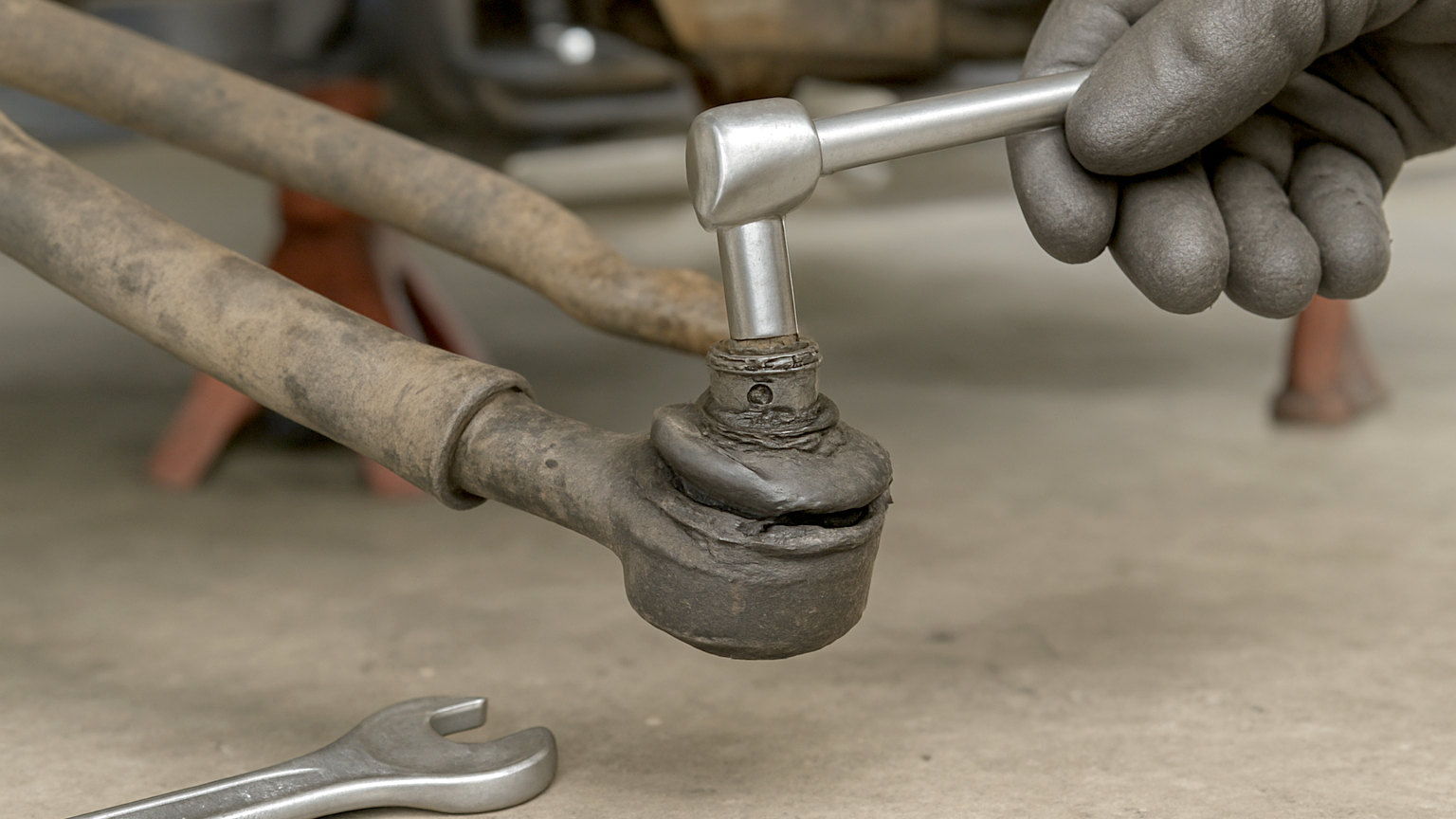
A knock or clunk that appears when turning is a worn joint announcing itself under load. Several components in the front of a car produce similar noises, and the conditions in which each appears are different enough to narrow the field considerably before anything is dismantled. What matters is whether it happens on lock, over bumps, under power or simply when the wheel is moved.
What does clicking on full lock mean?
A rhythmic clicking that appears when turning tightly under power, typically pulling out of a junction or manoeuvring in a car park, is the classic outer constant velocity joint. The clicking rate follows wheel speed and it is usually worse in one direction than the other. It is a driveshaft component rather than a steering one, but it presents as a steering noise because of when it appears.
What causes a knock over bumps while turning?
Worn track rod ends and suspension ball joints, which have play that is taken up sharply as the load reverses. Anti roll bar drop links are among the most common culprits and among the cheapest to replace, producing a distinct knock over uneven surfaces that is often worse at low speed. Worn lower arm bushes give a duller thud rather than a sharp knock.
What is a top mount and how does it fail?
The suspension strut top mount carries the strut to the body and, on the front, includes a bearing that lets the strut rotate as the wheel steers. When that bearing wears or the rubber deteriorates, turning the wheel produces a knock, creak or graunching noise from the top of the wheel arch, often felt through the wheel. It is very characteristic and frequently misattributed to the steering rack.
How do you distinguish them?
By where and when. Turn the wheel from lock to lock while stationary with the engine running and listen: a top mount usually knocks or creaks doing this while a CV joint stays silent. Drive slowly over a speed bump in a straight line: drop links and bushes knock while CV joints do not. Turn tightly under power: CV joints click. Each test isolates a different component.
Can the noise come from inside the car?
Sometimes, and it wastes a lot of diagnostic effort. A steering column that clicks as it turns, a clock spring assembly that has failed, or trim that rubs against a moving part all produce noises apparently connected to steering. Having someone listen inside the car while the wheel is turned stationary usually separates a cabin noise from something under the bonnet or at the wheel.
Which of these are urgent?
Track rod ends and ball joints matter most, since complete failure separates a steering or suspension connection and is genuinely dangerous. Drop links and top mounts are unpleasant rather than dangerous, though a badly failed top mount affects steering geometry. CV joints give long warning and eventually fail completely, leaving the car unable to transmit drive on that side.
Does the noise indicate severity?
Loosely. A joint that has just started to knock has developed enough play to be found on inspection, so the noise coincides fairly well with the point at which it becomes an MOT failure. What matters more is whether it is getting worse quickly, and whether the steering feel has changed alongside, which suggests the play is now large enough to affect geometry.
What should you check yourself?
With the wheel raised, rock the tyre at three and nine o clock for steering joints and at twelve and six for ball joints and wheel bearings. Look at every rubber boot on the track rods and ball joints for tears. Grasp the drop links and try to move them. Those checks take twenty minutes and identify the majority of causes.
What should you expect from a garage?
An inspection on a lift with the wheels hanging and again loaded, using a pry bar to reveal play. Ask which specific joint was found and whether alignment is included, since any track rod work changes the toe setting. A quote that simply says front end noise without naming a component is worth questioning before agreeing.


